


Qatar Red Crescent Society (QRCS) continues to implement its emergency humanitarian response at camps of internally displaced people (IDP) affected by flooding and storms in northern Syria.
The field personnel of QRCS’ representation mission in Turkey are replacing damaged tents with new ones, laying the muddy floors with gravel, and strengthening their foundations to enhance insulation and prevent rainwater leakage.
The basic needs of the affected IDPs are being distributed such as food parcels, non-food items (blankets, mattresses, and kitchenware), and Covid-19 preventive kits. A total of 510 families will benefit.
The project also involves supporting two health centres to provide medical services for camp residents and deploying a mobile medical clinic to remote and hard-to-reach camps.
The Zouf Health Centre receives approximately 2,300 visitors per month from the neighbouring camps while the Kafr Jales Health Centre receives 3,600 visitors per month.
They provide emergency ambulance services, outpatient clinics (internal medicine, paediatrics, gynaecology, reproductive health, and health education), laboratory tests, and free-of-charge medications.
The mobile medical clinic is deployed to remote and inaccessible camps where health care seekers have no access to neighbouring health centres. It aims to provide primary health care services for the population, particularly children and patients with chronic diseases, as well as free-of-charge medications.
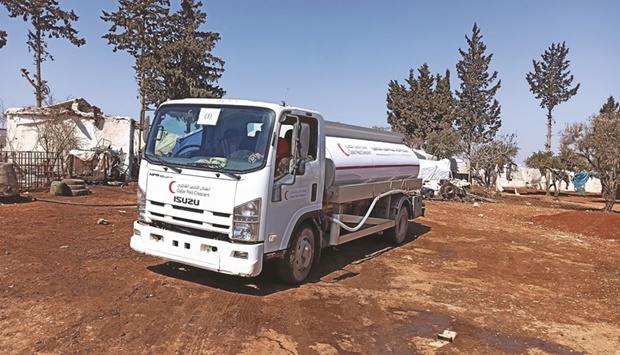
In Al-Bab, drinking water is distributed at and around camps under Phase 2 of a project aimed at meeting the basic clean water needs of approximately 14,000 beneficiaries, with a daily quota of 20-30 litres per family.
To ensure water cleanliness, necessary tests are being conducted besides purifying it using chlorine, in accordance with international standards.
At the same time, QRCS personnel are carrying out construction works of a village under the project for the benefit of IDPs in northern Syria. It aims to alleviate the suffering of displaced families by securing decent living conditions at concrete-built homes with water supply, electricity, and sewage services.
Work is underway to build a total of 36 units of 46sqm 2-BHK flats, and the village will have all utilities, roads, and infrastructure. The project will help 36 most vulnerable families at northern Syrian camps while creating more than 100 job opportunities for IDPs and locals at the project site.
In February, the site was visited by a delegation from QRCS headed by its secretary-general Ali bin Hassan al-Hammadi, who were in Jarabulus, Aleppo, to lay the foundation stone for a project to establish the Al-Nasr Charity Village, in partnership with the Turkish Red Crescent.
This year, QRCS plans to implement three construction projects with a total of 1,116 housing units. A total of 208 housing units were constructed over the past two years under two similar projects in Al-Bab, in addition to approximately 1,100 housing units under five projects in Idlib countryside over the past five years.
The basic needs of the affected IDPs are being distributed such as food parcels, non-food items (blankets, mattresses, and kitchenware), and Covid-19 preventive kits. A total of 510 families will benefit.
The project also involves supporting two health centres to provide medical services for camp residents and deploying a mobile medical clinic to remote and hard-to-reach camps.
The Zouf Health Centre receives approximately 2,300 visitors per month from the neighbouring camps while the Kafr Jales Health Centre receives 3,600 visitors per month.
They provide emergency ambulance services, outpatient clinics (internal medicine, paediatrics, gynaecology, reproductive health, and health education), laboratory tests, and free-of-charge medications.
The mobile medical clinic is deployed to remote and inaccessible camps where health care seekers have no access to neighbouring health centres. It aims to provide primary health care services for the population, particularly children and patients with chronic diseases, as well as free-of-charge medications.
In Al-Bab, drinking water is distributed at and around camps under Phase 2 of a project aimed at meeting the basic clean water needs of approximately 14,000 beneficiaries, with a daily quota of 20-30 litres per family.
To ensure water cleanliness, necessary tests are being conducted besides purifying it using chlorine, in accordance with international standards.
At the same time, QRCS personnel are carrying out construction works of a village under the project for the benefit of IDPs in northern Syria. It aims to alleviate the suffering of displaced families by securing decent living conditions at concrete-built homes with water supply, electricity, and sewage services.
Work is underway to build a total of 36 units of 46sqm 2-BHK flats, and the village will have all utilities, roads, and infrastructure. The project will help 36 most vulnerable families at northern Syrian camps while creating more than 100 job opportunities for IDPs and locals at the project site.
In February, the site was visited by a delegation from QRCS headed by its secretary-general Ali bin Hassan al-Hammadi, who were in Jarabulus, Aleppo, to lay the foundation stone for a project to establish the Al-Nasr Charity Village, in partnership with the Turkish Red Crescent.
This year, QRCS plans to implement three construction projects with a total of 1,116 housing units. A total of 208 housing units were constructed over the past two years under two similar projects in Al-Bab, in addition to approximately 1,100 housing units under five projects in Idlib countryside over the past five years.