


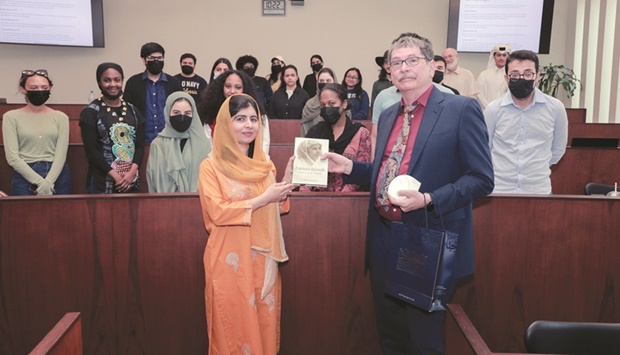
Nobel peace laureate Malala Yousafzai told the students at Georgetown University in Qatar (GU-Q) that they should not let the Taliban or any group misuse religion to keep girls and women out of school.
As part of her recent engagement in Qatar, the activist paid a visit to the GU-Q and led a classroom discussion on the message she shared at the Doha Forum, urging the global community to prioritise the fight for girls’ education.
Yousafzai was accompanied by Qatar Foundation (QF) president (Higher Education) Francisco Marmolejo and GU-Q dean Dr Clyde Wilcox.
“We were honoured to host Malala, the youngest ever Nobel Peace Prize winner and a remarkable young woman who has set an inspiring example of courage and commitment to social justice,” Dr Wilcox said. “Her classroom message resonated with our students, who are themselves committed advocates for change, and exemplify the values of service to others in pursuit of a better world."
Yousafzai highlighted that according to Unesco, there are an estimated 130mn girls aged 6-17 out of school, and an additional 15mn primary school age girls who will never enter a classroom, and that half of these girls are in sub-Saharan Africa.
She stressed the need to recognise the scale of the problem as a global human rights issue, with multiple causes including social norms, climate change, the lack of funding for infrastructure, and conflict.
Yousafzai expressed her pride in the shared message of the Doha Forum panel she had participated in, where Islamic scholars and analysts were in agreement that banning girls from attending school in Afghanistan has no basis in religious belief or practice.
For international economics senior Kamilah Idris, the opportunity to ask Yousafzai her views on at-home training programmes that provide benefits but reinforce social restrictions provided valuable insight into an issue she advocates through her school activities.
"As a Nigerian as well as the president of the GU-Q African Students Association, I am deeply concerned with topics related to human rights and social justice,” she said. “This is why I believe it’s important to have these conversations and discuss these topics because together we can provide solutions that can be adapted into our own contexts."
Dr Wilcox thanked Yousafzai for her visit, and presented her with a scholarly biography of Fatima Jinnah, an activist and stateswoman known in Pakistan as the "mother of the nation", written by GU-Q associate professor Dr M Reza Pirbhai.
Yousafzai was accompanied by Qatar Foundation (QF) president (Higher Education) Francisco Marmolejo and GU-Q dean Dr Clyde Wilcox.
“We were honoured to host Malala, the youngest ever Nobel Peace Prize winner and a remarkable young woman who has set an inspiring example of courage and commitment to social justice,” Dr Wilcox said. “Her classroom message resonated with our students, who are themselves committed advocates for change, and exemplify the values of service to others in pursuit of a better world."
Yousafzai highlighted that according to Unesco, there are an estimated 130mn girls aged 6-17 out of school, and an additional 15mn primary school age girls who will never enter a classroom, and that half of these girls are in sub-Saharan Africa.
She stressed the need to recognise the scale of the problem as a global human rights issue, with multiple causes including social norms, climate change, the lack of funding for infrastructure, and conflict.
Yousafzai expressed her pride in the shared message of the Doha Forum panel she had participated in, where Islamic scholars and analysts were in agreement that banning girls from attending school in Afghanistan has no basis in religious belief or practice.
For international economics senior Kamilah Idris, the opportunity to ask Yousafzai her views on at-home training programmes that provide benefits but reinforce social restrictions provided valuable insight into an issue she advocates through her school activities.
"As a Nigerian as well as the president of the GU-Q African Students Association, I am deeply concerned with topics related to human rights and social justice,” she said. “This is why I believe it’s important to have these conversations and discuss these topics because together we can provide solutions that can be adapted into our own contexts."
Dr Wilcox thanked Yousafzai for her visit, and presented her with a scholarly biography of Fatima Jinnah, an activist and stateswoman known in Pakistan as the "mother of the nation", written by GU-Q associate professor Dr M Reza Pirbhai.