


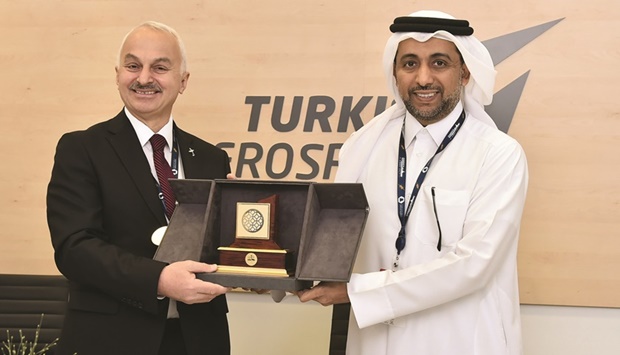
Qatar University (QU) and Turkish Aerospace Industries (TAI) signed a memorandum of understanding (MoU) at the recently held tth Doha International Maritime Defence Exhibition & Conference (Dimdex 2022).
The MoU was signed by Dr Hasan Rashid al-Derham, president of QU, and Prof Dr Temel Kotil, CEO of Turkish Aerospace Inc, in the presence of officials from both institutions.
Qatar University College of Engineering (QU-CENG) signed a memorandum of understanding with Turkish Aerospace Inc to establish collaboration in the field of research, consultancy, and knowledge transfer.
It aims to establish collaboration between QU and TAI in the academic, research and student training and support fields, as well as the exchange of information and consultancy.
In the terms of the MoU, CENG will provide TAI with different venues. The CENG faculty will also collaborate with TAI on projects by ensuring knowledge transfer and progressive development of existing projects.
CENG dean Dr Khalid Kamal Naji said: “To the extent applicable, we agreed to sign this MoU, to constitute a basis for further collaboration, including the exchange of faculty and undergraduate and postgraduate students, a faculty exchange programme between QU and Turkish universities under the ambit of TAI, placement of QU professors at TAI for exposure, conducting short courses and assisting with R&D in various departments of TAI, sponsorship of research studies, thesis and R&D projects in areas of mutual relevance, placement of QU undergraduate and postgraduate students, who meet the conditions determined by TAI, as short-term interns on mutually determined dates, and the conduct of training/seminar on IPR (Intellectual Property Rights) focusing on Qatar-Turkey bilateral IP arrangements, thus facilitating technology transfer and any other collaboration in areas of mutual interest. Research projects will be mutually selected by QU/TAI.”
Prof Dr Kotil added, “We are proud to sign a memorandum of understanding with the College of Engineering at Qatar University in order to complement the efforts made by the education and industry sectors as a part of the integration between the academic and industrial sectors."
"Our partnership will be reflected on both parties through joint activities and programs, support for students and graduates, and we will endeavor to support education and capacity building," he added.
Qatar University College of Engineering (QU-CENG) signed a memorandum of understanding with Turkish Aerospace Inc to establish collaboration in the field of research, consultancy, and knowledge transfer.
It aims to establish collaboration between QU and TAI in the academic, research and student training and support fields, as well as the exchange of information and consultancy.
In the terms of the MoU, CENG will provide TAI with different venues. The CENG faculty will also collaborate with TAI on projects by ensuring knowledge transfer and progressive development of existing projects.
CENG dean Dr Khalid Kamal Naji said: “To the extent applicable, we agreed to sign this MoU, to constitute a basis for further collaboration, including the exchange of faculty and undergraduate and postgraduate students, a faculty exchange programme between QU and Turkish universities under the ambit of TAI, placement of QU professors at TAI for exposure, conducting short courses and assisting with R&D in various departments of TAI, sponsorship of research studies, thesis and R&D projects in areas of mutual relevance, placement of QU undergraduate and postgraduate students, who meet the conditions determined by TAI, as short-term interns on mutually determined dates, and the conduct of training/seminar on IPR (Intellectual Property Rights) focusing on Qatar-Turkey bilateral IP arrangements, thus facilitating technology transfer and any other collaboration in areas of mutual interest. Research projects will be mutually selected by QU/TAI.”
Prof Dr Kotil added, “We are proud to sign a memorandum of understanding with the College of Engineering at Qatar University in order to complement the efforts made by the education and industry sectors as a part of the integration between the academic and industrial sectors."
"Our partnership will be reflected on both parties through joint activities and programs, support for students and graduates, and we will endeavor to support education and capacity building," he added.