


In the presence of HE the Minister of Culture Sheikh Abdulrahman bin Hamad al-Thani, the activities of the Seminar Series, organised by the Ministry of Culture in partnership with Qatar University (QU) and the Arab Center for Research and Policy Studies (ACRPS), continued yesterday at Ibn Khaldoun Hall, QU.
The seventh event was moderated by an official from the ministry and took the form of an open discussion where a number of Qatari writers, poets, editors, chief editors of local papers, academics, platform editors, and students were given the floor.
The seminar stressed the role of the cultural elites of the 1960s, 1970s, and 1980s in upholding the high standard of the cultural scene during these periods, praising the achievements of Al-Jisra Club and Doha Journal in promoting Qatari writers and poets both at home and abroad.
The older members of the audience acknowledged the need to bridge the generation gap and recommended there should be seminars where the elite can listen to the youth and understand their views as well as guide, counsel and train them in the various cultural activities.
Qatar Press Centre chief Saad al-Rumaihi started the discussion, and thanked the Ministry of Culture for its efforts in ensuring the enrichment of the cultural scene in the country. He stressed that Qatar was one of the first countries that had effective cultural contributions at the level of publishing companies and other cultural activities. He expressed his hope that this role will be renewed in the coming days. He said that the word ‘culture’ is a flexible term and part of any society in the world.
Al-Rumaihi referred to a number of travellers who came to the Gulf region to learn about the culture and nature of its people, including Christian Niebuhr, who came to Yemen. He stressed that Niebuhr was the first to write about the Arabian Peninsula, where he said that he arrived in a country called Qatar and lived there for a short period and then left.
Al-Rumaihi touched upon the great traveller Amin al-Rihani in his book Kings of the Arabs, when he was talking about the culture that the region went through and also talked about Qatar, as well as Mohamed Amin al-Shanqiti and Abdul Aziz al-Thaalbi, all of whom Arab and international personalities who passed through this region.
What they wrote confirms there was cultural activity in general in Qatar.
“We lacked the writing skills to record that these travellers passed through this region and talked about its culture. The Gulf region has gone through many phases and witnessed multiple cultures. The English culture came followed by the French and had effects on the words, vocabulary and customs instilled in the people of the region and even penetrated to the slang words. With the passage of time, people became aware and the Arabic vocabulary began to replace foreign vocabulary.”
Al-Rumaihi stated he is immensely pleased about the cultural activities witnessed by the Qatari society. There is a cultural boom at the level of the Qatari majlis, which began organising seminars and cultural activities. There is a renewed cultural activity among young people in the fields of arts. Perhaps the recent success of the theatre festival confirms the youth’s thirst for cultural and artistic activities.
Al-Rumaihi called on the ministry to continue this activity and said he is aware that financial obstacles may prevent the implementation of some ideas that may be suggested. He pointed out that the ministry has carried out many activities in order to enrich the cultural scene. As for the expectations from the ministry, he said that its role is supervisory, while the burden falls on the cultural elites to enrich cultural activity through seminars, exhibitions, literary debates and others.
Novelist and academic Dr Ahmed Abdul Malik wondered what the real intellectual is, and whether he is the one who publishes a book or creates a painting. He mentioned what al-Rumaihi referred to and stressed the importance of the role of civil society institutions as a good ground to enriching the cultural scene. The ministry provides support, but these institutions must play an important role in enriching the cultural scene.
Malik recalled the history of Al-Jisra Club, which he described as having had an important role in the 1980’s as it functioned proudly like a ministry. He called on the media to support cultural activity, and there should be cultural institutionalisation, as well as that of the cultural media, which would contribute to the development of ideas.
He stressed the importance of having a popular ground for culture, by establishing an association for writers. This is an important demand of intellectuals for nearly two decades and would preserve Qatari culture and its presence in the Arab Writers Union. He also called for disseminating cultural activities to all regions and cities of the country and not confine it to the capital Doha.
Khalid al-Obaidan, a member of the Shura Council, described the last edition of the Doha International Book Fair as an exceptional activity by the ministry to enrich the cultural scene. In this context he pointed out that the ministry spared no effort to support culture and intellectuals, and to hold festivals and seminars.
Al-Obaidan expressed solidarity with the call to establish an association for Qatari writers, based on strengthening the role of civil society, and in support of official efforts, in a way that enriches the cultural scene. Representation of civil society, and in this regard, he recalled the efforts of Al-Jisra Club in the past, noting that it brought up many high-ranking intellectuals and thinkers in the Arab world, in addition to holding cultural weeks abroad to introduce Qatari culture, and efforts made by Qatari youth.
Writer Ahmed al-Mohannadi was of the view that Qatari writers need more encouragement and support. Journalist, Sadiq al-Ammari, editor-in-chief of Al-Sharq newspaper responded to al-Mohannadi in this regard and stressed that the Qatari writer has a lot of freedom of expression. He said that less than 1% of articles are reviewed, but some of the articles that are, is due to violations of the law or so.
“Our task is to preserve the legal position of the newspaper,” al-Ammari said pointing out that the institutions provide support for the book, including that authored by al-Mohannadi and printed by Al-Sharq. The veteran journalist highlighted the importance of the role of culture and intellectuals in solving all differences in society, whether tribal or intellectual ones. He said that everyone can express his opinion while being reassured. There are many seminars and plays targeting the mass audience, especially young people. Al-Ammari also urged that the events should reach out to the target audience, especially the youth, so that the message of the Ministry of Culture reaches everybody.
For his part, Professor Abdulaziz al-Ishaq stressed that the past years have focused on recreational activities directed at the youth. He demanded the necessity of providing platforms to train these young people so that they would join the cultural elites in the future. It is important to hold seminars and lectures in which young people are not just listeners to elites’ talk. Rather, the youth should be given the opportunity to talk about what the cultural elites should listen to.
The academic stressed the importance of the ministry organising events dedicated to young people. He said that it is also hoped that training activities will be held after the end of the Seminar Series, in areas such as writing novels and scripts for plays. He said after a few years of focusing on the matter, the youth could be evaluated, but if this is neglected, there will not be cultural elites in the future.
Ali al-Mahmoud stressed that the attendance by intellectuals and media professionals in the Seminar Series is a clear evidence that the Ministry of Culture is moving in the right direction. “We must all be assistants to HE the Minister of Culture and help him in order to make his plans succeed for the advancement of the cultural scene.”
Journalist Saad Burshid said that in order to enrich the cultural scene, committees should be formed by specialists, whether at the level of theatre or music. Employees with cultural experience in institutions in the country should be retained even after they reach 60, especially those with cultural competencies and a history of enriching the cultural and artistic scene. Burshid believed that enriching the cultural scene depends on Qatari experts.
Dr Abdullah Faraj said: “What pleased me recently was what I witnessed at the book fair, which was a cultural event that brought together international and local publishing companies, in addition to the authors forum that coincided with the fair. I hope that there will be a larger umbrella that brings together all authors, whether writers, poets or an authors’ union.
“It saddens us that there is a group of young people in culture, literature, prose and media who do not find good people to coach them,” he said while calling for the backing of the Ministry of Culture and the minister to advance the cultural scene by taking the sound opinion of intellectuals. Dr Faraj hoped that cultural activities would continue during Ramadan and people would follow programmes such as the one he presents on YouTube with the support of the Ministry of Culture.
Abdulaziz al-Khater said: “ I wrote an article in which I asked for doing away with the Ministry of Culture and I said that culture must be based on the civil society because culture should not be reduced to institutions. Reliance on the renaissance of culture in the 1970s and 1980s is important, but it is necessary to launch new horizons. The civil society should play a role in enriching cultural life.”
He said that there is a difference between the cultural elites and the culture of the elite, which is the leadership of state institutions. As the latter was a forerunner and leader, and the role of cultural elites became weaker, because there is a vicious circle that hinders development. The culture of elites and cultural elites must be linked in order to reformulate the country’s culture through civil society institutions, he added.
Poet Abdul Rahman al-Dulaimi also spoke about the role of civil society and the importance of promoting native culture and paying attention to the mechanisms of culture in various branches of literature and the arts. He called on intellectuals to change their lifestyle and move to acculturation and dialogue and realise the role of cultural elites in achieving community solidarity.
Writer Buthaina al-Janahi said the Seminar Series is a good opportunity for her to introduce her platform Qalam Hibr, which she described as being able to attract young people and ensure their presence in the cultural scene. She said that this polarisation undoubtedly faces obstacles in the cultural scene, which requires the assistance of elites. The members of the cultural community are considered as soft forces that will move the scene. It is important that connections occur between different generations so that the process becomes integrative. Asserting it is necessary to establish bridges in order to establish this communication, al-Janahi pointed out that the cultural project needs tools that allow the presence of young people in the scene.
Hanadi Musa Zainal, a translation expert at the Ministry of Culture, saw that the Qatari intellectual does not lack anything, nor culture, nor awareness, nor love of the homeland. She added: “I do not think that the role of the Qatari intellectual is to reach the youth, but the latter is the one who should reach to the intellectuals.”
Writer Iman al Ishaq said that culture, with its concept and history, will be profound and we can only access it by diving into it. She added that culture has a major role in achieving the 11 sustainable development goals.
Al-Ishaq added that the language of dialogue currently differs from the younger generation and the old generation, and there are great interests to enrich the cultural role in the state. The state needs concerted efforts for the success of the objectives of the seminars.
At the end of yesterday’s seminar, HE the Minister Sheikh Abdulrahman stated: “Our goal was not that this issue is looked at as an administrative one. These viewpoints have to be understood, taken into account, studied, and what can be applied will be implemented. I thank you for your presence and enriching this session. Thank you.”
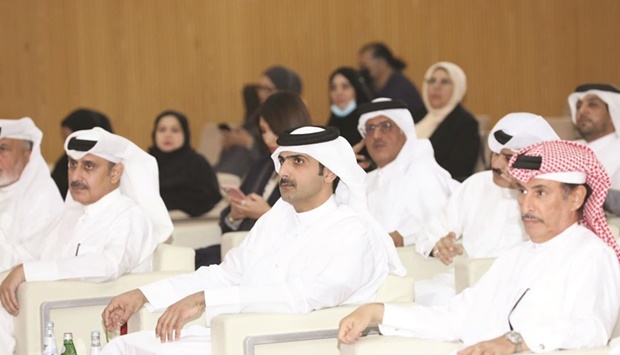
HE the Minister of Culture Sheikh Abdulrahman bin Hamad al-Thani and other dignitaries at the seminar.