


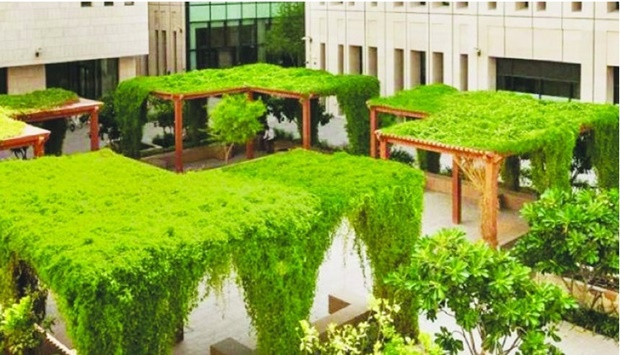
 Qatar Foundation (QF) has announced the launch of its Earthna Center for a Sustainable Future at the annual Doha Forum summit.
The Earthna Center will be dedicated to adopt thought leadership in policymaking, establishing and promoting policy priorities, strengthening links between education, research, and industry, and extending QF’s network of domestic and international collaboration. As it focuses on sustainability in hot and arid climates, sustainable energy, and maximising QF’s Education City campus as a test bed for new technologies and sustainable implementations.
Earthna’s mission is to support sustainability by advocating evidence based policy action, encouraging behavioural change in the community, and positioning Qatar as a leading voice for sustainability issues in arid and water scarce climates.
 Engineer Meshal al-Shamari |
Earthna Center aims to enable a wide community of experts, government, policy and decision makers, businesses, multilateral institutions, and civil society to generate a more sustainable future. It will also incorporate and build on QF’s existing efforts toward cultivating sustainable behaviors, mindsets, and action.

A high-level launch
Establishing Earthna Center was announced during a high-level panel discussion at the opening ceremony of the annual Doha Forum diplomatic summit, which discussed ways of making cities the focus for sustainable global solutions for nature and climate.
During the discussion, titled Building a New Sustainability Paradigm: Cities Contribution to the Climate Solution, panelists explored ways to enhance the resilience of cities by incorporating the concept of building with nature into their design.
Facing the challenges of arid climates
"Earthna is a centre specialised in sustainability, environmental preservation and studying the effects of climate change locally, regionally and globally, especially, in light of the major challenges countries all over the world are facing, which are reflected and exacerbated by climate change,” said Engineer al-Shamari.
“We found that the scope that is particularly important for Qatar is hot and arid countries that lack adequate studies and research, including scientific research and policies that support countries which suffer from the effects of desertification and climate change.
"Earthna will focus on these areas in the relevant countries, and there will be collaborations with countries of a similar nature to Qatar, to exchange experiences in this field and to develop policies with the aim of supporting countries that suffer from the same effects. We will also focus on sustainable energy, since Qatar is an oil and gas exporter, and especially since gas is considered a safe fuel compared to fossil fuels such as coal and petroleum.”
Engineer al-Shamari also highlighted the role of safe energy in the context of the transition toward renewable energy and alternatives to fossil fuels. "We are not only addressing the environmental field here, as energy plays a major economic and social role as well,” he said. “It also determines the changes that may occur in the near future. Many countries are trying to focus on these areas, and we seek to make Qatar a pioneer in this field and present best practices.”
"The third axis is sustainability in general and its role in linking economy with community development, and promoting sustainability and initiatives and activities that interest members of the society. It is crucial for us to have public policies for the state and a societal awareness of such developments."
Engineer al-Shamari also stressed the importance of collaboration between government, official institutions, and private businesses to spread awareness about sustainability practices and the role they play in preserving the environment and protecting the country from pollution and environmentally unfriendly practices.
“Every entity in Qatar specialises in a particular field,” he said. “For example, Qatar Foundation is a unique organisation in the field of scientific research and community awareness, and it is very important that we cooperate as government agencies, research, and non-profit organisations and support each other.”
He emphasised the importance of Qatar establishing the Ministry of Environment and Climate Change, and its role in promoting sustainability and preserving the environment, saying that Earthna will be keen to work with the Ministry to achieve common goals.
“We have worked with ministries locally, but Earthna’s goal is to expand cooperation to the regional and international level,” he said.
“It is possible to study best practices in other countries and their applicability in Qatar, and since Earthna is a non-profit centre, we have greater flexibility in communicating with international bodies. We can act as a gateway for these government agencies and become the link which connects them with international centers to implement best practices."
Bridging the gap between research and government
 Dr Soud bin Khalifa al-Thani |
“Earthna Center will work as the platform that will seek to use research of interest to Qatar and transform it into policies that serve the country and which can be implemented. In order to implement these policies, government agencies need another party to help them formulate it. Earthna looks to understand the current challenges and gaps and provide appropriate policies for these government agencies."
While Qatar is one of the largest gas-exporting countries in the world, and this industry has a significant impact on the nation’s carbon footprint, Dr al-Thani also pointed out that carbon emissions from gas are between 20% and 50% less than those of other fossil fuels.
“Over a period of 15 years from now, this energy will be completely clean, and with Qatar being an exporter of clean gas, this will help countries around the world in reducing their carbon footprint," he added.
And Dr al-Thani also placed Earthna in the context of QF’s mission to contribute to the building of a sustainable, diversified economy in Qatar. "That’s why Qatar Foundation has many universities and research centres,” he said. “QF has a lot of data, and the challenge is how to use this information for the purposes of implementing plans and developing policies.”
Qatar Foundation for Education, Science and Community Development (QF) continues its support to Qatar on its journey to becoming a diversified and sustainable economy in line with Qatar’s National Vision 2030. QF strives to serve the people of Qatar and beyond by providing specialised programmes across its innovation-focused ecosystem of education, research and development, community development and sustainability.