


• There is a way, which would minimise economic disruption in the EU: the bloc can introduce an import tariff on Russian gas
As Russian forces continue to shell civilian areas of Ukraine indiscriminately, the question of whether the European Union – or individual member states – should ban gas imports from Russia is becoming increasingly urgent. While the United States has already taken that step, a ban in Europe – which purchased nearly three-quarters of Russia’s natural-gas exports last year – would do far more damage to Putin’s war effort.
But a ban on Russian gas imports would also carry very severe short-run economic consequences for Europe, to the point that it might not be sustainable. Fortunately, there is another way, which would minimise economic disruption in the EU: the bloc can introduce an import tariff on Russian gas.
In normal times, such a tariff would violate World Trade Organisation rules. But, given Russia’s aggression, the EU could invoke the national-security exemption contained in Article XXI of the General Agreement on Tariffs and Trade. Moreover, Russia has long imposed a 30% export tax on gas. The EU can claim that its import tariff simply compensates for this distortion.
A targeted energy tariff could be implemented almost overnight, and has significant political advantages. It would balance the imperative of imposing costs on Russia with the need to ensure that Europeans are not left scrambling for fuel. It would facilitate the reduction – and eventual elimination – of Europe’s energy dependence on Russia. And, because the tariff would be implemented at the EU level, it would provide tangible proof that member countries can act together.
A tariff on imports of Russian gas would also go a long way toward refuting the accusation that Europe has been financing Russia’s war of aggression through its energy purchases. European countries that have available alternatives to Russian gas would change sources immediately. And while countries that lack such options could continue to purchase Russian gas for now, they would receive a powerful and persistent price signal to diversify over time. European demand for Russian gas would fall slowly at first, but the rate of decline would accelerate.
It helps that an EU tariff would provide a strong long-term incentive for private firms to offer a better option. If the EU makes it clear that the tariff will remain in place as long as Russia’s aggression against Ukraine continues, potential gas suppliers around the world will be motivated to seek new sources or invest more in exploiting existing reserves.
In the meantime, a tariff on Russian gas imports would produce substantial revenues for the EU. At a time of high global hydrocarbon prices, a 30% tariff on the value of Russian gas could easily net €30-50bn ($33-55bn) for the EU budget (on an annual basis).
Beyond financing assistance for vulnerable Europeans being hit by higher gas prices, those revenues could be used to provide more support to the Ukrainian government and to defray the costs of care for Ukrainian refugees. If each refugee requires about €5,000 in housing and living expenses, and 3-5mn Ukrainians seek shelter in the EU, the Union is facing a bill of €15-25bn.
There is little Russia could do to avoid the tariff. Given how large a share of Russia’s gas exports it purchases, the EU has considerable monopsony power. Other customers simply would not purchase enough to make up for such a huge loss. This includes China, which already purchases substantial amounts of gas from Russia and will not want to become more dependent on it.
The economic case for a tax on Russian gas imports is clear. The 30% already applied by Russia would constitute a reasonable starting point. The fear that European gas prices would then also increase by the same amount is unfounded since Russia has few alternative clients and would have to accept lower prices. To the extent that prices increase somewhat in the EU the cost for Europe should ultimately be minor, because the tariff revenue would remain in the EU. Moreover, the imposition of the tariff might calm markets, as it offers a way forward without a complete ban.
This points to another advantage of a targeted gas tariff: the impact on prices and liquefied natural gas flows would give policymakers much-needed information about the challenge of decoupling the European gas network completely from Russia. The tax could be modulated over time, depending on the political situation.
A tariff could also be applied to imports of Russian oil, though the rate should be much lower than for gas, because oil is much more easily transportable. Too high a rate would lead to a diversion of all Russian exports. But even a 10% tariff on oil, if implemented by all Western allies, could produce substantial revenues, which could be used to support vulnerable groups.
Of course, an EU tax on energy imports from Russia would not spur Russian President Vladimir Putin to abandon his war in Ukraine in the short term. He has backed himself into a political and strategic corner, and he cannot simply withdraw.
But that does not mean it is not worth putting as much pressure as possible on Putin’s regime, especially if it means reducing economic dependence on Russia in the longer term.
As Europe’s leaders attempt to devise “smart sanctions” – measures that inflict maximum pain on Russia and minimal pain on the EU – they should recognise that a tariff on gas imports from Russia could be the smartest sanction of all. — Project Syndicate
• Daniel Gros is a member of the board and a distinguished fellow at the Centre for European Policy Studies.
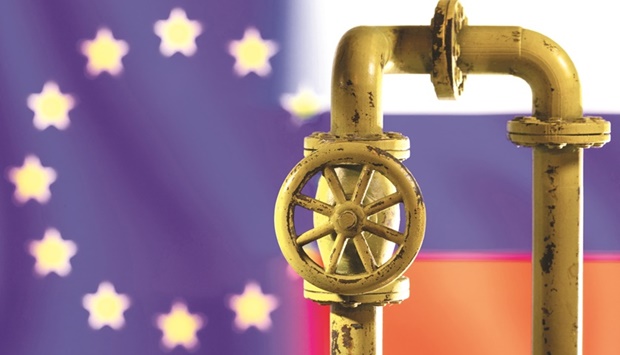
The impact on prices and liquefied natural gas flows would give policymakers much-needed information about the challenge of decoupling the European gas network completely from Russia, suggests the writer. (Reuters illustration)