


Nasa’s massive new rocket eased onto its launchpad yesterday, ready for a battery of tests that will clear it to blast off to the moon this summer on an uncrewed flight.
It left the Kennedy Space Centre’s Vehicle Assembly Building on Thursday evening and began a nearly 11-hour journey on a crawler-transporter to the hallowed Launch Complex 39B, arriving at 4.15am.
Around 10,000 people had gathered to watch the event.
With the Orion crew capsule fixed on top, the Space Launch System (SLS) Block 1 stands 322’ (98m) high – taller than the Statue of Liberty, but a little smaller than the 363’ Saturn V rockets that powered the Apollo missions to the Moon.
Still, it will produce 8.8mn pounds of maximum thrust (39.1 Meganewtons), 15% more than the Saturn V, meaning it’s expected to be the world’s most powerful rocket at the time it begins operating.
Having reached the iconic launchpad, where 53 Space Shuttles took off, there are roughly two more weeks’ worth of checks before what’s known as the “wet dress rehearsal.”
The SLS team will load more than 700,000 gallons (3.2mn litres) of cryogenic propellant into the rocket and practice every phase of launch countdown, stopping 10 seconds before blast off.
A symbol of US space ambition, it also comes with a hefty price tag: $4.1bn per launch for the first four Artemis missions, Nasa Inspector-General Paul Martin told Congress this month.
The National Aeronautics and Space Administration (Nasa) is targeting May as the earliest window for Artemis-1, an uncrewed lunar mission that will be the first integrated flight for SLS and Orion.
SLS will first place Orion into a low Earth orbit, and then, using its upper stage, perform what’s called a trans-lunar injection.
This manoeuvre is necessary to send Orion 280,000 miles beyond Earth and 40,000 miles beyond the moon – further than any spaceship capable of carrying humans has ventured.
On its three-week mission, Orion will deploy 10 shoebox size satellites known as CubeSats to gather information on the deep space environment.
It will journey around the far side of the moon, using thrust provided by the European Space Agency (ESA) thruster, and finally make its way back to Earth, where its heat shield will be tested against the atmosphere.
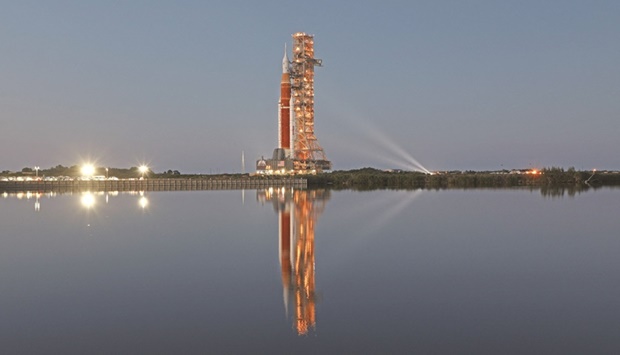
Nasa’s massive Artemis I rocket (above) is illuminated at dusk atop a mobile launch platform en route to Launch Pad 39B from the Vehicle Assembly Building at the Kennedy Space Centre in Florida.