


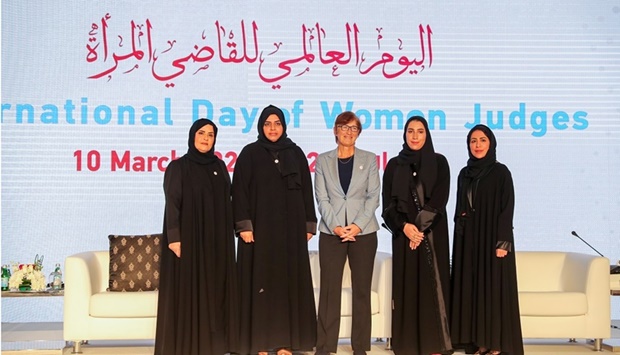
The Supreme Judiciary Council organised a panel discussion tackling Qatari women's experience in the judicial sector to mark the International Day of Women Judges, in the presence of HE President of the Supreme Judiciary Council Dr Hassan bin Lahdan al-Hassan al Mohanadi, HE Qatar's Attorney General Dr Issa bin Saad al-Juffali al-Nuaimi and a number of those working in the judiciary.
The discussion was moderated by the Dean of the College of Law at Hamad Bin Khalifa University Dr Susan L Karamanian.
The world celebrates for the first time this year the International Day of Women Judges, which was adopted by the UN General Assembly in April 2021 on Qatar's initiative.
The Director-General/Executive Director of the UN Office on Drugs and Crime (UNODC), Ghada Fathi Waly, along with the President of the UN Economic and Social Council, Collen Vixen Kelapile, contributed to the event through recorded speeches. The official logo for International Day of Women Judges was also launched.
Qatari women shared their experiences in the judiciary, praising the great support they received in various positions, in which they have proven their competence and ability.
Hessa al-Sulaiti, the first woman judge to join the judiciary, spoke at the beginning of the panel discussion about the atmosphere of challenge and optimism that she experienced when she decided to work in the judiciary, to prove that she is worthy of the confidence of the State leadership.
She also referred to the support and interaction she received in the judiciary, which contributed to her integration and interaction with the work environment, and her professional empowerment to become today a judge and head of a circuit in the Court of Appeal.
Speaking about her career, Aisha al-Emadi, a woman judge, expressed confidence that Qatari women had gone beyond the responsibility of empowerment and had already become empowered, and the increasing number of women judges in the Qatari judiciary reflected this fact. She stressed that woman judges had proved themselves.
Noor al-Hashimi, a public prosecutor, also spoke about the experience of women in the Public Prosecution service, one of the branches of the Qatari judiciary, noting that working in the judiciary and prosecution was part of the process of empowering women to serve the country.
Commenting on the experience of women in the judiciary, former CEO of the Qatar Foundation for Social Work, Amal bint Abdullatif al-Mannai, said that the process of empowering Qatari women and enhancing the proportion of their representation in the decision-making process was an original approach by Qatari leadership, which was keen to overcome the challenge of empowerment.
Al-Sulaiti praised the State's keenness to involve Qatari women in enacting legislation, judicial work, and decision-making to activate their role, guarantee their rights, implement the principles of empowerment and contribute to the sustainable development process in the country.
On providing the community with judges of both genders, Dr Mona al-Marzouqi, Dean of the College of Law at Qatar University confirmed that there was a co-operation agreement between the Supreme Judicial Council and Qatar University to implement the "Judges of Tomorrow" programme aimed at encouraging Qatari students to engage in the judiciary during their studies.
Director of the International Judicial Co-operation Department at the Supreme Judicial Council, Omar Ghanem Mohamed, stressed that empowering women had become a reality and not a slogan so that this Qatari experience inspires many countries of the world.
The discussion was moderated by the Dean of the College of Law at Hamad Bin Khalifa University Dr Susan L Karamanian.
The world celebrates for the first time this year the International Day of Women Judges, which was adopted by the UN General Assembly in April 2021 on Qatar's initiative.
The Director-General/Executive Director of the UN Office on Drugs and Crime (UNODC), Ghada Fathi Waly, along with the President of the UN Economic and Social Council, Collen Vixen Kelapile, contributed to the event through recorded speeches. The official logo for International Day of Women Judges was also launched.
Qatari women shared their experiences in the judiciary, praising the great support they received in various positions, in which they have proven their competence and ability.
Hessa al-Sulaiti, the first woman judge to join the judiciary, spoke at the beginning of the panel discussion about the atmosphere of challenge and optimism that she experienced when she decided to work in the judiciary, to prove that she is worthy of the confidence of the State leadership.
She also referred to the support and interaction she received in the judiciary, which contributed to her integration and interaction with the work environment, and her professional empowerment to become today a judge and head of a circuit in the Court of Appeal.
Speaking about her career, Aisha al-Emadi, a woman judge, expressed confidence that Qatari women had gone beyond the responsibility of empowerment and had already become empowered, and the increasing number of women judges in the Qatari judiciary reflected this fact. She stressed that woman judges had proved themselves.
Noor al-Hashimi, a public prosecutor, also spoke about the experience of women in the Public Prosecution service, one of the branches of the Qatari judiciary, noting that working in the judiciary and prosecution was part of the process of empowering women to serve the country.
Commenting on the experience of women in the judiciary, former CEO of the Qatar Foundation for Social Work, Amal bint Abdullatif al-Mannai, said that the process of empowering Qatari women and enhancing the proportion of their representation in the decision-making process was an original approach by Qatari leadership, which was keen to overcome the challenge of empowerment.
Al-Sulaiti praised the State's keenness to involve Qatari women in enacting legislation, judicial work, and decision-making to activate their role, guarantee their rights, implement the principles of empowerment and contribute to the sustainable development process in the country.
On providing the community with judges of both genders, Dr Mona al-Marzouqi, Dean of the College of Law at Qatar University confirmed that there was a co-operation agreement between the Supreme Judicial Council and Qatar University to implement the "Judges of Tomorrow" programme aimed at encouraging Qatari students to engage in the judiciary during their studies.
Director of the International Judicial Co-operation Department at the Supreme Judicial Council, Omar Ghanem Mohamed, stressed that empowering women had become a reality and not a slogan so that this Qatari experience inspires many countries of the world.