


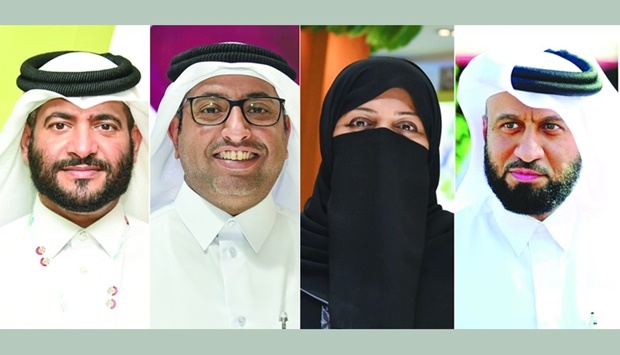
The 9th Qatar International Agricultural Exhibition (AgriteQ) and 3rd Qatar International Environmental Exhibition (EnviroteQ) have seen plenty of footfall, a number of officials at both the Ministry of Municipality and the Ministry of Environment and Climate Change have pointed out, saying that many are flocking to the place to buy local products on display as the holy month of Ramadan approaches,.
The officials stressed that the prices of the exhibitors for local agriculture products, dates and honey are being sold according to the mandatory price lists of the Ministry of Commerce and Industry.
They also noted that the exhibitions are considered a key opportunity to review and explore future projects of the two ministries, especially given that Qatar pays great importance to the agriculture and environment sectors.
The exhibitions are set to see the signing of a number of agreements and Memorandum of Understanding among the private and the government sectors for the support of such sectors.
Yousef Khalid al-Khelaifi, deputy head of the organising committee of the exhibitions and director of the agriculture affairs department at the Ministry of Municipality, said that the committee has taken all the necessary preventative and precautionary measures to guarantee the health and safety of all the participants and visitors.
He said that there is constant co-ordination with the Ministry of Public Health (MoPH) in this regard.
Al-Khelaifi noted that the agriculture sector in Qatar has made great achievements and quantum leaps over the past few years with regard to the quality and quantity of production.
There are also various projects, initiatives and programme to enhance local production and achieve the desired self-sufficiency targeted by the National Strategy for Food Security.
Hamad Sakit al-Shemari, director of the agriculture research department at the Ministry of Municipality, said that this edition of AgriteQ enjoys a good diversity of products on display by participating companies, laboratories and research centres, which is an indication of its great position among the local and external entities.
He said that his department has finalised the final touches on the upcoming five-year strategic plan, which includes a number of projects in the field of plant and livestock researches to achieve sustainability in these products.
Al-Shemari added that over the recent period, the concept of sustainable agriculture and farming started to become more and more prevalent in Qatar, where safe farming methods are used in greenhouses without the use of fertilisers, which would eventually reduce the cost of production.
Huda al-Dosari, head of the animal research section at the department, said that her section has recently concluded a project using bio-measures to estimate the weight of animals, and it is expected that a tender will be offered soon to produce the Qatari measuring tape that will used to measure the circumference the animal’s chest instead of weighing it.
She said that the project has been implemented in co-operation with a Japanese company to prepare this tape according to the approved Qatari standards.
Further, the section is working on a pioneering project to count all the breeds of livestock in Qatar – goats, sheep, cattle and camels – to identify them in terms of shape and genetics, to provide a database of the available breeds in the country and ease the inter-breeding and selection processes.
Salem al-Safran, assistant director of the natural protectorates department at the Ministry of Environment and Climate Change, said that more than 1,500 wild lawns have been identified and located across the country and many of these will be rehabilitated and enhanced over the next few years, as all the necessary geographical data of these, and their status and spaces, have been added to a database, in addition to the type of plants at each of them.
There will be a smart application to be launched soon, through which the user can review all the information about these lawns and their locations and images.
The officials stressed that the prices of the exhibitors for local agriculture products, dates and honey are being sold according to the mandatory price lists of the Ministry of Commerce and Industry.
They also noted that the exhibitions are considered a key opportunity to review and explore future projects of the two ministries, especially given that Qatar pays great importance to the agriculture and environment sectors.
The exhibitions are set to see the signing of a number of agreements and Memorandum of Understanding among the private and the government sectors for the support of such sectors.
Yousef Khalid al-Khelaifi, deputy head of the organising committee of the exhibitions and director of the agriculture affairs department at the Ministry of Municipality, said that the committee has taken all the necessary preventative and precautionary measures to guarantee the health and safety of all the participants and visitors.
He said that there is constant co-ordination with the Ministry of Public Health (MoPH) in this regard.
Al-Khelaifi noted that the agriculture sector in Qatar has made great achievements and quantum leaps over the past few years with regard to the quality and quantity of production.
There are also various projects, initiatives and programme to enhance local production and achieve the desired self-sufficiency targeted by the National Strategy for Food Security.
Hamad Sakit al-Shemari, director of the agriculture research department at the Ministry of Municipality, said that this edition of AgriteQ enjoys a good diversity of products on display by participating companies, laboratories and research centres, which is an indication of its great position among the local and external entities.
He said that his department has finalised the final touches on the upcoming five-year strategic plan, which includes a number of projects in the field of plant and livestock researches to achieve sustainability in these products.
Al-Shemari added that over the recent period, the concept of sustainable agriculture and farming started to become more and more prevalent in Qatar, where safe farming methods are used in greenhouses without the use of fertilisers, which would eventually reduce the cost of production.
Huda al-Dosari, head of the animal research section at the department, said that her section has recently concluded a project using bio-measures to estimate the weight of animals, and it is expected that a tender will be offered soon to produce the Qatari measuring tape that will used to measure the circumference the animal’s chest instead of weighing it.
She said that the project has been implemented in co-operation with a Japanese company to prepare this tape according to the approved Qatari standards.
Further, the section is working on a pioneering project to count all the breeds of livestock in Qatar – goats, sheep, cattle and camels – to identify them in terms of shape and genetics, to provide a database of the available breeds in the country and ease the inter-breeding and selection processes.
Salem al-Safran, assistant director of the natural protectorates department at the Ministry of Environment and Climate Change, said that more than 1,500 wild lawns have been identified and located across the country and many of these will be rehabilitated and enhanced over the next few years, as all the necessary geographical data of these, and their status and spaces, have been added to a database, in addition to the type of plants at each of them.
There will be a smart application to be launched soon, through which the user can review all the information about these lawns and their locations and images.