


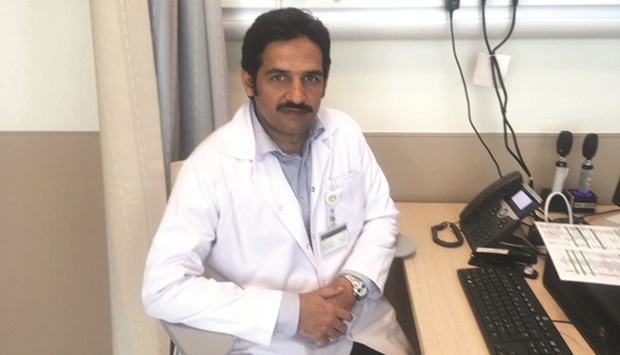
High-risk individuals who suffer from glaucoma, a silent but progressive disease that damages the optic nerve and eventually leads to blindness, should go for regular check-ups, a specialist with Hamad Medical Corporation (HMC) told Gulf Times.
Dr Shaukat Ayub Khan from the Ophthalmology Department was speaking in the context of the glaucoma awareness campaign that concludes on March 12.
The specialist, who was born in Doha and graduated from a Qatari high school later studied medicine at Khyber Medical College (KMC) in Peshawar, Pakistan.
After graduating in medicine and specialising in ophthalmology, Dr Khan returned to his birthplace to finish his residency at HMC Ophthalmology Department. “I was influenced to pursue my specialisation in Glaucoma by Dr Fatma al-Mansouri, the former director of the same department. Since 2008 I am working here.”
Dr Shaukat describes glaucoma as a 'silent illness' which continuously damages the optic nerve.
There are different types of glaucoma, the most common being the primary open-angle glaucoma. "Usually, patients do not discover it early on, but only when the vision is affected, by which time the eye pressure is too high, and they have glaucoma," he explained.
In angle-closure glaucoma, the patient can discover it early, because they have pain and redness in the eye and it is sometimes associated with vomiting. So, they directly go to emergency and are diagnosed early and get the treatment sooner.
"We advise the high-risk groups, those who have a family history of glaucoma, diabetics, those who wear minus glasses, who have myopia, or dark-skinned people, and those above 40 years, to get their eyes checked either annually or once every two years.
"There is no cure for glaucoma, we only have treatment which involves using eye drops daily to control the eye pressure and stop the disease progression," said the specialist who stressed that research is progressing on an injection in the eye which is effective for six months.
"The injection was FDA approved in the US on March 6, 2020, to be the first biodegradable sustained-release implant for the treatment of open-angle glaucoma. It is not widely used yet, because we don’t know what the more common side effects of the injection in the eye is. The safest treatment is the eye drops, as more research is still going on.”
Regarding patients who take certain eye drops and are advised by their doctor to press the lacrimal canaliculi (tears canals) in the lower eye lid with their index fingers just after putting the eye drops, Dr Khan said “when the tear or the eye drop passes through the canaliculi into the nose, it gets absorbed into the systemic circulation in the system. Sometimes this can cause some side effects, especially for those patients using beta-blockers, asthma patients, or people with heart problems. That is why we advise them to use this technique. If the side effects persist, we will change the type of medication.
"Glaucoma patients using eye drops can feel increased dryness in the eyes, so when using computer or mobile phones, they should blink more, take a break from the screen every 20 minutes and use lubricant eye drops more frequently.
"Surgery is advised for glaucoma patients who do not respond to a maximum dose of eye drops, have side effects and whose eye pressure is not coming down. The rate of success in glaucoma operations is 60% worldwide, and in 90% of the cases you need to go back to medication after the operation. That is why we don’t advise it as the first line, as long as the eye pressure is good with eye drops there is no need for surgery.”
Dr Shaukat said scientific research is still going on to improve treatment and techniques. “The aim is to do a glaucoma surgery in 10 minutes that will give you the ideal eye pressure for 10 years, but we are still far away from it.”
Dr Shaukat concluded by saying that “we are running a fellowship programme at the department with Dr Aida Kanaan and Dr Zakia al-Ansari our consultants, and we have Dr Omar al-Qadoora who has finished his fellowship training in glaucoma with us, and we have a new trainee now.”
Dr Shaukat Ayub Khan from the Ophthalmology Department was speaking in the context of the glaucoma awareness campaign that concludes on March 12.
The specialist, who was born in Doha and graduated from a Qatari high school later studied medicine at Khyber Medical College (KMC) in Peshawar, Pakistan.
After graduating in medicine and specialising in ophthalmology, Dr Khan returned to his birthplace to finish his residency at HMC Ophthalmology Department. “I was influenced to pursue my specialisation in Glaucoma by Dr Fatma al-Mansouri, the former director of the same department. Since 2008 I am working here.”
Dr Shaukat describes glaucoma as a 'silent illness' which continuously damages the optic nerve.
There are different types of glaucoma, the most common being the primary open-angle glaucoma. "Usually, patients do not discover it early on, but only when the vision is affected, by which time the eye pressure is too high, and they have glaucoma," he explained.
In angle-closure glaucoma, the patient can discover it early, because they have pain and redness in the eye and it is sometimes associated with vomiting. So, they directly go to emergency and are diagnosed early and get the treatment sooner.
"We advise the high-risk groups, those who have a family history of glaucoma, diabetics, those who wear minus glasses, who have myopia, or dark-skinned people, and those above 40 years, to get their eyes checked either annually or once every two years.
"There is no cure for glaucoma, we only have treatment which involves using eye drops daily to control the eye pressure and stop the disease progression," said the specialist who stressed that research is progressing on an injection in the eye which is effective for six months.
"The injection was FDA approved in the US on March 6, 2020, to be the first biodegradable sustained-release implant for the treatment of open-angle glaucoma. It is not widely used yet, because we don’t know what the more common side effects of the injection in the eye is. The safest treatment is the eye drops, as more research is still going on.”
Regarding patients who take certain eye drops and are advised by their doctor to press the lacrimal canaliculi (tears canals) in the lower eye lid with their index fingers just after putting the eye drops, Dr Khan said “when the tear or the eye drop passes through the canaliculi into the nose, it gets absorbed into the systemic circulation in the system. Sometimes this can cause some side effects, especially for those patients using beta-blockers, asthma patients, or people with heart problems. That is why we advise them to use this technique. If the side effects persist, we will change the type of medication.
"Glaucoma patients using eye drops can feel increased dryness in the eyes, so when using computer or mobile phones, they should blink more, take a break from the screen every 20 minutes and use lubricant eye drops more frequently.
"Surgery is advised for glaucoma patients who do not respond to a maximum dose of eye drops, have side effects and whose eye pressure is not coming down. The rate of success in glaucoma operations is 60% worldwide, and in 90% of the cases you need to go back to medication after the operation. That is why we don’t advise it as the first line, as long as the eye pressure is good with eye drops there is no need for surgery.”
Dr Shaukat said scientific research is still going on to improve treatment and techniques. “The aim is to do a glaucoma surgery in 10 minutes that will give you the ideal eye pressure for 10 years, but we are still far away from it.”
Dr Shaukat concluded by saying that “we are running a fellowship programme at the department with Dr Aida Kanaan and Dr Zakia al-Ansari our consultants, and we have Dr Omar al-Qadoora who has finished his fellowship training in glaucoma with us, and we have a new trainee now.”