


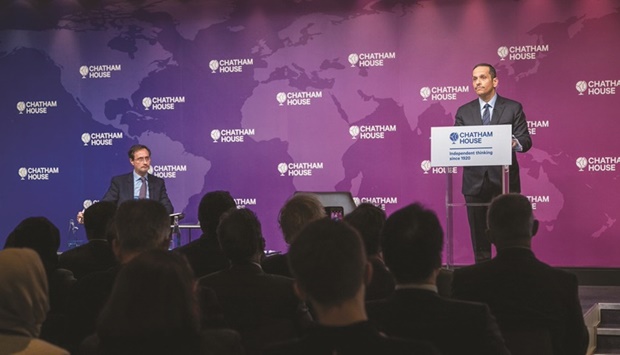

HE the Deputy Prime Minister and Minister of Foreign Affairs Sheikh Mohamed bin Abdulrahman al-Thani.
HE the Deputy Prime Minister and Minister of Foreign Affairs Sheikh Mohamed bin Abdulrahman al-Thani participated in a panel discussion at the Royal Institute of International Affairs (Chatham House) in London on “Qatar’s Regional and International Role.”
The panel, moderated by Director and Chief Executive of Chatham House Dr Robin Niblett, discussed Qatar’s steps to achieve stability in Afghanistan, the State’s diplomatic efforts in managing the Afghan crisis, the impact of the transition process in Afghanistan on Qatar and the Middle East, and the State’s role in mitigating the effects of energy shortages in the world.
HE Sheikh Mohamed stressed that Qatar’s foreign policy depends on strong alliances at the bilateral and multilateral levels, noting that the importance of this approach is reflected in the State’s mediation efforts in Afghanistan, the largest evacuation operations, and the co-ordination of vital humanitarian assistance for the Afghan people.
On the energy issue, HE the Foreign Minister added that Qatar works closely with global partners to develop long-term solutions to meet the world’s energy needs, as it is impossible to achieve global energy security unilaterally, adding that the problem requires continuous and broad co-operation.
Also, HE Sheikh Mohamed stressed that Qatar enjoys a unique position to encourage the peaceful resolution of disputes through dialogue and diplomacy, pointing out that Article 7 of the Constitution of the State of Qatar indicates that foreign policy is based on the principle of promoting international peace and security by encouraging the peaceful resolution of international disputes, and co-operation with all countries that seek peace, adding that Qatar conducts this task through mediation, humanitarian and development assistance, and counter-terrorism efforts.
He continued that Qatar’s goal has always been to ensure a better future for all, and it is working hard to mobilise its efforts and resources to achieve this end.
These efforts will not be fruitful without the continuous co-operation and support of Qatar’s partners around the world, he added.
He also stressed that recent global events highlighted the importance of international co-operation in various fields.
HE the Foreign Minister explained that 2022 is the year to solve common problems and unite people and embrace common passion rather than fears.
It is a really special time for Qatar, as it approaches the 2022 World Cup, which reflects the joint efforts of Qatar, FIFA, and international partners over the past 12 years, as Qatar has the privilege of hosting the first World Cup in the Middle East and the Arab world, he added.
HE Sheikh Mohamed stressed that the relations between Qatar and the United States have been solid for a long time, adding that the two countries are celebrating in 2022 the 50th anniversary of diplomatic relations between them.
He also stressed that the progress made by Qatar with various US administrations has always been in a positive direction.
He said that Qatar and the US didn’t co-operate only in the defence field, but also in various important areas such as economic, educational, and energy co-operation, in addition to the distinguished partnership with the US on the Afghan file.
He further added that Qatar hosted talks between the US and the Taliban for years until reaching an agreement, then Qatar hosted the Afghan dialogue alongside the US, in addition to supporting the evacuation efforts and supporting the efforts of the Global Coalition against ISIS.
HE the Foreign Minister pointed out that Qatar works very closely with the US on many strategic issues, adding that State works in an environment of international, bilateral, and multilateral alliances, and the US is the strongest ally and the most important partner of Qatar in many fields.
Regarding His Highness the Amir Sheikh Tamim bin Hamad al-Thani’s visit to the US last month, HE Sheikh Mohamed said that it was fruitful and a wide range of issues were discussed positively and fruitfully, such as the Afghan file, the Iranian nuclear talks, the Palestinian issue, and the energy.
He stressed that the two countries work closely together and that Qatar’s designation as a major non-Nato ally of the US was a reflection of this distinguished partnership.
HE Sheikh Mohamed said that Qatar’s relations with the US have remained very clear for a long time, noting that the bilateral relations were built through institutions in various periods; consequently, the US-Qatari relationship is always in a positive direction, and the institutional relationship is stronger than ever.
When asked about the issue of energy poverty facing Europe, he said that what the scene is witnessing is not a direct result of current events, pointing out that in the past period there was no strategic thinking to secure and sustain energy supplies with balanced policies that care about the environment as well.
He added that now, with the current challenges, Qatar is of course the largest producer and exporter of liquefied natural gas along with the US.
He said that the discussions should be on how to deal with this issue collectively and in co-operation with countries and trading partners.
He said that Qatar has been producing in the past few years at its maximum capacity, expressing hope to increase production in the next two years.
He said that Qatar is in constant discussion with various countries and partners for plans to ensure supply sustainability.
Regarding the transition to renewable energy, he expressed his belief that this is a journey that everyone must take, including Qatar and fossil fuel producers, explaining that Qatar also needs to view it as a joint effort, a journey that many countries are now beginning to realise.
He added that taking environmental policies into account is important, and leads to a more realistic transition plan.
He stressed that the State had remained a reliable source of energy, noting that Qatar is trying to make the world cleaner and safer, and this has been demonstrated by LNG.
He said that Qatar had a leading role in carbon sequestration and in reducing methane, and in renewable energy projects, indicating that Qatar would open the first solar energy project to produce part of its energy needs.
HE Sheikh Mohamed emphasised the importance of conducting a comprehensive dialogue with the neighbours in the region, adding Qatar understands their concerns, but it also doesn’t accept interference in the internal affairs of different countries, especially since it is not accepted as a general principle by the United Nations.
Regarding the international response to health crises, HE Sheikh Mohamed noted that Qatar plays a role with various partners within the UN to ensure the response to the Covid-19 pandemic, stressing that international co-operation always remains at the forefront of Qatar’s priorities, as its assistance has reached about 50 countries until now.
HE Sheikh Mohamed said that there is a positive momentum to enhance co-operation among the Gulf Co-operation Council (GCC) countries, as the years of the Gulf crisis should do not be repeated, and all the GCC leaders are now looking forward to ensuring the creation of a better future.
He stressed that Qatar believes that it is time again for the GCC to be more active, adding Qatar has seen this clear in various issues.
He explained that one of the issues was Afghanistan, where the council had close co-ordination with various countries.
Two days ago, Qatar hosted a meeting between the Taliban and GCC representatives in Doha to talk about the Afghan issue and create a better understanding of the situation there, stressing that there is a unified Gulf position on this issue.
On the Palestinian issue, HE the Minister of Foreign Affairs said that Qatar plays its role in helping the Palestinian people to alleviate their suffering, but this is just a pain killer and not a solution, stressing that the Israelis must seriously come to the negotiating table to reach to the ultimate goal of seeing the solution approved by the Arab countries through the peace initiative.
Regarding Afghanistan, HE the Foreign Minister stressed the importance of continuing to deal with the Taliban to correct the course, saying that this is a long journey and it will not happen in one day, people should be realistic, there is a need to make sure that there is a continuation of engagement with them.
He added Qatar continues to encourage and urge them for reforms and not to back down from any of the things that Afghanistan has achieved in the past 20 years, and to engage in a genuine reconciliation process.
He said that Qatar cannot go to Afghanistan to renew or recapitalise its economy or return the systems that will run on its own.
He stressed that this requires a collective effort by the international community and Qatar’s international partners, adding that Qatar is in very close consultation with various partners to provide a blueprint to move forward in Afghanistan to address the humanitarian file, economic issues, migration, and combating terrorism.
He stressed that Qatar has close contact with Iran, the United States, and other parties regarding the Joint Comprehensive Plan of Action, noting that the State is trying to help bridge the gap because the agreement and negotiations are taking place between countries thousands of miles away from Iran, but Qatar lives near Iran, therefore, it is in its interest to have an agreement and to reach an understanding with Iran, and then there will also be a regional understanding between the GCC states and Iran.
He added that Qatar encourages all parties to be constructive and positive with the initiatives, expressing hope that Qatar will get a positive result in the near future, as Qatar’s role is to encourage both parties to engage positively.