


Asian markets mostly fell again yesterday on fears that Russia is about to invade Ukraine, but early signs that tensions could be easing boosted European stocks and sent oil prices down.
Equities have been in turmoil after US national security adviser Jake Sullivan warned last week that Russia could storm into Ukraine “any day now”, having amassed more than 100,000 troops on its border in recent weeks.
Western powers have drawn up a series of tough sanctions against Moscow in the event of an invasion but there is a big worry that such a move would have economic consequences since the two countries are key sources of vital commodities including oil, gas and wheat.
The price of each of them has soared in recent weeks.
However, while Washington continues to fret, there was a glimmer of hope that recent diplomatic efforts could pay off, with Russian foreign minister Sergei Lavrov saying there was “always a chance” for agreement with the West.
In a televised meeting, he told President Vladimir Putin that talks with US and European leaders showed enough of an opening for progress on his goals, adding: “I would suggest continuing.”
German Chancellor Olaf Scholz was due in Moscow on Tuesday for talks with Putin.
Hopes were also given a lift after a Russian defence ministry spokesman said some forces on the border were beginning to return to their bases.
“The geopolitical risks still remain elevated as Russian troops remain at the Ukrainian border, but the risk of military conflict happening this week appears to have eased,” said OANDA’s Edward Moya.
The exchange between Putin and Lavrov improved the mood on markets slightly, helping Wall Street off its intra-day lows, though all three main indexes ended in negative territory for a second day. Earlier, Tokyo retreated as investors brushed off data showing Japan’s economy rebounded in the final three months of 2021, while there were also losses in Hong Kong, Sydney, Singapore, Seoul, Wellington, Taipei and Manila, but Shanghai, Mumbai, Bangkok and Jakarta edged up.
Oil prices fell around 2% at one point before paring the losses, though they remain at more than seven-year highs and within touching distance of $100 a barrel.
The long-running saga over the Fed’s plans for fighting inflation — which is at a 40-year high — were also still on traders’ minds, with the central bank expected to hike rates next month but speculation rife over how much it will move and how many more times.
St Louis Fed President James Bullard said Monday officials needed to be decisive in their actions, telling CNBC “our credibility is on the line here”.
He added that the bank should “front load” its actions and raise the benchmark borrowing rate to 1% by July, echoing similar remarks last week that caused a stir on trading floors. But some commentators warned that with prices being fuelled by factors such as surging energy costs and supply chain problems, the Fed hikes could have little effect.
“What we are seeing is a Fed that is reacting to inflationary prints even though many of the pressures on inflation are factors that the Fed really can’t solve,” Kristina Hooper, of Invesco, told Bloomberg Television.
“So that certainly increases the risks and reduces the clarity.”
Still, with the global economy in recovery mode and most governments easing containment measures, observers remain upbeat about the outlook for markets.
In Tokyo, the Nikkei 225 closed down 0.8% to 26,865.19 points; Hong Kong Hang Seng Index ended down 0.8% to 24,355.71 points and Shanghai Composite closed up 0.5% to 3,446.09 points yesterday.
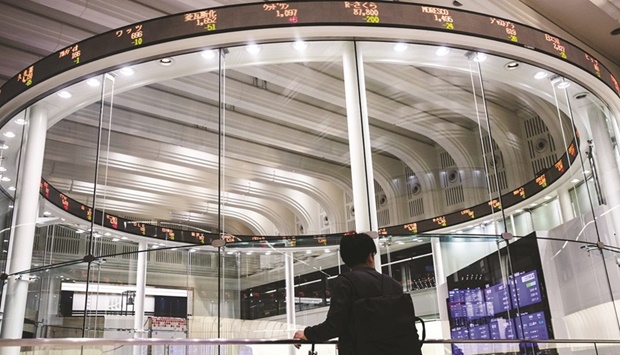
An electronic ticker displays share prices at the Tokyo Stock Exchange. The Nikkei 225 closed down 0.8% to 26,865.19 points yesterday.