


US consumers don’t expect red-hot inflation levels to last in the long term. That’s the takeaway from data analysis by six co-authors including New York Fed President John Williams, who was listed as a co-writer in the regional Fed’s Liberty Street Economics blog series for the first time.
The authors drew in part from the January consumer survey from Federal Reserve Bank of New York, which showed that the median one-year-ahead inflation expectations fell for the first time since October 2020, to 5.8%. The outlook over three years dropped even more sharply, and the decline was broad-based across age, education and income.
Combined with data from the University of Michigan’s sentiment index, this indicates that consumers seem to recognise the unusual nature of the current bout of high inflation, the economists said in the blog post on Monday.
“This result suggests that while consumers are highly attuned to current inflation news in updating their short-term inflation expectations, they are taking less signal than before the pandemic from the recent sharp movements in realized inflation when revising their three-year-ahead expectations,” they said.
In their analysis, Williams and his five co-authors found that medium-term expectations have exhibited lower sensitivity to inflation surprises during the pandemic than before it. They also found that the five-year inflation outlook has remained “remarkably stable” since last summer.
Taken together, this suggests that consumers “do not view the current elevated inflation as very long-lasting,” they wrote. All products and services surveyed by the New York Fed declined in January, including the year-ahead price changes for food, rent, gas, medical care, college education and gold. The survey also showed that the median households is expecting one-year-ahead earnings growth to rise by 3%, the same as last month. Last year, an average gain of 2.6% was expected.
The median three-year ahead inflation expectations decreased by 0.5 percentage point to 3.5%.
Last week, the Labor Department published data that showed consumer price rose 7.5% in January from a year earlier, the biggest increase in decades. Persisting high inflation has led has led the central bank to pivot toward a tighter monetary stance to help cool off prices.
The Fed‘s next policy meeting is set for March 15-16, and some economists are calling on the central bank to make an aggressive, half-point increase to signal its determination to contain rising prices.
While inflation is expected to return to more manageable levels, the so-called misery rate, the combination of inflation and unemployment will take some time to be reduced. A Bloomberg News survey of economists finds that the misery-rate will return to levels seen in early 2020 by early 2023.
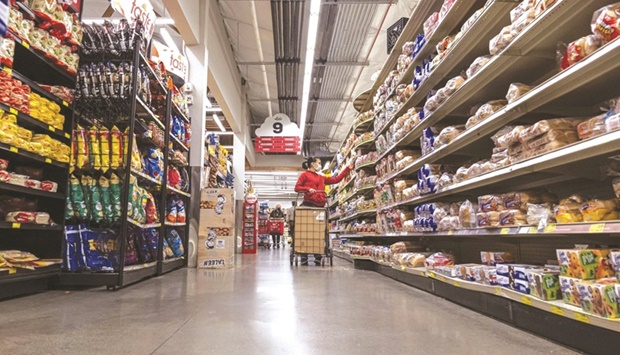
A customer shops for groceries at a store in San Francisco. US consumers don’t expect red-hot inflation levels to last in the long term. That’s the takeaway from data analysis by six co-authors including New York Fed President John Williams, who was listed as a co-writer in the regional Fed’s Liberty Street Economics blog series for the first time.