


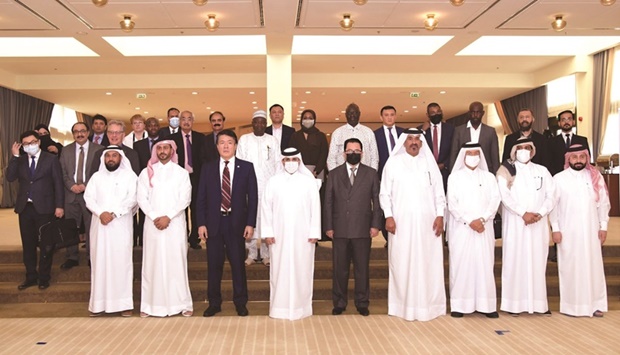
HE the Minister of Municipality Dr Abdullah bin Abdulaziz bin Turki al-Subaie has said that Qatar, within the framework of its national vision, places food security and securing the food needs of its population among its priorities.
He said the Qatar National Food Security Strategy 2018-2023 aims to provide basic and strategic food commodities to consumers in the country at an appropriate cost and high quality and in compliance with the requirements of Islamic Shariah and safety standards, which enables Qatar to achieve first place in the Arab world and 24th globally in the Global Food Security Index (GFSI).
Speaking at the opening of the Strategic Commodities and Food Safety Forum, organised by the Ministry of Municipality in co-operation with the Islamic Organisation for Food Security (IOFS), the minister pointed out that the national strategy for food security was based on a number of basic pillars.
The pillars included the development and increase of local production of fresh goods, taking into account the proper utilisation of natural resources, diversification of foreign trade sources to avoid exposure to any potential risks that may arise in crises and emergencies, and the formation of a strategic stockpile in the country of food commodities that can be stored for long periods.
In this regard, Qatar has enhanced its storage capabilities by implementing a project to build food security facilities and warehouses in Hamad Port, on an area of more than 0.5mn sqm.
The project includes storage silos, manufacturing facilities specialising in rice, raw sugar, and edible oils.
These products will be available for local, regional and international use given that the project has been equipped with the appropriate infrastructure and the construction of infrastructure and equipment for handling, processing, packing, reloading, and transport operations associated with the project.
HE the Minister expressed Qatar's aspiration to continue co-operation with the member states of the IOFS in the co-ordination and rapprochement in the field of policies and plans to provide strategic food commodities, and achieve food safety standards and requirements, thus contributing to achieving common goals related to providing food security.
For his part, OIC Assistant Secretary-General for Economic Affairs Ahmad Sengendo described the forum as distinct and important, providing an opportunity for experts to discuss issues of sustainability of food sources, especially since the Covid-19 outbreak has greatly affected this issue globally.
He indicated that many sectors concerned with food security have reached the poverty line with food scarcity and lack of access to basic commodities, while millions of people have lost their jobs and means of livelihood, most of whom are citizens of the OIC, according to a UN report.
He noted the importance of providing food commodities and reducing poverty, to achieve food security in the OIC countries, according to a programme for strategic commodities.
He explained that the conference on food security and strategic commodities last year in the Turkish city of Istanbul set action plans for wheat, rice, and cassava commodities, enabling the countries that produce them to obtain greater benefits in their dealings with food chains in the world.
Sengendo called on the participants in the forum to discuss the solutions and challenges facing the member states concerning the production of strategic goods and to develop long and short-term plans to achieve stability in the commodity market and enhance production capacities within efforts related to management and information exchange in this regard.
He also stressed the importance of diversifying the agricultural sector with the increase in the population and working to avoid risks that might harm humans, plants, and animals.
This includes tackling the issue of climate change, adopting healthy methods in preparing halal food and its standards, encouraging the Member States to strengthen the authorities related to the issue of food security, and emphasising the important role in this, especially what it means next to the investment, and preparing action plans to enhance the work of the relevant institutions to develop a food safety system that supports the economies of the OIC countries, focusing on the capabilities available to them.
He stressed the need to provide healthy food to avoid the outbreak of diseases, to take the required measures to implement the organisation's action plan for the year 2025, and intensify cooperation with Africa on the issue of food production and commodities, especially since it is a continent that enjoys different and diverse resources, taking the inherent opportunities in it, as it constitutes a fertile environment for agricultural investment.
He said the commitment of the OIC General Secretariat to deal with member states to increase the production of commodities and enhance standards related to food safety.
Kazakhstan's ambassador to Qatar Arman Issagaliyev, whose country hosts the headquarters of the General Secretariat of the IOFS, said that the stability of the food market and the outbreak of coronavirus (Covid-19) pandemic were of high concern to the international community.
He reviewed the efforts made by Kazakhstan in the field of food security and the development of the agricultural sector using modern technologies, and the high productivity of grain, especially wheat, from which it produces nearly 7mn tonnes annually, as well as the assistance it provides to countries in need.
He commended Qatar's role in enhancing IOFS's efforts, achieving its goals and implementing a number of programs within the activities of the organisation, including managing food security and developing the halal formula and other important initiatives, stressing the role of the organization in ensuring food security and its sustainability.
The Secretary-General of the Islamic Chamber of Commerce, Industry and Agriculture (ICCIA) Yousef Hasan Khalawi affirmed the importance of joint action and establishing real and successful partnerships through this forum to achieve food security and ensure means for providing food, between organizations that are based on public service, especially Islamic organisations, reviewing the lessons learned from the Covid-19 crisis, including the loss of a sense for security — food security in particular, at a large level.
He called for the establishment of the halal industry on sound foundations and strategic pillars with healthy standards and quality, pointing out that 20-25% of the world's population is in Islamic countries, as they represent a quarter of the world's population, which means that the halal industry is directed to them.
Halal-exporting countries are outside the region, and those who are directed to this industry are the public inside and outside the Islamic world, he noted, adding that taking care of the development of this industry is at the top of the interests of the Chamber, as well as the organization's joint Islamic action organisations.
Director-General of IOFS Yerlan Baidaulet pointed out Qatar's support for the organisation, calling the governments of Islamic countries to deal with the issue of food scarcity and to use modern technologies to develop basic agricultural commodities such as wheat, rice and cassava by investing further efforts in that.
He also noted that one of the organisation's programmes is to establish an electronic platform that provides training and specialised information, with which the countries of the organization should focus on the issue of food security and food safety, as well as build successful partnerships in this regard.
Director-General of the International Center for Biosaline Agriculture (ICBA) Dr Tarifa A Alzaabi emphasised the high importance of the topic of food security, expressing her sincere appreciation to Qatar for hosting this significant forum, given that food security, sustainability and safety are basic pillars that attract everyone's attention in light of the changes that the world is witnessing — including climate change.
She reviewed the centre's efforts in conducting research with the participation of 36 member states, searching for innovative solutions to all these challenges and supporting marginalised groups through the implementation of 26 projects to help countries enhance their food and water security and the livelihood of their residents.
The three-day forum will address topics of developing the production of strategic commodities such as wheat, rice and cassava, in addition to other topics related to food safety and promoting healthy consumption patterns, as well as challenges and opportunities related to the field of strategic food production.
The forum will also review the experiences of the IOFS member states, with a focus on building technical and knowledge capacities and exchanging experiences of research institutes of member states.
A number of participants will present scientific working papers on the topic of the forum, in addition to holding seminars on the activities of IOFS that have been implemented in the past two years, and offering solutions to meet the critical challenges faced by countries in relation to the production of strategic goods.
The forum will also address other topics related to food safety, and the promotion of practices aimed at improving food safety and quality by reviewing the experiences of member states in the field of sustainable agriculture and organic agriculture, as well as supporting and promoting agricultural practices that rely on environmentally friendly techniques and optimal management of natural resources.
It is expected that, at the end of the forum, the aspired goals of IOFS and the member states will be agreed upon, an executive plan will be prepared to develop the production of strategic commodities, and a mechanism will be established to integrate the methodologies of the IOFS member states, as well as the OIC regarding the developments of food commodities, in addition to developing a plan to implement the healthy food and food safety programme for 2022-2023.
He said the Qatar National Food Security Strategy 2018-2023 aims to provide basic and strategic food commodities to consumers in the country at an appropriate cost and high quality and in compliance with the requirements of Islamic Shariah and safety standards, which enables Qatar to achieve first place in the Arab world and 24th globally in the Global Food Security Index (GFSI).
Speaking at the opening of the Strategic Commodities and Food Safety Forum, organised by the Ministry of Municipality in co-operation with the Islamic Organisation for Food Security (IOFS), the minister pointed out that the national strategy for food security was based on a number of basic pillars.
The pillars included the development and increase of local production of fresh goods, taking into account the proper utilisation of natural resources, diversification of foreign trade sources to avoid exposure to any potential risks that may arise in crises and emergencies, and the formation of a strategic stockpile in the country of food commodities that can be stored for long periods.
In this regard, Qatar has enhanced its storage capabilities by implementing a project to build food security facilities and warehouses in Hamad Port, on an area of more than 0.5mn sqm.
The project includes storage silos, manufacturing facilities specialising in rice, raw sugar, and edible oils.
These products will be available for local, regional and international use given that the project has been equipped with the appropriate infrastructure and the construction of infrastructure and equipment for handling, processing, packing, reloading, and transport operations associated with the project.
HE the Minister expressed Qatar's aspiration to continue co-operation with the member states of the IOFS in the co-ordination and rapprochement in the field of policies and plans to provide strategic food commodities, and achieve food safety standards and requirements, thus contributing to achieving common goals related to providing food security.
For his part, OIC Assistant Secretary-General for Economic Affairs Ahmad Sengendo described the forum as distinct and important, providing an opportunity for experts to discuss issues of sustainability of food sources, especially since the Covid-19 outbreak has greatly affected this issue globally.
He indicated that many sectors concerned with food security have reached the poverty line with food scarcity and lack of access to basic commodities, while millions of people have lost their jobs and means of livelihood, most of whom are citizens of the OIC, according to a UN report.
He noted the importance of providing food commodities and reducing poverty, to achieve food security in the OIC countries, according to a programme for strategic commodities.
He explained that the conference on food security and strategic commodities last year in the Turkish city of Istanbul set action plans for wheat, rice, and cassava commodities, enabling the countries that produce them to obtain greater benefits in their dealings with food chains in the world.
Sengendo called on the participants in the forum to discuss the solutions and challenges facing the member states concerning the production of strategic goods and to develop long and short-term plans to achieve stability in the commodity market and enhance production capacities within efforts related to management and information exchange in this regard.
He also stressed the importance of diversifying the agricultural sector with the increase in the population and working to avoid risks that might harm humans, plants, and animals.
This includes tackling the issue of climate change, adopting healthy methods in preparing halal food and its standards, encouraging the Member States to strengthen the authorities related to the issue of food security, and emphasising the important role in this, especially what it means next to the investment, and preparing action plans to enhance the work of the relevant institutions to develop a food safety system that supports the economies of the OIC countries, focusing on the capabilities available to them.
He stressed the need to provide healthy food to avoid the outbreak of diseases, to take the required measures to implement the organisation's action plan for the year 2025, and intensify cooperation with Africa on the issue of food production and commodities, especially since it is a continent that enjoys different and diverse resources, taking the inherent opportunities in it, as it constitutes a fertile environment for agricultural investment.
He said the commitment of the OIC General Secretariat to deal with member states to increase the production of commodities and enhance standards related to food safety.
Kazakhstan's ambassador to Qatar Arman Issagaliyev, whose country hosts the headquarters of the General Secretariat of the IOFS, said that the stability of the food market and the outbreak of coronavirus (Covid-19) pandemic were of high concern to the international community.
He reviewed the efforts made by Kazakhstan in the field of food security and the development of the agricultural sector using modern technologies, and the high productivity of grain, especially wheat, from which it produces nearly 7mn tonnes annually, as well as the assistance it provides to countries in need.
He commended Qatar's role in enhancing IOFS's efforts, achieving its goals and implementing a number of programs within the activities of the organisation, including managing food security and developing the halal formula and other important initiatives, stressing the role of the organization in ensuring food security and its sustainability.
The Secretary-General of the Islamic Chamber of Commerce, Industry and Agriculture (ICCIA) Yousef Hasan Khalawi affirmed the importance of joint action and establishing real and successful partnerships through this forum to achieve food security and ensure means for providing food, between organizations that are based on public service, especially Islamic organisations, reviewing the lessons learned from the Covid-19 crisis, including the loss of a sense for security — food security in particular, at a large level.
He called for the establishment of the halal industry on sound foundations and strategic pillars with healthy standards and quality, pointing out that 20-25% of the world's population is in Islamic countries, as they represent a quarter of the world's population, which means that the halal industry is directed to them.
Halal-exporting countries are outside the region, and those who are directed to this industry are the public inside and outside the Islamic world, he noted, adding that taking care of the development of this industry is at the top of the interests of the Chamber, as well as the organization's joint Islamic action organisations.
Director-General of IOFS Yerlan Baidaulet pointed out Qatar's support for the organisation, calling the governments of Islamic countries to deal with the issue of food scarcity and to use modern technologies to develop basic agricultural commodities such as wheat, rice and cassava by investing further efforts in that.
He also noted that one of the organisation's programmes is to establish an electronic platform that provides training and specialised information, with which the countries of the organization should focus on the issue of food security and food safety, as well as build successful partnerships in this regard.
Director-General of the International Center for Biosaline Agriculture (ICBA) Dr Tarifa A Alzaabi emphasised the high importance of the topic of food security, expressing her sincere appreciation to Qatar for hosting this significant forum, given that food security, sustainability and safety are basic pillars that attract everyone's attention in light of the changes that the world is witnessing — including climate change.
She reviewed the centre's efforts in conducting research with the participation of 36 member states, searching for innovative solutions to all these challenges and supporting marginalised groups through the implementation of 26 projects to help countries enhance their food and water security and the livelihood of their residents.
The three-day forum will address topics of developing the production of strategic commodities such as wheat, rice and cassava, in addition to other topics related to food safety and promoting healthy consumption patterns, as well as challenges and opportunities related to the field of strategic food production.
The forum will also review the experiences of the IOFS member states, with a focus on building technical and knowledge capacities and exchanging experiences of research institutes of member states.
A number of participants will present scientific working papers on the topic of the forum, in addition to holding seminars on the activities of IOFS that have been implemented in the past two years, and offering solutions to meet the critical challenges faced by countries in relation to the production of strategic goods.
The forum will also address other topics related to food safety, and the promotion of practices aimed at improving food safety and quality by reviewing the experiences of member states in the field of sustainable agriculture and organic agriculture, as well as supporting and promoting agricultural practices that rely on environmentally friendly techniques and optimal management of natural resources.
It is expected that, at the end of the forum, the aspired goals of IOFS and the member states will be agreed upon, an executive plan will be prepared to develop the production of strategic commodities, and a mechanism will be established to integrate the methodologies of the IOFS member states, as well as the OIC regarding the developments of food commodities, in addition to developing a plan to implement the healthy food and food safety programme for 2022-2023.