


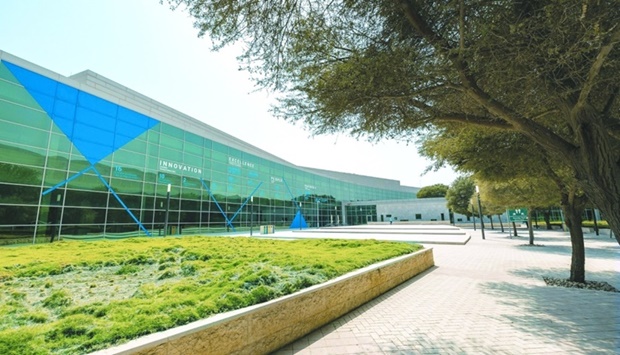
Hamad Bin Khalifa University (HBKU), part of Qatar Foundation (QF), offers an innovative learning experience by fusing advanced scientific research with multidisciplinary academic programmes, university provost Dr Michael Benedik has noted.
The HBKU’s integrated and multidisciplinary academic programmes focus on high-demand fields and are taught at its six colleges.
They are supported by three national research institutes with strong international affiliations.
Researchers and scientists at the HBKU are driving scientific advancement and bring their students along as active participants, helping them make the giant leap from acquiring knowledge to engaging and developing novel ideas of their own.
“This is the ideal experience for students, having research-active faculty who teach,” says Dr Benedik. “They educate using the latest, most up-to-date discoveries, which is at the core of the HBKU’s cutting-edge pedagogy.”
“Students learn the best ideas; not just on the facts, but on the processes and ‘how do you know things’,” he said. “What’s unique about the HBKU, relative to other research universities, is our focus on how to solve problems – both locally and globally.”
“By melding research and a graduate education, we are able to be creative and innovative with our programmes,” he added.
The HBKU’s current projects are diverse and span precision medicine platforms, technologies that influence behaviour, digital health tools, drug repurpose screening, a coronavirus (Covid-19) public policy tracker, “green” transportation solutions for smart cities, Covid-19 misinformation, a regulatory framework for using AI, and Islamic bioethics.
The HBKU, situated in Education City, some of the really “big ideas” in science, technology, engineering, law, humanities and social science, public policy, and other fields that are being incubated there.
It has the advanced infrastructure, technologies, and expertise to steer scientific research in a balanced and sustainable direction.
Internationally recognised research serves Qatar’s knowledge-based economy, and shapes solutions that have a global impact.
HBKU students choose from specialised Master’s and PhD programmes in sustainability, genomics and precision medicine, social policy and programme evaluation, exercise science, digital humanities, Islamic art, architecture and urbanism, audiovisual translation and other areas.
“We train students to find solutions to challenges impacting their communities, countries, and the sector or industry they work in,” Dr Benedik said.
Students are mentored in research labs, such as the Persuasive Technology, Digital Addiction and Intelligent Behaviour Analytics Lab.
They can engage with thought leaders and impact discussions through the Policy Lab Series and Astrolabe student journal.
Faculty from around the world gravitate to the HBKU and are internationally recognised for pursuing high-impact research.
The number of scientific publications rises steadily each year, opening doors for more external funding.
The growing reputation has attracted reciprocal academic partnerships with Geneva’s Graduate Institute, the University of California, Berkeley, the Harvard Stem Cell Institute, Boeing, the US National Aeronautics and Space Administration (Nasa), the Smithsonian Institution, and others in industry.
The HBKU now leads conversations on genomics in the Arab region, blockchain and Fintech, persuasive technology, solar solutions, digital disinformation, climate adaptation, and other contemporary challenges.
Within the past year, HBKU faculty have led the largest international study of its kind on Covid-19 family life in 72 countries.
The HBKU colleges are the College of Science and Engineering, the College of Health and Life Sciences, the College of Islamic Studies, the College of Humanities and Social Sciences, the College of Law, and the College of Public Policy.
The HBKU’s research complex, with a 223,000sq m footprint, houses three national research institutes with core facilities, labs, and state-of-the-art facilities that are national assets and open to all students.
The Qatar Environment and Energy Research Institute (QEERI) has a national mandate to address grand challenges related to energy, water, and environment, while the Qatar Computing Research Institute works with stakeholders in industry and the government, and the Qatar Biomedical Research Institute is directed at turning cutting-edge scientific discoveries into life-saving therapies and meaningful health outcomes.
A nascent RDI (research, development and innovation) ecosystem, supported by the HBKU’s Innovation Centre and Office of the Vice-President for Research, rewards original thinking and entrepreneurship.
Novel solutions, products, and business models developed by students and faculty are considered for funding to take their industrially-relevant ideas to commercialisation.
HBKU innovation director Dr Nadir Yildirim said: “The Innovation Centre embodies the university’s research and impact-focus and our commitment to an ecosystem that enables collaboration on idea generation and transforming theoretical ideas into applied solutions for real-world impact.”
They are supported by three national research institutes with strong international affiliations.
Researchers and scientists at the HBKU are driving scientific advancement and bring their students along as active participants, helping them make the giant leap from acquiring knowledge to engaging and developing novel ideas of their own.
“This is the ideal experience for students, having research-active faculty who teach,” says Dr Benedik. “They educate using the latest, most up-to-date discoveries, which is at the core of the HBKU’s cutting-edge pedagogy.”
“Students learn the best ideas; not just on the facts, but on the processes and ‘how do you know things’,” he said. “What’s unique about the HBKU, relative to other research universities, is our focus on how to solve problems – both locally and globally.”
“By melding research and a graduate education, we are able to be creative and innovative with our programmes,” he added.
The HBKU’s current projects are diverse and span precision medicine platforms, technologies that influence behaviour, digital health tools, drug repurpose screening, a coronavirus (Covid-19) public policy tracker, “green” transportation solutions for smart cities, Covid-19 misinformation, a regulatory framework for using AI, and Islamic bioethics.
The HBKU, situated in Education City, some of the really “big ideas” in science, technology, engineering, law, humanities and social science, public policy, and other fields that are being incubated there.
It has the advanced infrastructure, technologies, and expertise to steer scientific research in a balanced and sustainable direction.
Internationally recognised research serves Qatar’s knowledge-based economy, and shapes solutions that have a global impact.
HBKU students choose from specialised Master’s and PhD programmes in sustainability, genomics and precision medicine, social policy and programme evaluation, exercise science, digital humanities, Islamic art, architecture and urbanism, audiovisual translation and other areas.
“We train students to find solutions to challenges impacting their communities, countries, and the sector or industry they work in,” Dr Benedik said.
Students are mentored in research labs, such as the Persuasive Technology, Digital Addiction and Intelligent Behaviour Analytics Lab.
They can engage with thought leaders and impact discussions through the Policy Lab Series and Astrolabe student journal.
Faculty from around the world gravitate to the HBKU and are internationally recognised for pursuing high-impact research.
The number of scientific publications rises steadily each year, opening doors for more external funding.
The growing reputation has attracted reciprocal academic partnerships with Geneva’s Graduate Institute, the University of California, Berkeley, the Harvard Stem Cell Institute, Boeing, the US National Aeronautics and Space Administration (Nasa), the Smithsonian Institution, and others in industry.
The HBKU now leads conversations on genomics in the Arab region, blockchain and Fintech, persuasive technology, solar solutions, digital disinformation, climate adaptation, and other contemporary challenges.
Within the past year, HBKU faculty have led the largest international study of its kind on Covid-19 family life in 72 countries.
The HBKU colleges are the College of Science and Engineering, the College of Health and Life Sciences, the College of Islamic Studies, the College of Humanities and Social Sciences, the College of Law, and the College of Public Policy.
The HBKU’s research complex, with a 223,000sq m footprint, houses three national research institutes with core facilities, labs, and state-of-the-art facilities that are national assets and open to all students.
The Qatar Environment and Energy Research Institute (QEERI) has a national mandate to address grand challenges related to energy, water, and environment, while the Qatar Computing Research Institute works with stakeholders in industry and the government, and the Qatar Biomedical Research Institute is directed at turning cutting-edge scientific discoveries into life-saving therapies and meaningful health outcomes.
A nascent RDI (research, development and innovation) ecosystem, supported by the HBKU’s Innovation Centre and Office of the Vice-President for Research, rewards original thinking and entrepreneurship.
Novel solutions, products, and business models developed by students and faculty are considered for funding to take their industrially-relevant ideas to commercialisation.
HBKU innovation director Dr Nadir Yildirim said: “The Innovation Centre embodies the university’s research and impact-focus and our commitment to an ecosystem that enables collaboration on idea generation and transforming theoretical ideas into applied solutions for real-world impact.”