


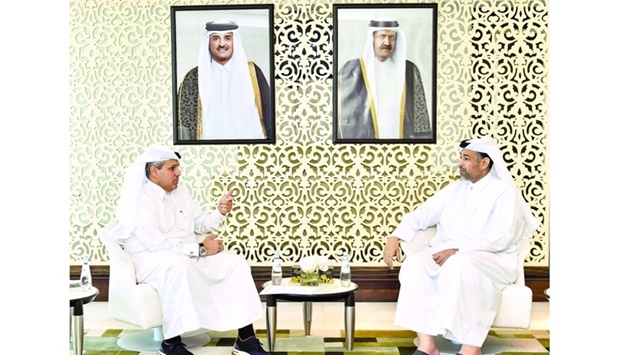
HE the Minister has answered questions on a wide range of topics including:
When will the overlapping of interests between the Ministries of Environment and the Municipality be resolved?
How will the ministry deal with "dust"...and what will be the fate of the crushers? (operating in stone quarries)
What about extending camping throughout the year and reducing fees?
How far have Qatar's efforts gone to confront climate change?
When will the series of trespassing on land end?
What is the future plan for waste and wastewater recycling?
Is the current environmental law sufficient to deter violators?
What have the air and sea water quality monitoring stations achieved?
When will nature reserves open their doors to the public?
Has the ministry succeeded in raising awareness of environmental risks?

Excerpts from the interview:
HE Sheikh Dr Faleh bin Nasser bin Ahmed al-Thani, Minister of Environment and Climate Change, has affirmed that the creation of the Ministry of Environment and Climate Change represents a strategic step, confirming the continuous interest and unlimited support that His Highness the Amir Sheikh Tamim bin Hamad al-Thani, gives to the cause of the environment and climate, and gives impetus to the efforts made by the State to address the phenomenon of climate change.
| The ministry is currently working to develop the organisational structure of the ministry and the creation of specialised departments that will have a fundamental role in the success of sustainable development projects. They will achieve the ministry’s goals in preserving the environment, promoting green growth, and limiting the phenomenon of climate change. New departments to be added to the ministry, including the sector of nature reserves and protection of wildlife There is also another proposal to establish a sector for climate change The ministry has completed the draft update of the environmental law. |
This is in addition to completing other sectoral strategies that the Ministry is working to implement, such as the National Biodiversity Strategy (2015-2025), and the programmes proposed in the National Action Plan to Combat Desertification (2015-2024).It will also implement programmes to reduce greenhouse gas emissions and improve air quality to reduce global warming and climate change problems.
To protect the ozone layer, restore the abundance of biodiversity, protect wildlife and marine life, combat the deterioration resulting from various activities, combat desertification, and enhance Qatar's role in international agreements related to the environment and climate change.
HE the minister said that the current situation of the ministry requires adding new sectors, including the sector of nature reserves and protection of wildlife.
Despite the existence of a department for the protection of wildlife within the current structure, its efforts were focused on protecting the existing wildlife only.
There are no special projects to multiply, develop, and diversify them.
He added that among the proposals is the separation of marine control from land control and the establishment of an independent administration for each of them.
There is also another proposal to establish a sector for climate change with the aim to achieve sustainable development that does not negatively affect the environment, such as maintaining the sustainability of energy and water and other sources.
To sustain natural resources, whether through the use of electric cars or reducing reliance on materials that need to be recycled, and we are thinking of giving incentives to encourage community members to do so through the legislation that is being prepared.
He revealed that the ministry has completed the draft update of the environmental law and its implementing regulations.
It is in the process of being reviewed and audited by the competent authorities.
Regarding the project to monitor some nature reserves with cameras to monitor violations, he said that there is a plan to install security surveillance cameras in some fenced nature reserves to protect them from encroachments and preserve the animals.
To test them and to ensure their tolerance to external conditions and their efficiency in monitoring, and if the experiment is successful, the implementation of the other phases of the project will be started and the cameras will be installed in the targeted reserves.
The ministry looks forward to applying the best practices and modern technologies to raise the efficiency of control and inspection and reduce abuses on the environment.
In this regard, the environmental monitoring patrols, which are deployed in various regions of the country, work around the clock to protect the country's meadows, reserves and coasts from any environmental encroachments or abuses.
I call on all citizens and residents to cooperate with it by reporting any environmental violation, by calling the call center on 184.
With regard to infrastructure projects, industrial projects and major projects, the competent departments of the Ministry set the environmental requirements for each project.
The specialised inspectors, monitor the implementation of these requirements during the project construction stages, in addition to monitoring the project after its start and operation.
The Ministry is implementing a project to install and operate a laboratory information management system.
What is the purpose of this project?
The Laboratory Information Management System is one of the tools that raise the level of performance in environmental laboratories according to international standards.
It is a type of programme designed to improve laboratory productivity and efficiency.
By documenting data and laboratory analysis results in a database.
This contributes to tracking and analyzing data related to samples and experiments, and the progress of laboratory operations and tools.
The materials used in it to ensure the achievement of quality control and assurance (QC/QA).Thus, the entire laboratory operations can be effectively managed, starting from receiving samples Question: In many cases, fish deaths occur in some areas of the sea, including Khor al-Adeed.
What is your explanation for this phenomenon, what is its extent, and can it be avoided?
The phenomenon of fish deaths may occur as a result of one of the recurring natural phenomena in the Arabian Gulf, such as the phenomenon of red tides resulting from an increase in nutrients and phytoplankton in the marine environment.
The amount of fish deaths depends on the spatial-temporal size of the phenomenon.
Noting that there is continuous coordination between the Gulf countries in monitoring and tracking the course of this phenomenon.
The Ministry of Environment and Climate Change periodically collects samples of marine water for analysis and monitoring of concentrations of nutrients and phytoplankton.
In addition to monitoring the ratios of organic and inorganic chemical variables.
Regarding camping, he said that the ministry works annually to develop and facilitate the camping season in terms of procedures and registration.
We look forward during the next season to add services to meet the camps’ needs, which will be announced in due course.
With regard to making camping throughout the year, he said that this is difficult to achieve, and there is a committee in charge with the camping season that manages everything related to it and decides whether to extend it or not.
Regarding camping fees, he said that they are normal and are not overpriced when compared to the charges borne by the state in order to provide many services to the camps.
Regarding complaints about dust and the disturbance of crushers in some areas, he confirmed that there is a plan to establish 4 logistic areas that host activities related to the recycling of construction waste, gravel, excavation products, sand, etc.
In response to a question about the high prices of washed and ordinary sand despite its availability in large quantities in Sealine and al-Naqian, he said sand is the cheapest commodity in Qatar, where the price per cubic meter is only QR4, and the price of a full load may not exceed 100 riyals.
Its cheap price make some companies use it in other areas such as landfill, for example, and therefore we intend during the coming period, in cooperation with the Ministry of Municipality, to reconsider the issue of sand, either by raising its price or setting specific procedures for its uses.
With regard to the overlapping competencies of the Ministries of Municipality and Environment, he said so far there are common matters between the two ministries, and work is underway in coordination with the Ministry of Municipality to complete the separation process in a way that achieves the interests of both parties and ensures the workflow.
Specialized committees have been formed from both ministries to oversee the separation process.
The committees have gone a long way in the separation process, and it is expected to be completed in the near future.
Regarding the air quality monitoring stations in the World Cup stadiums, he stressed that they are part of the expansion of the air quality monitoring network in the country.
The ministry has contracted with a specialized company to equip, install, and operate these stations before the start of the 2022 World Cup matches.
They will include 8 major stadiums and training grounds, through cooperation with the Supreme Committee for Delivery and Legacy in selecting and preparing the station sites according to the highest international standards.
The operation of the first air quality monitoring station near the training grounds at Qatar University has been completed.
It is equipped with the best international technologies and has been linked to the national air quality monitoring network in the country.
The installation of a station at Al Janoub Stadium was also completed.
It is now being activated in preparation for its operation and linking it to the national air quality monitoring network.
Work is currently underway to install another station at Al Thumama Stadium.
His Excellency the minister concluded by answering a question on greenhouse gases and said: “The State of Qatar is aware of the urgent need to address this phenomenon and reduce the emissions of greenhouse gases, or what is known as the greenhouse gases.
Last year was a starting basis for advancing the course of Qatar in dealing with this issue.
As the National Strategy for Environment and Climate Change was launched, which was developed around the axis of reducing greenhouse gas emissions within the five priority areas of the strategy, in addition to our submission of Qatar's nationally determined contributions plan to the United Nations Framework Convention on Climate Change, which reflects the level of ambition that Qatar plans to achieve in addressing the phenomenon of climate change, besides the country's declaration of its commitment to reduce carbon emissions in the country by 25% by 2030, to make Qatar a pioneer in this field.”