


The US Treasury trimmed its quarterly sale of long-term debt for a second straight time, reflecting diminishing borrowing needs after a record ramp-up in debt to fund pandemic-relief spending.
The Treasury Department said in a statement that it will sell $110bn of long-term securities at auctions next week – down $10bn from November and in line with many dealers’ forecasts. It’s the first back-to-back reduction since 2015, after the unprecedented sizes of last year.
Decisions for future refundings may be more challenging, with the Federal Reserve signalling it will be reducing its holdings of Treasuries – forcing the department to sell more debt to the public. Fed Chair Jerome Powell said last month decisions on the bond portfolio are pending in upcoming policy meetings.
While the Treasury didn’t rule out further reductions in debt sales, its panel of outside advisers cautioned that the Fed’s plans may prevent additional cuts. The Treasury Borrowing Advisory Committee, or TBAC – comprising dealers, investors and other stakeholders – said the Fed’s bond-portfolio runoff could create about $1.6tn in additional new financing needs for the Treasury over the next three years.
“The scenarios that seem most appealing,” would “slow or stop” the cutback in debt issuance, TBAC said on Wednesday in a report. The Treasury said in its statement that “additional reductions may be necessary depending on developments in projected borrowing needs going forward.”
For the coming quarter, the deepest cutbacks will be for seven-year notes and 20-year bonds, while issuance of inflation-linked debt, known as TIPS, will see a slight uptick.
That’s “given Treasury’s desire to stabilise the share of TIPS as a percent of total marketable debt outstanding,” the statement said.
Next week’s quarterly refunding auctions break down as follows:
* $50bn of three-year notes on February 8, versus $52bn in January and $56bn in November
* $37bn of 10-year notes on February 9, compared with $39bn last quarter
* $23bn of 30-year bonds on February 10, versus $25bn in November
* The refunding will raise $55.2bn in new cash
Following the release, the 20-year bond outperformed relative to other maturities, as some dealers had predicted the Treasury would make smaller cuts to that benchmark than it ended up doing.
The Treasury also announced the following reductions in issuance plans:
* Reduce sales of 2-, 3-year and 5-year note auctions by $2bn per month over the next three months
* Cut 7-year notes by $3bn per month over the next three months
* Decrease both the new and reopened 20-year bond auction sizes by $4bn, starting in February
* Reduce both the new and reopened 10-year note auction sizes by $2bn, starting in February
* Reduce both the new and reopened 30-year bond auction sizes by $2bn, starting in February
Cut reopening sizes of floating rate note sales in February and March by $2bn each, with the same reduction for the next new-issue two-year FRN in April.
The Treasury’s trimming issuance of all of its nominal coupon-bearing securities – those that pay interest – by a total of $111bn during the quarter through April versus the previous three months.
TBAC, in response to questions posed by Treasury, said “ongoing fiscal uncertainty” and the Fed’s debt roll-off will combine to create a range of potential financing outcomes going forward.
The Treasury is used to dealing with a range of uncertainties when it makes issuance plans, and what happens at the May refunding will depend on developments between now and then, a senior Treasury official told reporters on Wednesday. The Fed’s balance-sheet plans, which may not be clear yet in May, would be just one of them, the official said.
“It is still too early in the process of refining Fed balance-sheet estimates for any formal plan from the issuance side, but as the Fed’s endeavours to run down SOMA become clearer, larger borrowing will follow intuitively to make up for any funding shortfall,” BMO Capital Markets strategist Ben Jeffery wrote in a note, using an acronym for the Fed’s bond holdings.
The Treasury’s new plans released Wednesday follow an increase in its estimate of federal borrowing needs for the three months through March – though that was due to a smaller cash pile at the start of the quarter than it previously estimated.
With regard to plans for bill issuance, the department said it’s “actively evaluating whether to change the 17-week” cash management bill to benchmark status, with an announcement to come at an upcoming refunding. TBAC has several times in the past advised that bills should amount to about a 15% to 20% range of the total debt pile is ideal.
As for Treasury Inflation-Protected Securities, which compensate for increases in consumer prices, issuance plans are as follows:
* 30-year TIPS new issue size maintained at $9bn for February
* 10-year TIPS reopening size maintained at $14bn in March
* 5-year TIPS new issue size boosted by $1bn for April, to $20bn.
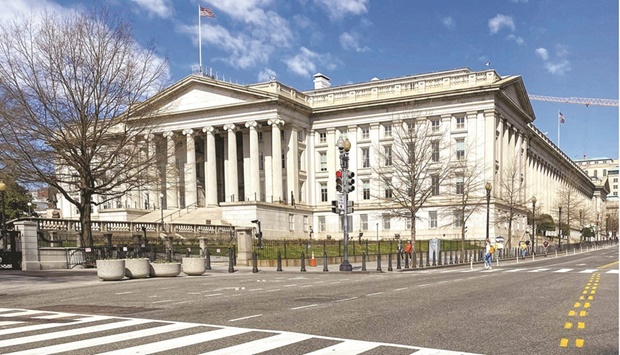
The US Treasury Department building in Washington, DC. The US Treasury trimmed its quarterly sale of long-term debt for a second straight time, reflecting diminishing borrowing needs after a record ramp-up in debt to fund pandemic-relief spending.