


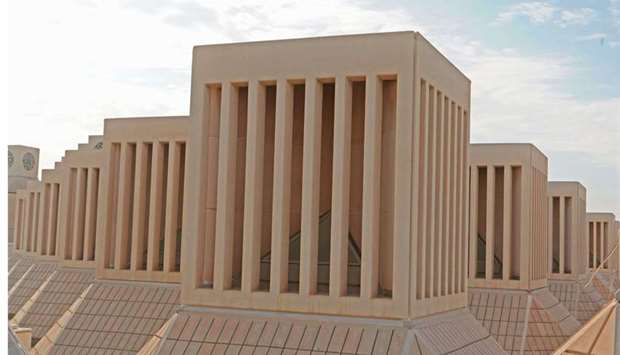
Qatar University (QU) has stressed that its digital hub project acts as a gateway to archives for scientific and intellectual outputs.
QU had initiated a project in 2014 to archive all research, faculty and student contributions, scientific publications, and research seminars as electronic content, preserving and storing them in a digital repository for public access through the university's website. The institutional repository (IR) is maintained by Qatar University Library that captures, provides access and ensures long-term preservation of all collection items.
Aisha al-Abdulla, section head of the Digital Repository and Archives at QU Library, said: “ The need to disseminate and access freely the institutions’ academic achievements and research activities, especially their peer-reviewed academic articles, has encouraged experimentation with IRs. Qatar University Library plays an effective and important role in using information services and supporting electronic archiving trends.
"The digital repository plays a crucial role in highlighting the academic achievements of the QU institution. Moreover, it is committed to providing long-term, reliable access to and sustainable storage of scholarly resources. Its goal is to increase the visibility of Qatar University's academic achievements and scientific research on a local and global scale. It emphasises QU's global and regional rankings, as well as its contribution growth.
“The digital repository's objective is to provide a reliable access to scholarly content. Qatar University's digital repository's aim is to collect and archive scientific and academic content, make it accessible and ensure its quality."
Mohamed Zalat, Digital Services specialist at QU Library, said: “Digital content published by faculty members and researchers is deposited at the university IR, as these submitted works represent their period of joining Qatar University. This is in addition to granting the university a non-exclusive distribution licence to preserve and make their work available worldwide. The digital repository accepts all kinds of digital content such as articles, manuscripts, working papers, technical reports or conference papers, data, books, images, video and audio files, and educational materials.”
Haneen Khader, Digital Services Specialist at QU Library, said: “The number of research papers in the digital repository, noting that the collections that contain academic contributions contain more than 14,000 records, divided into 7,797 academic articles, 2,244 records produced by researchers in Qatar University research centres, and 963 records of theses and dissertations generated by Qatar University graduate students, as well as 3,965 records published by Qatar University.
“The research and academic records in the special collections, on the other hand, have 1,163 records, which are distributed among the Covid-19 database, which has 244 entries, the Qatar blockade, which has 894 records, and the 2022 World Cup collection, which is a
new collection with 25 academic records.”
Noora Alwared, Distinctive Collection Metadata specialist at Qatar University Library, spoke about the significance of the archival documents project, which includes a number of multi-source historical documents organised into three sections: historical documents from the Ottoman archives, historical documents from the Russian archives, and additional historical documents from the Indian archives.
These archival records are valuable as they include documents and letters linked to the history of the Arabian Gulf, allowing scholars to use them in their scientific research to analyse the region's history from a variety of perspectives.
Sara Alyafei, Planning and Co-ordination specialist at QU Library, said: “The Qatar University electronic archive project was launched in June 2021 as part of the library's plan to document the history and development of Qatar University from 1978 to the present day.
“The initiative was inspired by the relevance of historical eras that the university has lived through, as well as the enormous amount of materials dealing with these eras that are currently unavailable in one location. The purpose of this initiative is to archive, preserve and make available the university's historical documents to all researchers and university affiliations, who will have free access to these resources through the framework of Qatar University's digital hub.”
Al-Yafei also emphasised that as part of QU’s belief in the pioneering role of research, the platform has been updated to include all digital sources: articles, university publications and achievements, graduation ceremonies, newsletters, photographs and video recordings.
Aisha al-Abdulla, section head of the Digital Repository and Archives at QU Library, said: “ The need to disseminate and access freely the institutions’ academic achievements and research activities, especially their peer-reviewed academic articles, has encouraged experimentation with IRs. Qatar University Library plays an effective and important role in using information services and supporting electronic archiving trends.
"The digital repository plays a crucial role in highlighting the academic achievements of the QU institution. Moreover, it is committed to providing long-term, reliable access to and sustainable storage of scholarly resources. Its goal is to increase the visibility of Qatar University's academic achievements and scientific research on a local and global scale. It emphasises QU's global and regional rankings, as well as its contribution growth.
“The digital repository's objective is to provide a reliable access to scholarly content. Qatar University's digital repository's aim is to collect and archive scientific and academic content, make it accessible and ensure its quality."
Mohamed Zalat, Digital Services specialist at QU Library, said: “Digital content published by faculty members and researchers is deposited at the university IR, as these submitted works represent their period of joining Qatar University. This is in addition to granting the university a non-exclusive distribution licence to preserve and make their work available worldwide. The digital repository accepts all kinds of digital content such as articles, manuscripts, working papers, technical reports or conference papers, data, books, images, video and audio files, and educational materials.”
Haneen Khader, Digital Services Specialist at QU Library, said: “The number of research papers in the digital repository, noting that the collections that contain academic contributions contain more than 14,000 records, divided into 7,797 academic articles, 2,244 records produced by researchers in Qatar University research centres, and 963 records of theses and dissertations generated by Qatar University graduate students, as well as 3,965 records published by Qatar University.
“The research and academic records in the special collections, on the other hand, have 1,163 records, which are distributed among the Covid-19 database, which has 244 entries, the Qatar blockade, which has 894 records, and the 2022 World Cup collection, which is a
new collection with 25 academic records.”
Noora Alwared, Distinctive Collection Metadata specialist at Qatar University Library, spoke about the significance of the archival documents project, which includes a number of multi-source historical documents organised into three sections: historical documents from the Ottoman archives, historical documents from the Russian archives, and additional historical documents from the Indian archives.
These archival records are valuable as they include documents and letters linked to the history of the Arabian Gulf, allowing scholars to use them in their scientific research to analyse the region's history from a variety of perspectives.
Sara Alyafei, Planning and Co-ordination specialist at QU Library, said: “The Qatar University electronic archive project was launched in June 2021 as part of the library's plan to document the history and development of Qatar University from 1978 to the present day.
“The initiative was inspired by the relevance of historical eras that the university has lived through, as well as the enormous amount of materials dealing with these eras that are currently unavailable in one location. The purpose of this initiative is to archive, preserve and make available the university's historical documents to all researchers and university affiliations, who will have free access to these resources through the framework of Qatar University's digital hub.”
Al-Yafei also emphasised that as part of QU’s belief in the pioneering role of research, the platform has been updated to include all digital sources: articles, university publications and achievements, graduation ceremonies, newsletters, photographs and video recordings.