


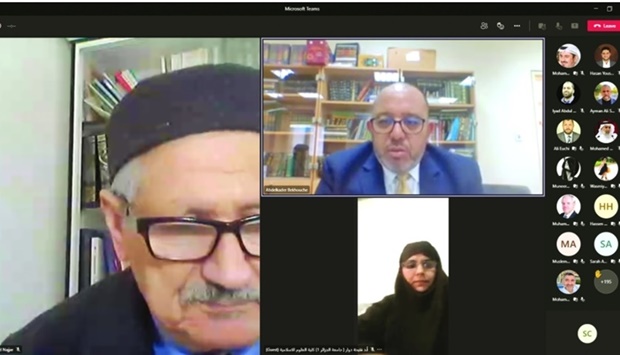
The College of Sharia and Islamic Studies at Qatar University (QU), in collaboration with Qatar National Commission for Education, Culture and Science, organised an international forum titled 'Islamic Culture as a University: Contemporary Challenges and Prospects of Development'.
The forum saw the participation of leading academic speakers from various Arab and Islamic universities.
The forum consisted of three sessions, each of which addressed a specific topic. The first session focused on the place of the Islamic Culture course in Islamic colleges and universities, the second on the cultural challenges that the course encounters, as well as its decisions and teaching techniques, while the third and last session was devoted to applied and practical discussions about the course. The expert speakers shared their practical experiences in teaching the course of Islamic Culture.
The forum opened with an opening address by Dr Hassan bin Rashid al-Derham, president of QU. He spoke about the importance of the forum and how it reflects the continuous efforts of the College of Sharia to improve and develop courses and equip them with the most recent and effective learning approaches.
He also stressed that the Islamic Culture course continues to be of immense benefit for educating both students and scholars about the
religion of Islam, its breadth, deep conceptions, as well as the nation's shared concerns and some of the most effective ways of undertaking them.
In his speech, Dr Ibrahim al-Ansari, dean of the College of Sharia and Islamic Studies, confirmed that the organisation of the forum was a testimony to the college’s commitment to collaborate and share experiences with stakeholders worldwide.
In his paper, Dr Mohamed al-Musleh, associate dean for Academic Affairs, declared that by organising the forum, the College of Sharia intends to meet three objectives. The first is to bring together those who work in the field of Islamic Culture, as educators or researchers, to reflect and discuss the different ways in which the course may be advanced so that it responds to contemporary issues. The second is that QU and other universities exchange thoughts, experiences and practices about developing the Islamic Culture course. The third and last objective is to urge institutional and individual efforts at the university to advance the course.
The paper of Dr Adnan Mohamed Zarzour, a former professor of Islamic Culture at QU and a number of other universities, addressed the question of Islamic culture in universities as a contemporary challenge. He was followed by Prof Dr Abdul Majeed al-Najjar, professor of Islamic Culture at the American University in Cairo, while Dr Fatiha Dawar from the University of Algiers spoke on the vision of thinker Mohamed al-Mubarak for the course of Islamic Culture at universities.
The forum is a step of many to come toward advancing the course of Islamic Culture as outlined by key specialist organisations, such as the Association of Arab Universities, the Association of Islamic Universities, and the Organisation for Islamic Education and Learning.
The forum was organised on the occasion of a larger cultural event, the 'Doha, Capital of Culture in the Islamic World 2021' initiative.
The forum consisted of three sessions, each of which addressed a specific topic. The first session focused on the place of the Islamic Culture course in Islamic colleges and universities, the second on the cultural challenges that the course encounters, as well as its decisions and teaching techniques, while the third and last session was devoted to applied and practical discussions about the course. The expert speakers shared their practical experiences in teaching the course of Islamic Culture.
The forum opened with an opening address by Dr Hassan bin Rashid al-Derham, president of QU. He spoke about the importance of the forum and how it reflects the continuous efforts of the College of Sharia to improve and develop courses and equip them with the most recent and effective learning approaches.
He also stressed that the Islamic Culture course continues to be of immense benefit for educating both students and scholars about the
religion of Islam, its breadth, deep conceptions, as well as the nation's shared concerns and some of the most effective ways of undertaking them.
In his speech, Dr Ibrahim al-Ansari, dean of the College of Sharia and Islamic Studies, confirmed that the organisation of the forum was a testimony to the college’s commitment to collaborate and share experiences with stakeholders worldwide.
In his paper, Dr Mohamed al-Musleh, associate dean for Academic Affairs, declared that by organising the forum, the College of Sharia intends to meet three objectives. The first is to bring together those who work in the field of Islamic Culture, as educators or researchers, to reflect and discuss the different ways in which the course may be advanced so that it responds to contemporary issues. The second is that QU and other universities exchange thoughts, experiences and practices about developing the Islamic Culture course. The third and last objective is to urge institutional and individual efforts at the university to advance the course.
The paper of Dr Adnan Mohamed Zarzour, a former professor of Islamic Culture at QU and a number of other universities, addressed the question of Islamic culture in universities as a contemporary challenge. He was followed by Prof Dr Abdul Majeed al-Najjar, professor of Islamic Culture at the American University in Cairo, while Dr Fatiha Dawar from the University of Algiers spoke on the vision of thinker Mohamed al-Mubarak for the course of Islamic Culture at universities.
The forum is a step of many to come toward advancing the course of Islamic Culture as outlined by key specialist organisations, such as the Association of Arab Universities, the Association of Islamic Universities, and the Organisation for Islamic Education and Learning.
The forum was organised on the occasion of a larger cultural event, the 'Doha, Capital of Culture in the Islamic World 2021' initiative.