


Serbia’s 77th-ranked Miomir Kecmanovic emerged as a big winner from the Novak Djokovic saga — and capitalised on his good fortune by reaching the fourth round at the Australian Open on Friday. Kecmanovic was drawn to play compatriot and world number one Djokovic in the first round, but after the defending champion was deported, found himself instead facing lucky loser Salvatore Caruso. He easily beat the Italian, and has been winning ever since.
Kecmanovic knocked out another Italian, 25th seed Lorenzo Sonego, 6-4, 6-7 (8/10), 6-2, 7-5 to win through to the round of 16 for the first time and will face French 17th seed Gael Monfils. Kecmanovic’s lucky break in Melbourne has already netted him $A300,000 (US$215,000) in prize money and 180 ranking points. “It’s unbelievable. A week ago I was supposed to play the world number one and didn’t have much of a chance there, but now I’m in the last 16,” the 22-year-old Kecmanovic said. “I’m so happy that I was able to use this second chance and that I’ve been playing some really good tennis. I just wanted to use it the best that I can.”
Kecmanovic said he had not been in contact with compatriot Djokovic, who is back in Serbia after his deportation over his anti-vaccination status. “I think he’s still recovering from everything and I didn’t really want to bother him. Give him his space. I’ll definitely talk to him eventually after things calm down,” he said.
Djokovic’s coach calls
Australian Open saga ‘unjust’
Novak Djokovic’s long-time coach Marian Vajda said Australia’s deportation of the world number one was “unjust” but said the Serb had not had his “last word in tennis”.
“It was a political process,” the Slovak coach said in his first comments since Djokovic’s visa was cancelled ahead of the Australian Open over his Covid-19 vaccination status. “It was an unhealthy and unjust decision and it will definitely have significant consequences, as it was also an invasion of his privacy, his family,” Vajda said in the interview published Thursday.
Djokovic flew out of Melbourne last Sunday after he failed in a last-gasp court bid to stay and play in the opening Grand Slam tournament of the year, where he was targeting a record 21st major title. His dramatic departure followed a protracted, high-stakes legal battle between the player and Australian authorities that cast a shadow over the tournament.
Vajda said he was “shocked” by the decision to deport Djokovic. Djokovic’s refusal to be vaccinated could compromise his participation at the year’s three other Grand Slams, with question marks over his future plans. “It is clear that the whole situation hit him mentally,” said Vajda. “It will hurt him for a long time and it will be difficult to get it out of his head.”
He insisted Djokovic would survive the setback. “Novak is strong, steadfast and has not yet said his last word in tennis,”
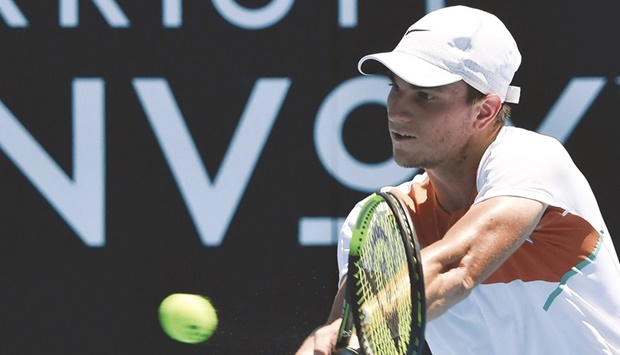
Serbia’s Miomir Kecmanovic plays a backhand during his third round match against Italy’s Lorenzo Sonego at Australian Open in Melbourne yesterday. (AFP)