


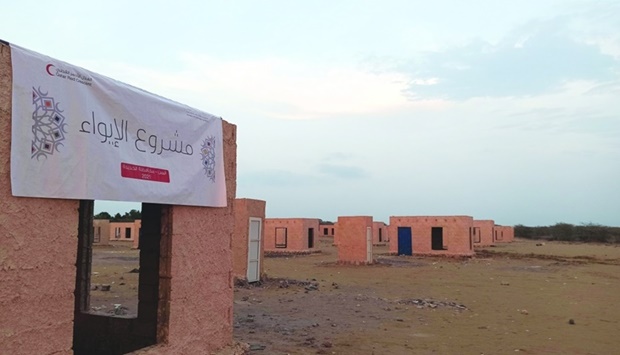
Qatar Red Crescent Society (QRCS) has launched a shelter project in the Al-Hudaydah and Raymah Governorates of Yemen to provide adequate and safe shelter for 280 displaced, returnees, and most vulnerable families over three months at a total cost of $436,500.
The targeted areas were selected in co-ordination with the municipalities, the Executive Unit for Internally Displaced Persons, and community committees. The new homes are designed to suit the local environment in each community.
Currently, 211 new shelters with bathrooms are being constructed and 69 damaged homes were restored in the two governorates.
In a statement, project supervisor engineer Abdulbasit Mohamed said: “We have two models of construction. The first one is for mountainous areas, with a solid water-proof stone foundation, stone slabs, brick walls, wood roofs with concrete angles, iron gate door, and aluminum bathroom door. The windows will be installed by the beneficiaries, to choose the materials best suiting the weather.
“The second model of construction is good for coastal areas. It differs from the first model in that its roof is made of iron structures covered by tarpaulin and straw to ensure mild temperature inside. To be contributed by the beneficiaries, the windows will be made of mud to control the temperature depending on the weather conditions”.
Zakaria Daoud, a beneficiary of the project Takarir (a village of Al-Jabin District, Raymah), talked about his needs and other locals, saying: “The heavy rainfall destroyed our homes, rainwater leaked inside, and we became homeless. Now, we have these homes built for us by QRCS. The best of thanks to Allah and that organisation for their care and support. I hope there will be more support”.
Even though humanitarian organisations are doing a lot of work, numerous IDPs, returnees, and affected people in Yemen still live in harsh conditions, lacking almost everything that would help them to survive, QRCS noted.
This project comes as one of the most important development projects funded and implemented by QRCS since 2017 to alleviate the shelter problem in the areas worst hit by the war.
The targeted areas were selected in co-ordination with the municipalities, the Executive Unit for Internally Displaced Persons, and community committees. The new homes are designed to suit the local environment in each community.
Currently, 211 new shelters with bathrooms are being constructed and 69 damaged homes were restored in the two governorates.
In a statement, project supervisor engineer Abdulbasit Mohamed said: “We have two models of construction. The first one is for mountainous areas, with a solid water-proof stone foundation, stone slabs, brick walls, wood roofs with concrete angles, iron gate door, and aluminum bathroom door. The windows will be installed by the beneficiaries, to choose the materials best suiting the weather.
“The second model of construction is good for coastal areas. It differs from the first model in that its roof is made of iron structures covered by tarpaulin and straw to ensure mild temperature inside. To be contributed by the beneficiaries, the windows will be made of mud to control the temperature depending on the weather conditions”.
Zakaria Daoud, a beneficiary of the project Takarir (a village of Al-Jabin District, Raymah), talked about his needs and other locals, saying: “The heavy rainfall destroyed our homes, rainwater leaked inside, and we became homeless. Now, we have these homes built for us by QRCS. The best of thanks to Allah and that organisation for their care and support. I hope there will be more support”.
Even though humanitarian organisations are doing a lot of work, numerous IDPs, returnees, and affected people in Yemen still live in harsh conditions, lacking almost everything that would help them to survive, QRCS noted.
This project comes as one of the most important development projects funded and implemented by QRCS since 2017 to alleviate the shelter problem in the areas worst hit by the war.