


Chileans yesterday cast their votes for far-right and leftist candidates for a president to lead the country through a period of constitutional change amid a clamour for social reform.
The country of 19mn people is on edge, fearing renewed mass protests in response to the outcome of the neck-and-neck race between ultra-conservative lawyer Jose Antonio Kast, 55, and former student activist Gabriel Boric, a millennial 20 years Kast’s junior.
For a country that has voted centrist since the democratic ousting of dictator Augusto Pinochet 31 years ago, there is a stark choice between two political outsiders, one promising a “social welfare” state, the other a continuation of Chile’s neo-liberal economic model.
Many fear the socially and fiscally conservative policies of law-and-order candidate Kast - an apologist for Pinochet, who is also a proponent of cutting taxes and social spending.
Others are put off by Boric’s political alliance with the Communist Party, which many in Chile equate with the failure of Venezuela, from where it hosts many migrants widely blamed for a rise in crime.
Socially liberal Boric, who has taken up the mantle of Chile’s 2019 anti-inequality uprising, has vowed to increase social spending in a country with one of the world’s largest gaps between rich and poor.
Polls opened at 8am (1100GMT) and after casting his ballot, Boric reiterated his plans for “a more humane Chile, a more dignified Chile, a more egalitarian Chile.”
Kast, for his part, emphasised the country needed “justice, order, security.”
Boric pledged to recognise the election’s outcome, unlike Kast who said he might seek a recount if the final margin is under 50,000 votes.
“We have hope, we believe that we will enter another stage in Chile, a stage where we can test the concept of the welfare state,” Boric-backer Sebastian Vera, a 35-year-old history teacher, said on his way to the ballot box.
But if Kast wins, he said, “I am afraid of a setback...to a place where our neo-liberal system will become even tougher than it already is.”
Nataly Hidd, a 32-year-old civil servant, said she was “scared of what can happen to my country” after the vote. “There will be protests, one way or the other.”
Student Nicolas Julio, 21, said he too was scared. “I don’t trust either of the two,” he said, adding he “panicked” over having to decide which candidate was “the lesser evil.”
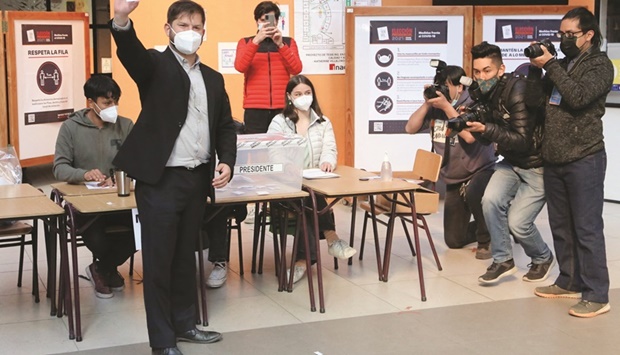
Chile’s presidential candidate Gabriel Boric shows his ballot at a polling station during the presidential election, in Punta Arenas, Chile, yesterday.