


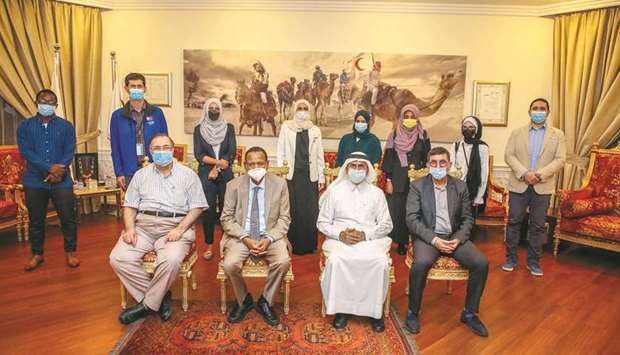
HE the Secretary-General of Qatar Red Crescent Society (QRCS), ambassador Ali bin Hassan al-Hammadi, said that "humanitarian diplomacy" aims to serve the human being, without conditions, and seeks to persuade those concerned to take measures that protect the victims of conflicts and disasters, based on international humanitarian law and relevant international charters, along with traditional diplomacy.
In a lecture to a delegation of the Master of Arts (MA) in Islam and Global Affairs (IGA) students at the College of Islamic Studies (CIS), Hamad bin Khalifa University (HBKU), al-Hammadi delved deeply into the realm of diplomacy and humanitarianism, from the underlying premises to practical outcomes.
Both in theory and in application, he discussed traditional diplomacy versus humanitarian diplomacy, two concepts that have the common cultural ground of advocating human respect, dignity, freedom, and right to a decent and safe life, towards the ultimate goal of serving vulnerable people.
"Traditional/political diplomacy and humanitarian diplomacy are two key, interlinked principles," said al-Hammadi. "Traditional diplomacy is concerned with protecting the country's nationals and helping certain groups under political conditions. It is practised by diplomats designated by their governments with official decisions/decrees. Traditional diplomacy uses the formal media, and its natural place of work is embassies, foreign capitals, international and regional organisations, and diplomat gatherings.
"On the other hand, humanitarian diplomacy seeks to serve humanity without conditions, by persuading others to take actions to protect the victims of conflict and/or disasters. It relies on IHL and relevant international conventions, in addition to traditional diplomacy. Therefore, humanitarian diplomacy can be seen as one tool of soft power, or the ability to achieve your goals by means of motivation and attraction. Humanitarians/charities, NGOs, cultural organisations, and other nonofficial players are all involved".
"In Islam, humanitarianism has a clear, broad, and noble concept derived from the religious perception of the human race as the highest of all species," he explained.
Al-Hammadi presented Qatar's international diplomatic and humanitarian models, its role in helping poor countries respond to Covid-19, and its multifaceted contributions to ending poverty in all its forms as one of the UN Sustainable Development Goals (SDGs).
The lecture shed light on the strategic partnership between QRCS and Qatar Fund for Development (QFFD), working together on numerous relief interventions and development projects around the world.
They also have strategic understandings to develop humanitarian action in Qatar.
The last point in the lecture was the International Red Cross and Red Crescent Movement, which comprises the International Committee of the Red Cross (ICRC) and the International Federation of Red Cross and Red Crescent Societies (IFRC).
"The Movement has a tremendous power, as evident particularly in delivering aid to the most vulnerable people affected by war. It seeks to mobilise resources to meet the challenges of humanitarian action, which has become more competitive than ever before. More than 17mn volunteers and 500,000 employees from 192 countries around the world work under its umbrella, to ensure the fulfillment of humanitarian commitments before, during, and after a disaster, emergency, or conflict. They are both local and international, independent and impartial at the same time. Their slogan is 'Everywhere for Everyone'," al Hammadi said.
In a lecture to a delegation of the Master of Arts (MA) in Islam and Global Affairs (IGA) students at the College of Islamic Studies (CIS), Hamad bin Khalifa University (HBKU), al-Hammadi delved deeply into the realm of diplomacy and humanitarianism, from the underlying premises to practical outcomes.
Both in theory and in application, he discussed traditional diplomacy versus humanitarian diplomacy, two concepts that have the common cultural ground of advocating human respect, dignity, freedom, and right to a decent and safe life, towards the ultimate goal of serving vulnerable people.
"Traditional/political diplomacy and humanitarian diplomacy are two key, interlinked principles," said al-Hammadi. "Traditional diplomacy is concerned with protecting the country's nationals and helping certain groups under political conditions. It is practised by diplomats designated by their governments with official decisions/decrees. Traditional diplomacy uses the formal media, and its natural place of work is embassies, foreign capitals, international and regional organisations, and diplomat gatherings.
"On the other hand, humanitarian diplomacy seeks to serve humanity without conditions, by persuading others to take actions to protect the victims of conflict and/or disasters. It relies on IHL and relevant international conventions, in addition to traditional diplomacy. Therefore, humanitarian diplomacy can be seen as one tool of soft power, or the ability to achieve your goals by means of motivation and attraction. Humanitarians/charities, NGOs, cultural organisations, and other nonofficial players are all involved".
"In Islam, humanitarianism has a clear, broad, and noble concept derived from the religious perception of the human race as the highest of all species," he explained.
Al-Hammadi presented Qatar's international diplomatic and humanitarian models, its role in helping poor countries respond to Covid-19, and its multifaceted contributions to ending poverty in all its forms as one of the UN Sustainable Development Goals (SDGs).
The lecture shed light on the strategic partnership between QRCS and Qatar Fund for Development (QFFD), working together on numerous relief interventions and development projects around the world.
They also have strategic understandings to develop humanitarian action in Qatar.
The last point in the lecture was the International Red Cross and Red Crescent Movement, which comprises the International Committee of the Red Cross (ICRC) and the International Federation of Red Cross and Red Crescent Societies (IFRC).
"The Movement has a tremendous power, as evident particularly in delivering aid to the most vulnerable people affected by war. It seeks to mobilise resources to meet the challenges of humanitarian action, which has become more competitive than ever before. More than 17mn volunteers and 500,000 employees from 192 countries around the world work under its umbrella, to ensure the fulfillment of humanitarian commitments before, during, and after a disaster, emergency, or conflict. They are both local and international, independent and impartial at the same time. Their slogan is 'Everywhere for Everyone'," al Hammadi said.