


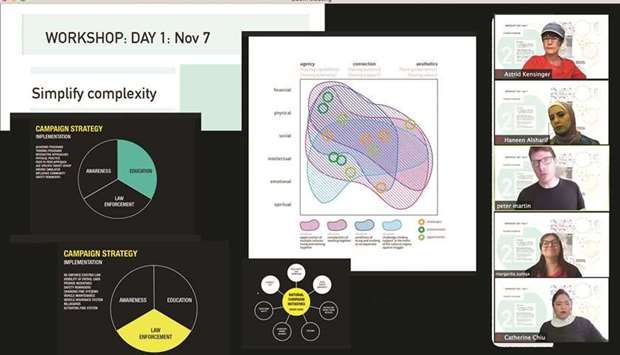
The applications of arts and design go beyond the traditional and the popular areas as exemplified by the recent collaboration between and Virginia Commonwealth University School of the Arts in Qatar (VCUarts Qatar) and the Ministry of Public Health (MoPH).
It started with MoPH approaching VCUarts Qatar with a specific need – to use visual communication to help disseminate the core message of health promotion and illness prevention to the residents of Qatar drawn from over 90 nationalities.
Peter Martin, assistant professor, Graphic Design, and Byrad Yyelland, assistant professor, Liberal Arts and Sciences, held initial discussions with MoPH, and incorporated the initiative into a multiversity course titled ‘Innovation for Wellbeing’ which they co-teach,
According to Martin the success of MoPH work depends on the active and responsive participation of the public. This makes it essential to have an identity built around a narrative that is coherent, relevant, and accessible to the diverse individuals and communities in Qatar.
"To begin revealing the elements and scope of a potential narrative, 12 students from Hamad Bin Khalifa University and VCUarts Qatar collaborated in identifying significant circumstances, attitudes, behaviors, relationships within daily living in Qatar.”
“These students, who were part of the interdisciplinary course developed and facilitated by myself and Byrad, organised themselves into four teams. Using a variety of disciplinary lenses their findings were designed into “situation” mappings that revealed interrelationships and structures of challenges, achievements, and opportunities relevant to areas of public health. These situations were then collated into two potential narratives for the branding and identity of public health in Qatar, which were then used by the Graphic Design visual identity concept development workshop.”
Two Class of 2021 graphic design students, Aisha al-Abdallah and Azza Alawad, then presented their respective pitch to MoPH's Public Health director Dr Sheikh Mohammad bin Hamad al-Thani, as well as VCUarts Qatar’s dean Amir Berbic, and director of strategic engagement, Lejla Niksic. The collaboration led to Alawad, along with another graphic design senior Cut Izza Alyssa, being offered an internship at MoPH’s headquarters.
“There is more to design than branding and aesthetically pleasing visuals; there are design-thinking and strategising elements as well,” Alyssa said.
“For instance, during the internship, we did a considerable amount of research to understand cultural habits prevalent in Qatar; we applied our critical thinking skills to develop varied approaches in disseminating information about Covid-19 precautions, to a multinational population. It was an incredible opportunity to apply what we'd learned in our classes in real-life settings - and to get a ring-side view of the considerable effort that goes into safeguarding the health of a population.”
During the internship, both Alawad and Alyssa benefitted from the departmental rotations and field trips that gave them an understanding of the complexity of modern health care, and how best to use design to build awareness and convey specific messages.
“Our field trips gave us a chance to talk to teams conducting Covid-19 research, and gain insight into the systematic thinking required to be able to communicate effectively; we saw, from a different perspective, how design influences human behavior and change in the real world,” Alawad said.
Peter Martin, assistant professor, Graphic Design, and Byrad Yyelland, assistant professor, Liberal Arts and Sciences, held initial discussions with MoPH, and incorporated the initiative into a multiversity course titled ‘Innovation for Wellbeing’ which they co-teach,
According to Martin the success of MoPH work depends on the active and responsive participation of the public. This makes it essential to have an identity built around a narrative that is coherent, relevant, and accessible to the diverse individuals and communities in Qatar.
"To begin revealing the elements and scope of a potential narrative, 12 students from Hamad Bin Khalifa University and VCUarts Qatar collaborated in identifying significant circumstances, attitudes, behaviors, relationships within daily living in Qatar.”
“These students, who were part of the interdisciplinary course developed and facilitated by myself and Byrad, organised themselves into four teams. Using a variety of disciplinary lenses their findings were designed into “situation” mappings that revealed interrelationships and structures of challenges, achievements, and opportunities relevant to areas of public health. These situations were then collated into two potential narratives for the branding and identity of public health in Qatar, which were then used by the Graphic Design visual identity concept development workshop.”
Two Class of 2021 graphic design students, Aisha al-Abdallah and Azza Alawad, then presented their respective pitch to MoPH's Public Health director Dr Sheikh Mohammad bin Hamad al-Thani, as well as VCUarts Qatar’s dean Amir Berbic, and director of strategic engagement, Lejla Niksic. The collaboration led to Alawad, along with another graphic design senior Cut Izza Alyssa, being offered an internship at MoPH’s headquarters.
“There is more to design than branding and aesthetically pleasing visuals; there are design-thinking and strategising elements as well,” Alyssa said.
“For instance, during the internship, we did a considerable amount of research to understand cultural habits prevalent in Qatar; we applied our critical thinking skills to develop varied approaches in disseminating information about Covid-19 precautions, to a multinational population. It was an incredible opportunity to apply what we'd learned in our classes in real-life settings - and to get a ring-side view of the considerable effort that goes into safeguarding the health of a population.”
During the internship, both Alawad and Alyssa benefitted from the departmental rotations and field trips that gave them an understanding of the complexity of modern health care, and how best to use design to build awareness and convey specific messages.
“Our field trips gave us a chance to talk to teams conducting Covid-19 research, and gain insight into the systematic thinking required to be able to communicate effectively; we saw, from a different perspective, how design influences human behavior and change in the real world,” Alawad said.