


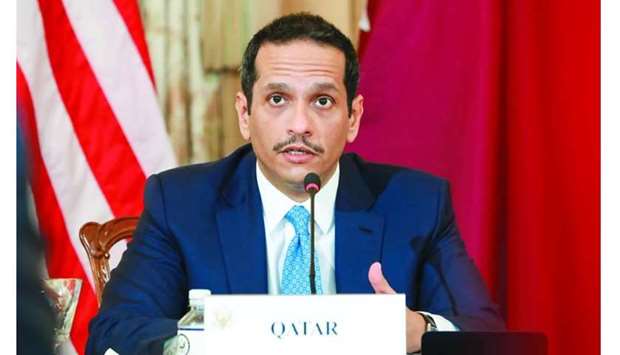
HE the Deputy Prime Minister and Minister of Foreign Affairs Sheikh Mohamed bin Abdulrahman al-Thani has said that Qatar's position on normalisation with the Assad regime is very clear and it is not an option, stressing the need to hold Assad accountable for the war crimes he committed against his people. This came in a joint press conference with US Secretary of State Antony Blinken in Washington on Friday.
HE Sheikh Mohamed said that Qatar also supports the pursuit of a political and a peaceful solution in accordance with UN Security Council Resolution 2254, and it hopes that all states will unite when it comes to Syria, and that states take their own values into account when it comes to their relations with other states. He said that Qatar's position will remain as it is, as Qatar does not see any serious steps taken by Assad regime to repair the damage done to Syria and its people, and as a result, changing Qatar position is not a viable option.
For his part, Blinken said that his country does not support normalisation with the Assad regime. He said that the US is concerned about the signals being sent by UAE officials' visits and interactions with Syria, and urges its partners not to forget the crimes committed by the Assad regime. HE Sheikh Mohamed considered that the region's relationship with Iran depends on a unique set of dynamics, noting that Iran is a neighbouring country and a good relationship with it must be maintained. He underlined that Qatar relationship with Iran is not defined by Qatar alliance with the US or others.
However, Qatar uses this relationship to communicate with Iran and facilitate interaction with its allies. He stressed that Qatar encourages Iran and the US not to escalate and return to the Joint Comprehensive Plan of Action. HE Sheikh Mohamed added that Qatar disagrees with Iran about different policies in the region, but this does not mean that Qatar will not deal with Iran. Qatar is trying to communicate in order to achieve stability in the region. It is neither in Qatar's interest nor in Iran's interest to have instability in the region, and Qatar wants to avoid entering into a nuclear race.
On the possibility of Qatar playing a mediating role in Ethiopia, he expressed Qatar's deep concern over the escalation there, considering that African stability is largely linked to our regional stability, and Qatar hopes to see security and stability in the region. HE Sheikh Mohamed stressed that Qatar usually plays the mediation role after being requested by the two conflicting parties. Ethiopia has not yet asked Qatar, but Qatar is happy to assist in de-escalation efforts. The international community, including the US, has been involved in these efforts, and Qatar would be happy to contribute as well.
HE Sheikh Mohamed said that Qatar also supports the pursuit of a political and a peaceful solution in accordance with UN Security Council Resolution 2254, and it hopes that all states will unite when it comes to Syria, and that states take their own values into account when it comes to their relations with other states. He said that Qatar's position will remain as it is, as Qatar does not see any serious steps taken by Assad regime to repair the damage done to Syria and its people, and as a result, changing Qatar position is not a viable option.
For his part, Blinken said that his country does not support normalisation with the Assad regime. He said that the US is concerned about the signals being sent by UAE officials' visits and interactions with Syria, and urges its partners not to forget the crimes committed by the Assad regime. HE Sheikh Mohamed considered that the region's relationship with Iran depends on a unique set of dynamics, noting that Iran is a neighbouring country and a good relationship with it must be maintained. He underlined that Qatar relationship with Iran is not defined by Qatar alliance with the US or others.
However, Qatar uses this relationship to communicate with Iran and facilitate interaction with its allies. He stressed that Qatar encourages Iran and the US not to escalate and return to the Joint Comprehensive Plan of Action. HE Sheikh Mohamed added that Qatar disagrees with Iran about different policies in the region, but this does not mean that Qatar will not deal with Iran. Qatar is trying to communicate in order to achieve stability in the region. It is neither in Qatar's interest nor in Iran's interest to have instability in the region, and Qatar wants to avoid entering into a nuclear race.
On the possibility of Qatar playing a mediating role in Ethiopia, he expressed Qatar's deep concern over the escalation there, considering that African stability is largely linked to our regional stability, and Qatar hopes to see security and stability in the region. HE Sheikh Mohamed stressed that Qatar usually plays the mediation role after being requested by the two conflicting parties. Ethiopia has not yet asked Qatar, but Qatar is happy to assist in de-escalation efforts. The international community, including the US, has been involved in these efforts, and Qatar would be happy to contribute as well.