


The activities of the 57th Conference of the International Organisation of City and Region Planners (ISOCARP), organised by the Ministry of Municipality from November 8-11 in Doha, continued Tuesday as the organising committee of the conference held field visits and workshops in a number of vital urban sites in the country including Education City, Katara — the Cultural Village Foundation, Aspire Zone, Msheireb and Qatar Railways Company (Qatar Rail).


At Education City
At Katara
A workshop was held at Education City, highlighting its cultural features and characteristics and its distinguished role in community service.
A second workshop was also held at Aspire, where a tour of one of the 2022 World Cup stadiums, Khalifa International Stadium, was organized.
Katara Cultural Village hosted a workshop in which it highlighted Qatar's great efforts towards building cities capable of withstanding the climate change that the world is witnessing. The workshop reviewed Katara — the Cultural Village project and its stages of development.
Another workshop was held at Msheireb, the heart of Doha, in which the participating experts discussed the idea behind the city's design.
A tour was conducted to explore the city and its various sites, and to discuss ways of smart and sustainable urban planning.
A workshop was also organised on the 'Rail' project to discuss working papers in the field of urban planning.
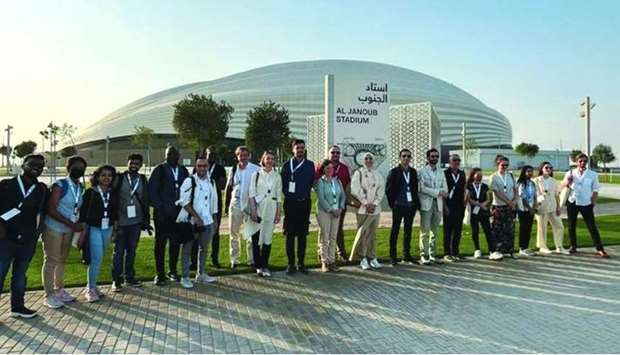
The local committee of the conference organised visits for the participants to Lusail and Al Wakra to get acquainted with its landmarks, the most important of which is Al Janoub Stadium, which is distinguished by its modern design.
The tour concluded with a visit to the Al Wakra Souq, one of the country's timeless heritage landmarks.
The second day of the conference had witnessed a plenary session, during which participants discussed the social responsibility that falls on the shoulders of city and regions planners to ensure safer, inclusive and comfortable living conditions for all.
The environmental conservation team at the conference also discussed its efforts to preserve one of the country's green eco-gems, which is the mangrove forest.
A second workshop was also held at Aspire, where a tour of one of the 2022 World Cup stadiums, Khalifa International Stadium, was organized.
Katara Cultural Village hosted a workshop in which it highlighted Qatar's great efforts towards building cities capable of withstanding the climate change that the world is witnessing. The workshop reviewed Katara — the Cultural Village project and its stages of development.
Another workshop was held at Msheireb, the heart of Doha, in which the participating experts discussed the idea behind the city's design.
A tour was conducted to explore the city and its various sites, and to discuss ways of smart and sustainable urban planning.
A workshop was also organised on the 'Rail' project to discuss working papers in the field of urban planning.
The local committee of the conference organised visits for the participants to Lusail and Al Wakra to get acquainted with its landmarks, the most important of which is Al Janoub Stadium, which is distinguished by its modern design.
The tour concluded with a visit to the Al Wakra Souq, one of the country's timeless heritage landmarks.
The second day of the conference had witnessed a plenary session, during which participants discussed the social responsibility that falls on the shoulders of city and regions planners to ensure safer, inclusive and comfortable living conditions for all.
The environmental conservation team at the conference also discussed its efforts to preserve one of the country's green eco-gems, which is the mangrove forest.