


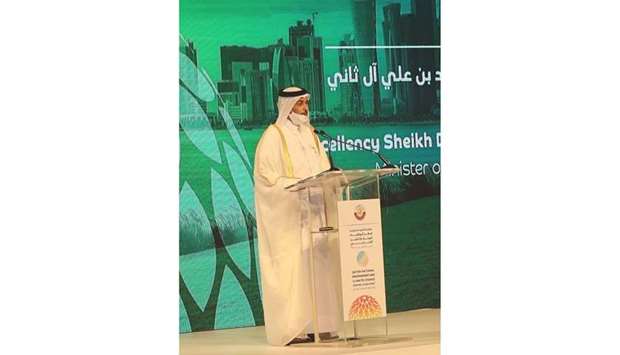
HE the Minister of Environment and Climate Change Sheikh Dr Faleh bin Nasser bin Ahmed bin Ali al-Thani said that launching the Qatar National Environment and Climate Change Strategy marks a new phase in Qatar's efforts in facing climate change. Speaking during the ceremony to mark the launch of the strategy, the minister said that the strategy is one of the main pillars to realise Qatar National Vision 2030, which is in line with the UN Sustainable Development Goals and Qatar's ambition to become one of the region's leading countries in the field. He added that this will be accomplished through the implementation of a number of projects and initiatives that contribute to lower CO2 emissions, and rely on renewable energy sources.
HE al-Thani said that introducing a Ministry of Environment reflected the unlimited support and interest of His Highness the Amir Sheikh Tamim bin Hamad al-Thani to the issue of the environment and climate change. He said that today's celebration comes days after the issuance of Amiri decision no. 57 of 2021 that assigning the jurisdiction of ministries, and included in its eighth article the jurisdiction of the Ministry of Environment and Climate Change in limiting emissions that lead to climate change.
HE al-Thani said that introducing a Ministry of Environment reflected the unlimited support and interest of His Highness the Amir Sheikh Tamim bin Hamad al-Thani to the issue of the environment and climate change. He said that today's celebration comes days after the issuance of Amiri decision no. 57 of 2021 that assigning the jurisdiction of ministries, and included in its eighth article the jurisdiction of the Ministry of Environment and Climate Change in limiting emissions that lead to climate change.

He expressed his thanks to His Highness the Amir for supporting the environment and looking to address the climate change challenge, saying that it placed Qatar in a distinguished place as an active member of the international community on the matter and highlighted the remarks made by the Amir during the Climate Action Summit of pledging $100mn to support small island developing states and least developed countries (LDCs) to address climate change and environmental challenges.
He pointed out that Qatar plays a major role in co-operation with international organisations and bodies concerned with the environment and climate change, as it was one of the first countries to join the United Nations Framework Convention on Climate Change in 1996, the Kyoto Protocol in 2005 and the Paris Agreement in 2016. The minister also noted that Qatar is a member of the International Renewable Energy Agency (IRENA), which supports countries in their transition to a sustainable energy future. Qatar also hosted the 18th Conference of the Parties (COP18) in 2012, which is one of the global climate change negotiations stations that contributed to reaching the Paris Agreement.
"Qatar is preparing for its participation in COP 26, set to take place in Glasgow in November, and signed a Memorandum of Understanding (MoU) with Global Green Growth Institute in the field of adapting with climate change." There are a number of projects being carried out in the environmental field, including the initiative launched in 2019 to plant a million trees, which is halfway complete so far and is set to be concluded before the World Cup 2022. The minister thanked HE the Prime Minister and Minister of Interior on his directives and support of efforts in the field of protecting the environment and climate change.
During the ceremony, Vice-President for Surface Facilities Development at QatarEnergy Ahmed al-Amoodi gave a brief explanation of the strategy, explaining that it constitutes a main pillar of Qatar National Vision 2030 and that this vision was taken as the basis for drawing up the environmental strategy, taking into account the Qatar Development Strategy, which was launched in 2018, and all other existing strategies, including the water strategy and the climate change strategy, so that the Qatar National Environment and Climate Change Strategy will be in an integrated manner.
He explained that the preparation of the strategy was started in February 2021, with the participation of more than 20 concerned government agencies from various ministries, departments, companies, and more than 50 international experts from specialists worldwide, adding that the strategy was implemented in several stages, which included a complete identification process for the environment in Qatar and determine the starting point and the stage of comparisons with a number of countries.
He indicated that after implementing about 400 workshops, 30 countries were selected for comparisons, pointing out that it was decided to implement 89 initiatives, including 40 initiatives that existed before, and 49 new initiatives, all of these initiatives were placed under one environmental strategy, all laws related to the environment in Qatar were also covered to evaluate their effectiveness, noting that the strategy seeks to achieve three goals, the first is the well-being of the Qatari people, the second is economic flexibility, and the third is environmental protection.
Governance system
Al-Amoodi noted that the strategy covers 5 areas: greenhouse gas emissions, air quality, biodiversity, water, circular economy, waste management, and land use, indicating that a governance system has been established to implement the strategy, to reach the specific goals by 2030, including reducing greenhouse gas emissions by 25% by date, as well as the establishment of 30 air quality monitoring stations by 2023, and the increase in the number of reserves concerning biodiversity.
In a statement to Qatar News Agency (QNA), Assistant Undersecretary for Environment Affairs at the Ministry of Environment and Climate Change Eng Hassan Jumaa Bu Jamhour al-Mohannadi noted the participation of 20 representatives from various ministries in preparing the Qatar National Strategy for Environment and Climate Change. He pointed out in this context that studies and standard comparisons were conducted that included about 30 countries, and the assistance of more than 50 experts from the world's specialists, intellectuals and scientists in this regard.
He reviewed the five main pillars of the strategy on greenhouse gas emissions, air quality, biodiversity, water, waste, and land use, and said that about the first pillar on greenhouse gas emissions, for example, international co-operation will be a key factor in reducing emissions, noting that in this context, Qatar has pledged to reduce greenhouse gas emissions by 25% until 2030. Compared to the usual path, he indicated that to achieve this goal, Qatar will adopt low-carbon technologies and solutions based on natural materials, explaining that reducing greenhouse gas emissions will bring many benefits, such as improving the quality of ambient and indoor air, for example.
Al-Mohannadi stressed that this strategy constitutes a starting point for the next leg of "our journey aimed at achieving harmony and balance between the economy, the people and nature", pointing out that when developing the strategy, great attention was paid to establishing a strong governance structure that would constitute a key enabling factor to ensure success in its implementation, explaining that the effective implementation of this strategy would be a model for other countries to follow to steer the ship towards a more sustainable future.
Spreading awareness
He called for continuing to spread awareness about the importance of taking care of the environment and preserving natural reserves, stressing that the strategy constitutes the fulcrum for unifying and expanding efforts to ensure optimal protection of the ecosystem, it is also the cornerstone for managing Qatar's water resources to achieve its sustainability, as well as its contribution to improving waste management practices, which will enable the promotion of the circular economy.
He pointed out that the Qatar Environment and Climate Change Strategy is characterised by being integrated in terms of land use, and it aims to improve agricultural productivity and sustainability in line with the Qatar Food Security Strategy, while the more efficient use of land will improve the quality of life in Qatar by providing public transportation and green spaces.
He explained that the launch of the Qatar Environment and Climate Change Strategy reflects Qatar's great interest in the phenomenon of climate change as one of the most important environmental problems at the national and global levels, because of the risks and challenges it entails, it is necessary to strengthen the global response and coordinate urgent co-operation between the concerned parties.
The Qatar National Environment and Climate Change Strategy and the National Climate Change Action Plan 2030 contribute to achieving a balance between the urgent need to work in the field of climate change and environmental protection, and the need to promote sustainable social and economic development in an economy based mainly on the export of liquefied natural gas and related products.
By signing the Paris Climate Agreement with other world leaders, Qatar pledged to commit to reducing global temperatures by much less than 2C, and to strive to limit global warming to no more than 1.5C. Qatar's efforts, however, are still in their infancy, as the commitment to preserve the environment is an integral part of the constitution of Qatar, and is one of the main pillars defined in Qatar National Vision 2030, and is given a high priority in the first and second national development strategy.
Qatar also recently submitted its second report on nationally determined contributions to the United Nations Framework Convention on Climate Change, in which it pledged to reduce global greenhouse gas emissions by 25% by 2030, compared to business-as-usual rates.
This progress reflects Qatar's clear adherence to its commitments under the Paris Agreement, and is fully consistent with the objectives set out in Qatar National Vision 2030 and other strategies and plans at the national level.
This goal is also one of the most ambitious goals undertaken by any other country in the region, and it is the only goal that is fully supported by approved plans and programs that define the mechanisms that will be implemented to achieve the goal.
The National Action Plan for Climate Change 2030 identifies the programs developed by each sector and the actions expected to be implemented to achieve the desired goals, as the oil and gas sector is the largest contributor to efforts to reduce emissions. However, all other sectors and relevant stakeholders have identified their ambitious contributions to achieve this target.
Qatar is also aware that many of the effects of climate change will continue for many decades to come, and it is difficult to find immediate solutions to them, and that all stakeholders should cooperate in order to reduce its impact on societies, the environment and the economy.
Qatar is currently implementing a new monitoring, reporting and verification system that provides decision makers with the right information at the right time, enabling informed decisions on a range of issues related to climate and the environment.
With regard to the major achievements and initiatives, Qatar has already succeeded in implementing programs and projects aimed at reducing greenhouse gas emissions, improving environmental protection methods, and adapting to the impacts of climate change.
The state will depend to a large extent on the energy sector to drive economic growth and achieve social development. Therefore, it is keen to find the right balance between providing clean energy and making it available at an affordable cost for all, while at the same time committing to being responsible towards the environment and constantly promoting the preservation of natural resources.
QatarEnergy intends to reduce the carbon intensity of LNG facilities by 25% by 2030, and to reach the target of zero emissions from routine flaring in natural gas production, as well as reduce the weighted methane intensity by 0.2% by 2025. Mitigating Greenhouse Gas Emissions from its Operations Qatar Power has invested heavily in advanced technology to increase energy efficiency and reduce emissions from natural gas flaring, and plans to start relying on clean and renewable energy sources in the coming years.
He pointed out that Qatar plays a major role in co-operation with international organisations and bodies concerned with the environment and climate change, as it was one of the first countries to join the United Nations Framework Convention on Climate Change in 1996, the Kyoto Protocol in 2005 and the Paris Agreement in 2016. The minister also noted that Qatar is a member of the International Renewable Energy Agency (IRENA), which supports countries in their transition to a sustainable energy future. Qatar also hosted the 18th Conference of the Parties (COP18) in 2012, which is one of the global climate change negotiations stations that contributed to reaching the Paris Agreement.
"Qatar is preparing for its participation in COP 26, set to take place in Glasgow in November, and signed a Memorandum of Understanding (MoU) with Global Green Growth Institute in the field of adapting with climate change." There are a number of projects being carried out in the environmental field, including the initiative launched in 2019 to plant a million trees, which is halfway complete so far and is set to be concluded before the World Cup 2022. The minister thanked HE the Prime Minister and Minister of Interior on his directives and support of efforts in the field of protecting the environment and climate change.
During the ceremony, Vice-President for Surface Facilities Development at QatarEnergy Ahmed al-Amoodi gave a brief explanation of the strategy, explaining that it constitutes a main pillar of Qatar National Vision 2030 and that this vision was taken as the basis for drawing up the environmental strategy, taking into account the Qatar Development Strategy, which was launched in 2018, and all other existing strategies, including the water strategy and the climate change strategy, so that the Qatar National Environment and Climate Change Strategy will be in an integrated manner.
He explained that the preparation of the strategy was started in February 2021, with the participation of more than 20 concerned government agencies from various ministries, departments, companies, and more than 50 international experts from specialists worldwide, adding that the strategy was implemented in several stages, which included a complete identification process for the environment in Qatar and determine the starting point and the stage of comparisons with a number of countries.
He indicated that after implementing about 400 workshops, 30 countries were selected for comparisons, pointing out that it was decided to implement 89 initiatives, including 40 initiatives that existed before, and 49 new initiatives, all of these initiatives were placed under one environmental strategy, all laws related to the environment in Qatar were also covered to evaluate their effectiveness, noting that the strategy seeks to achieve three goals, the first is the well-being of the Qatari people, the second is economic flexibility, and the third is environmental protection.
Governance system
Al-Amoodi noted that the strategy covers 5 areas: greenhouse gas emissions, air quality, biodiversity, water, circular economy, waste management, and land use, indicating that a governance system has been established to implement the strategy, to reach the specific goals by 2030, including reducing greenhouse gas emissions by 25% by date, as well as the establishment of 30 air quality monitoring stations by 2023, and the increase in the number of reserves concerning biodiversity.
In a statement to Qatar News Agency (QNA), Assistant Undersecretary for Environment Affairs at the Ministry of Environment and Climate Change Eng Hassan Jumaa Bu Jamhour al-Mohannadi noted the participation of 20 representatives from various ministries in preparing the Qatar National Strategy for Environment and Climate Change. He pointed out in this context that studies and standard comparisons were conducted that included about 30 countries, and the assistance of more than 50 experts from the world's specialists, intellectuals and scientists in this regard.
He reviewed the five main pillars of the strategy on greenhouse gas emissions, air quality, biodiversity, water, waste, and land use, and said that about the first pillar on greenhouse gas emissions, for example, international co-operation will be a key factor in reducing emissions, noting that in this context, Qatar has pledged to reduce greenhouse gas emissions by 25% until 2030. Compared to the usual path, he indicated that to achieve this goal, Qatar will adopt low-carbon technologies and solutions based on natural materials, explaining that reducing greenhouse gas emissions will bring many benefits, such as improving the quality of ambient and indoor air, for example.
Al-Mohannadi stressed that this strategy constitutes a starting point for the next leg of "our journey aimed at achieving harmony and balance between the economy, the people and nature", pointing out that when developing the strategy, great attention was paid to establishing a strong governance structure that would constitute a key enabling factor to ensure success in its implementation, explaining that the effective implementation of this strategy would be a model for other countries to follow to steer the ship towards a more sustainable future.
Spreading awareness
He called for continuing to spread awareness about the importance of taking care of the environment and preserving natural reserves, stressing that the strategy constitutes the fulcrum for unifying and expanding efforts to ensure optimal protection of the ecosystem, it is also the cornerstone for managing Qatar's water resources to achieve its sustainability, as well as its contribution to improving waste management practices, which will enable the promotion of the circular economy.
He pointed out that the Qatar Environment and Climate Change Strategy is characterised by being integrated in terms of land use, and it aims to improve agricultural productivity and sustainability in line with the Qatar Food Security Strategy, while the more efficient use of land will improve the quality of life in Qatar by providing public transportation and green spaces.
He explained that the launch of the Qatar Environment and Climate Change Strategy reflects Qatar's great interest in the phenomenon of climate change as one of the most important environmental problems at the national and global levels, because of the risks and challenges it entails, it is necessary to strengthen the global response and coordinate urgent co-operation between the concerned parties.
The Qatar National Environment and Climate Change Strategy and the National Climate Change Action Plan 2030 contribute to achieving a balance between the urgent need to work in the field of climate change and environmental protection, and the need to promote sustainable social and economic development in an economy based mainly on the export of liquefied natural gas and related products.
By signing the Paris Climate Agreement with other world leaders, Qatar pledged to commit to reducing global temperatures by much less than 2C, and to strive to limit global warming to no more than 1.5C. Qatar's efforts, however, are still in their infancy, as the commitment to preserve the environment is an integral part of the constitution of Qatar, and is one of the main pillars defined in Qatar National Vision 2030, and is given a high priority in the first and second national development strategy.
Qatar also recently submitted its second report on nationally determined contributions to the United Nations Framework Convention on Climate Change, in which it pledged to reduce global greenhouse gas emissions by 25% by 2030, compared to business-as-usual rates.
This progress reflects Qatar's clear adherence to its commitments under the Paris Agreement, and is fully consistent with the objectives set out in Qatar National Vision 2030 and other strategies and plans at the national level.
This goal is also one of the most ambitious goals undertaken by any other country in the region, and it is the only goal that is fully supported by approved plans and programs that define the mechanisms that will be implemented to achieve the goal.
The National Action Plan for Climate Change 2030 identifies the programs developed by each sector and the actions expected to be implemented to achieve the desired goals, as the oil and gas sector is the largest contributor to efforts to reduce emissions. However, all other sectors and relevant stakeholders have identified their ambitious contributions to achieve this target.
Qatar is also aware that many of the effects of climate change will continue for many decades to come, and it is difficult to find immediate solutions to them, and that all stakeholders should cooperate in order to reduce its impact on societies, the environment and the economy.
Qatar is currently implementing a new monitoring, reporting and verification system that provides decision makers with the right information at the right time, enabling informed decisions on a range of issues related to climate and the environment.
With regard to the major achievements and initiatives, Qatar has already succeeded in implementing programs and projects aimed at reducing greenhouse gas emissions, improving environmental protection methods, and adapting to the impacts of climate change.
The state will depend to a large extent on the energy sector to drive economic growth and achieve social development. Therefore, it is keen to find the right balance between providing clean energy and making it available at an affordable cost for all, while at the same time committing to being responsible towards the environment and constantly promoting the preservation of natural resources.
QatarEnergy intends to reduce the carbon intensity of LNG facilities by 25% by 2030, and to reach the target of zero emissions from routine flaring in natural gas production, as well as reduce the weighted methane intensity by 0.2% by 2025. Mitigating Greenhouse Gas Emissions from its Operations Qatar Power has invested heavily in advanced technology to increase energy efficiency and reduce emissions from natural gas flaring, and plans to start relying on clean and renewable energy sources in the coming years.