


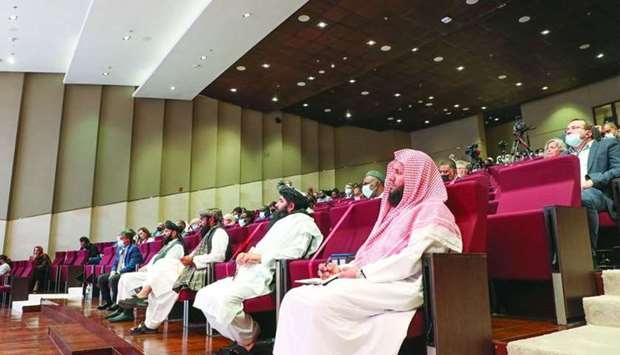
The Center for Conflict and Humanitarian Studies (CHS) at Doha Institute for Graduate Studies hosted a public conversation with Mawlawi Amir Khan Muttaqi, the acting Foreign Minister of Afghanistan on Monday.
CHS founding director Professor Sultan Barakat led the event. A statement said a central pillar of the vision and mission of CHS is to serve as a convening platform to build bridges and facilitate dialogue between all concerned parties in conflict-affected societies.
To this end, the public event brought together a range of academics, diplomats, students, journalists, and other interested individuals, providing an opportunity for the live audience to enter into a dialogue with a senior official in the interim Taliban-led government.
Following a brief introduction to the event, Muttaqi delivered a public address to the live audience, which was simultaneously broadcast on CHS’ social media platforms and by various news agencies. Muttaqi described the US withdrawal which, after 20 years, as a historical achievement rooted in legitimate resistance.
"As a result of this withdrawal and the subsequent ‘fall’ of Kabul with the fleeing of former President Ashraf Ghani, the city faced a power vacuum that laid the potential for rising instability and the emergence of serious security risks. The Taliban were subsequently requested to enter and restore security to Kabul," the speaker said.
Muttaqi drew attention to the Taliban’s positive engagement with the international community in establishing good-neighbourliness and friendly cooperation, which he considered inseparable from the political independence and sovereignty that Afghanistan now enjoys.
Following the talks with US representatives in Doha which culminated in an agreement in 2020, Muttaqi expressed that a new chapter of positivity with the international community based on the cultivation of new relationships is on the horizon.
He then highlighted the advantages that Afghanistan holds with regards to its geographical location, which should be utilised for the benefit of the region and international community. In doing so, an economic revolution in Afghanistan would bring prosperity to a country ravaged by 45 years of war.
Muttaqi stressed that Kabul does not wish to enter into or instigate any conflicts. The Afghans, including the Taliban, have an insatiable appetite for peace. The interim government is not only avoiding conflict to satisfy the international community, but also to prevent further emigration of skilled Afghans, citing its various detrimental effects to Afghanistan.
After the public address, Muttaqi engaged in an extended conversation with Professor Barakat. They discussed topics including the current state of political diversity and inclusivity in government and its future prospects; the inclusion of women as civil servants; the $9bn of frozen assets and collapsing banking system, and its relation to the restoration of peace and security; the rising threat of terrorism, particularly from ISIS, in which security agreements that do not harm Afghan national interests were highlighted; the closure of schools despite girls’ education being an Islamic duty and how this cannot always be an easy task, given the size, various beliefs and tribal diversity of Afghanistan; and lastly, the geographical advantage of Afghanistan and the regional role that Kabul wishes to play.
In a question and answer session with a live audience, questions were raised on topics comprising of: Kabul’s relationship with Iran and its minority community; the adoption of the constitution; how long Afghanistan can continue functioning in light of its financial situation and frozen assets; the Taliban’s positive interactions with the international community and the optimistic signs for international co-operation; the fleeing of Afghans and their safe return; the critical humanitarian and security challenges faced by Afghans and what the Taliban’s long-term economic vision; the Taliban’s policy towards the advancement and protection of Afghan women; and finally, the hold that the narcotics trade has on Afghanistan, and what the Taliban have done and continued to do so to curb this grip. The latter would be beneficial not only to Afghanistan, but to the international community as a whole.
Constructively, the event allowed for dialogue and cross-fertilisation of ideas between a leading Taliban figure and an international audience committed to a peaceful and prosperous Afghanistan. The conversation is available to watch in Pashto on the Twitter page and in English on CHS YouTube page, and will soon be uploaded onto the website alongside a report of the event.
To this end, the public event brought together a range of academics, diplomats, students, journalists, and other interested individuals, providing an opportunity for the live audience to enter into a dialogue with a senior official in the interim Taliban-led government.
Following a brief introduction to the event, Muttaqi delivered a public address to the live audience, which was simultaneously broadcast on CHS’ social media platforms and by various news agencies. Muttaqi described the US withdrawal which, after 20 years, as a historical achievement rooted in legitimate resistance.
"As a result of this withdrawal and the subsequent ‘fall’ of Kabul with the fleeing of former President Ashraf Ghani, the city faced a power vacuum that laid the potential for rising instability and the emergence of serious security risks. The Taliban were subsequently requested to enter and restore security to Kabul," the speaker said.
Muttaqi drew attention to the Taliban’s positive engagement with the international community in establishing good-neighbourliness and friendly cooperation, which he considered inseparable from the political independence and sovereignty that Afghanistan now enjoys.
Following the talks with US representatives in Doha which culminated in an agreement in 2020, Muttaqi expressed that a new chapter of positivity with the international community based on the cultivation of new relationships is on the horizon.
He then highlighted the advantages that Afghanistan holds with regards to its geographical location, which should be utilised for the benefit of the region and international community. In doing so, an economic revolution in Afghanistan would bring prosperity to a country ravaged by 45 years of war.
Muttaqi stressed that Kabul does not wish to enter into or instigate any conflicts. The Afghans, including the Taliban, have an insatiable appetite for peace. The interim government is not only avoiding conflict to satisfy the international community, but also to prevent further emigration of skilled Afghans, citing its various detrimental effects to Afghanistan.
After the public address, Muttaqi engaged in an extended conversation with Professor Barakat. They discussed topics including the current state of political diversity and inclusivity in government and its future prospects; the inclusion of women as civil servants; the $9bn of frozen assets and collapsing banking system, and its relation to the restoration of peace and security; the rising threat of terrorism, particularly from ISIS, in which security agreements that do not harm Afghan national interests were highlighted; the closure of schools despite girls’ education being an Islamic duty and how this cannot always be an easy task, given the size, various beliefs and tribal diversity of Afghanistan; and lastly, the geographical advantage of Afghanistan and the regional role that Kabul wishes to play.
In a question and answer session with a live audience, questions were raised on topics comprising of: Kabul’s relationship with Iran and its minority community; the adoption of the constitution; how long Afghanistan can continue functioning in light of its financial situation and frozen assets; the Taliban’s positive interactions with the international community and the optimistic signs for international co-operation; the fleeing of Afghans and their safe return; the critical humanitarian and security challenges faced by Afghans and what the Taliban’s long-term economic vision; the Taliban’s policy towards the advancement and protection of Afghan women; and finally, the hold that the narcotics trade has on Afghanistan, and what the Taliban have done and continued to do so to curb this grip. The latter would be beneficial not only to Afghanistan, but to the international community as a whole.
Constructively, the event allowed for dialogue and cross-fertilisation of ideas between a leading Taliban figure and an international audience committed to a peaceful and prosperous Afghanistan. The conversation is available to watch in Pashto on the Twitter page and in English on CHS YouTube page, and will soon be uploaded onto the website alongside a report of the event.