


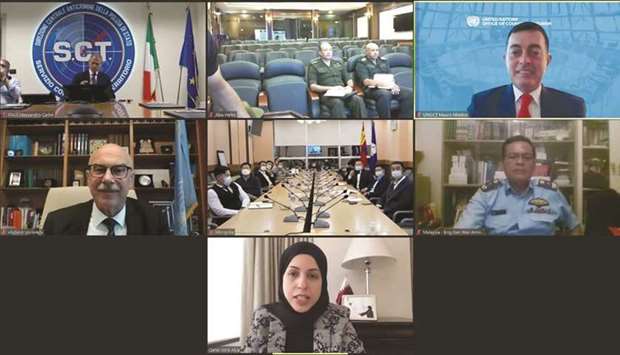
HE the Permanent Representative of the State of Qatar to the United Nations Sheikha Alya Ahmed bin Saif al-Thani co-chaired, with UN Office of Counter-Terrorism (UNOCT) under-secretary-general Vladimir Voronkov, a virtual meeting of the International Expert Group Meeting on Vulnerable Targets and Unmanned Aircraft Systems, convened by the UNOCT with the Counter-Terrorism Committee Executive Directorate (CTED), the UN Alliance of Civilisations, the United States, and the UN Interregional Crime and Justice Research Institute (UNICRI), in consultation with Interpol.
The two-day meeting comes within the context of the follow-up and development of the strategies of the Global Programme on Countering Terrorist Threats against Vulnerable Targets, which was launched early this year, and funded by Qatar as part of its commitment to support the UNOCT’s strategic priorities.
At the beginning of the meeting, HE Sheikha Alya expressed Qatar's readiness to contribute to strengthening international co-operation and building capacities to confront terrorist acts against targets at risk, and stressed that continuous efforts are being made to mitigate all risks against soft and easy targets.
She added that vital infrastructures and open public spaces, or the so-called "soft" targets, are uniquely vulnerable to terrorist attacks, and deserve continuous efforts to mitigate all risks, and emphasised on the need for international co-operation and partnerships between a wide range of actors.
HE Sheikha Alya said: "Qatar has taken this matter into consideration within the framework of its partnership with international partners such as the UNOCT and Interpol. It has developed expertise and capabilities in this field."
"The United Nations, specifically the UNOCT, has an important role to play in co-ordinating efforts to protect vulnerable targets, identify best practices and gaps, and support capacity building," she added.
HE Sheikha Alya called for effective and necessary preventative measures to be taken with regard to the targets at risk, and highlighted the need for a better understanding of the various and new threats against them.
These include unmanned aerial systems (UAS), which provide a means for collecting intelligence information, conducting surveillance and reconnaissance, as well as carrying out attacks.
"Terrorists have wasted no time in exploiting these opportunities to carry out their reprehensible agenda, as they have with other new technologies,” HE Sheikha Alya said. “Although UAS technology is relatively new, it has proven accessible to actors with limited resources, which makes is especially dangerous."
She added: "The open nature of so-called ‘soft’ targets is cause for special concern in this regard, as it makes them prime targets. Therefore, there is a need for specific measures to protect them, and to anticipate and thwart misuse of drones by terrorist groups."
"However, while UAS can be a threat in the wrong hands, this versatile technology can be harnessed by UN member states and the United Nations in the context of security and as a useful addition to the counter-terrorism toolkit,” the envoy said. “This includes intelligence, surveillance and reconnaissance, border security and management, and protection of vulnerable targets.”
A panel of experts, representatives from UN member States, local authorities, international, regional and non-regional organisations, the private sector and civil society, participated in the meeting.
At the beginning of the meeting, HE Sheikha Alya expressed Qatar's readiness to contribute to strengthening international co-operation and building capacities to confront terrorist acts against targets at risk, and stressed that continuous efforts are being made to mitigate all risks against soft and easy targets.
She added that vital infrastructures and open public spaces, or the so-called "soft" targets, are uniquely vulnerable to terrorist attacks, and deserve continuous efforts to mitigate all risks, and emphasised on the need for international co-operation and partnerships between a wide range of actors.
HE Sheikha Alya said: "Qatar has taken this matter into consideration within the framework of its partnership with international partners such as the UNOCT and Interpol. It has developed expertise and capabilities in this field."
"The United Nations, specifically the UNOCT, has an important role to play in co-ordinating efforts to protect vulnerable targets, identify best practices and gaps, and support capacity building," she added.
HE Sheikha Alya called for effective and necessary preventative measures to be taken with regard to the targets at risk, and highlighted the need for a better understanding of the various and new threats against them.
These include unmanned aerial systems (UAS), which provide a means for collecting intelligence information, conducting surveillance and reconnaissance, as well as carrying out attacks.
"Terrorists have wasted no time in exploiting these opportunities to carry out their reprehensible agenda, as they have with other new technologies,” HE Sheikha Alya said. “Although UAS technology is relatively new, it has proven accessible to actors with limited resources, which makes is especially dangerous."
She added: "The open nature of so-called ‘soft’ targets is cause for special concern in this regard, as it makes them prime targets. Therefore, there is a need for specific measures to protect them, and to anticipate and thwart misuse of drones by terrorist groups."
"However, while UAS can be a threat in the wrong hands, this versatile technology can be harnessed by UN member states and the United Nations in the context of security and as a useful addition to the counter-terrorism toolkit,” the envoy said. “This includes intelligence, surveillance and reconnaissance, border security and management, and protection of vulnerable targets.”
A panel of experts, representatives from UN member States, local authorities, international, regional and non-regional organisations, the private sector and civil society, participated in the meeting.