


Asian and European markets fell on Wednesday as a strong lead from Wall Street was overshadowed by ongoing worries about rising inflation and tighter monetary policy, a possible US debt default the Delta coronavirus variant.
The rally enjoyed across equities for more than a year has met a roadblock in recent months as supply chain problems and a surge in energy prices caused by a recovery in demand has led to a sustained spike in inflation.
That has put increasing pressure on central banks around the world to wind in the ultra-loose monetary policies put in place last year to battle the impact of the pandemic, which have been key to the rebound in the global economy as well as markets.
And investors are not happy, with some now warning that continuously high prices combined with signs that global growth is slowing could lead to a period of stagflation.
The US Federal Reserve is widely expected to soon announce it will begin cutting back its massive bond-buying programme, with interest rates possibly rising as soon as next year.
Other central banks have also hinted at moves soon or have already acted.
On Wednesday, the Reserve Bank of New Zealand announced a first rate rise in seven years, joining the banks of South Korea and Norway.
A healthy study showing a forecast-beating improvement in the US services sector in September added to the argument for the Fed to act.
“The survey revealed business activity and new orders continued to rise at a solid pace in September, pointing to the US economy’s solid resilience notwithstanding the Delta Covid wave and supporting the view the Fed will likely announce a...tapering plan at its next meeting early in November,” said National Australia Bank’s Rodrigo Catril.
Wall Street’s three main indexes rallied Tuesday, the day after a painful rout, but Asia was unable to follow suit.
Tokyo fell for an eighth straight session, while Hong Kong, Seoul, Sydney, Wellington, Mumbai, Bangkok and Taipei were also well in the red.
But Singapore, Manila, and Jakarta posted gains.
Shanghai remained closed until Friday for a holiday. London, Paris and Frankfurt were deep in negative territory in morning trade, while US futures also sank.
There were warnings of more fluctuations to come.
“For the last five or six months we’ve entered a period of kind of a mini-cycle in the US where you’ve got a changing Fed regime, and we are at the extended end of a recovery,” Kieran Calder, of Union Bancaire Privee, told Bloomberg Television.
“It leaves the market vulnerable to external shocks and increased volatility.”
Crude edged higher again after shooting up more than 4% to multi-year highs in the past two days after Opec and other major producers refused to lift output despite the rally in prices and concerns about the impact on inflation.
The crisis at Chinese developer Evergrande continues to cast a shadow as the firm drowns in a sea of debt worth more than $300bn and struggles to find the money to stay afloat.
In Tokyo, the Nikkei 225 closed down 1.1% to 27,528.87 points and Hong Kong Hang Seng Index ended down 0.6% to 23,966.49 points yesterday. Shanghai was closed for a holiday.
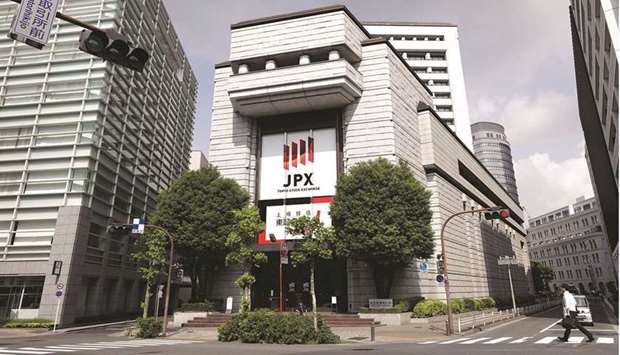
An external view of the Tokyo Stock Exchange. The Nikkei 225 closed down 1.1% to 27,528.87 points yesterday.