


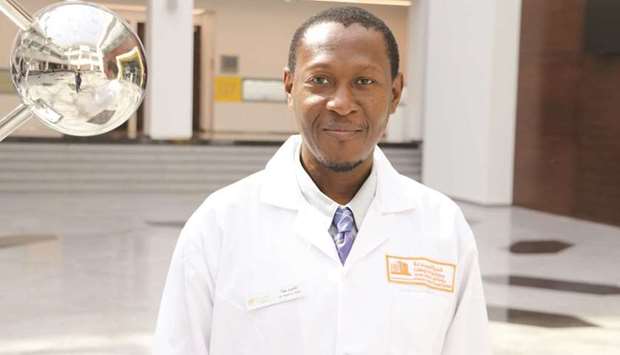
A Qatar University (QU) professor is working on the prevalence of colon cancer in Qatar and world.
Dr Nashiru Billa, professor of Pharmaceutical Sciences at the College of Pharmacy, was awarded a QU International Research Collaboration Co-fund (IRCC, Cycle 4) grant worth $121,680 over two years, titled ‘Colon cancer targeted muco-adhesive and muco-penetrative nano-formulation of curcumin’.
This research endeavour is motivated by the fact that colon cancer is the third most common type of cancer worldwide, while it is largely preventable through lifestyle modifications. "This statistic is closely mirrored in Qatar and likely to worsen due to significant impositions by the Covid-19 pandemic, among other factors," QU said in a statement.
Chemotherapy is the mainstay treatment option in managing colon cancer, with surgery or radiation administered depending on the severity of the disease. The side effects associated with chemotherapy can be severe or even fatal. "There is, thus, a quest for safer, yet effective treatment options. Curcumin, obtained from the Indian spice turmeric, has been the subject of intense research in the past decade, largely due to the low incidence of colon cancer among natives of the sub-Indian continent," the statement noted.
Several in vitro and in vivo studies point to the anti-colon cancer effects of curcumin, with potentially minimal side effects. However, it is poorly soluble and hence presents sub-therapeutic concentrations when administered orally unless some form of chemical modification or formulation intervention is imparted. Nanoparticle formulations have the ability to traverse tissue, especially, actively diving tissues like cancer tissue. Therefore, through appropriate formulation approaches, it is possible to deploy curcumin into colon cancer tissue so that its effects are enhanced without the associated side effects akin to chemotherapy.
"Thus, our aim was to potentiate the anti-colon cancer effects of curcumin through nano-formulation. The nano-particles would comprise chitosan (obtained from chitin, the major constituent of the exoskeleton of arthropods) and modified citrus pectin (from the rind of citrus fruits) and expected to be deployed to the colon following oral administration as a muco-adhesive and muco-penetrative delivery system for curcumin. The chitosan is expected to impart mucoadhesion to colon tissue, while the modified citrus pectin is expected to retain the integrity of the nanoparticles when administered orally and also impart anticancer effects after caecal arrival," the statement explained.
A key feature within this research endeavour worth highlighting is the use of naturally obtained excipients used in the formulation of nanoparticles, which may not only contribute to minimising side effects from curcumin but also be acceptable to colon cancer patients in Qatar and other places.
This international collaborative grant will be executed along with Dr Syahril Abdulla of the University of Putra, Malaysia. Dr Billa and Dr Syahril have previously secured a number of grants and co-supervised students.
The Qatar University collaborators include Dr Hesham Korashy and Dr Mohamed Izham.
This research endeavour is motivated by the fact that colon cancer is the third most common type of cancer worldwide, while it is largely preventable through lifestyle modifications. "This statistic is closely mirrored in Qatar and likely to worsen due to significant impositions by the Covid-19 pandemic, among other factors," QU said in a statement.
Chemotherapy is the mainstay treatment option in managing colon cancer, with surgery or radiation administered depending on the severity of the disease. The side effects associated with chemotherapy can be severe or even fatal. "There is, thus, a quest for safer, yet effective treatment options. Curcumin, obtained from the Indian spice turmeric, has been the subject of intense research in the past decade, largely due to the low incidence of colon cancer among natives of the sub-Indian continent," the statement noted.
Several in vitro and in vivo studies point to the anti-colon cancer effects of curcumin, with potentially minimal side effects. However, it is poorly soluble and hence presents sub-therapeutic concentrations when administered orally unless some form of chemical modification or formulation intervention is imparted. Nanoparticle formulations have the ability to traverse tissue, especially, actively diving tissues like cancer tissue. Therefore, through appropriate formulation approaches, it is possible to deploy curcumin into colon cancer tissue so that its effects are enhanced without the associated side effects akin to chemotherapy.
"Thus, our aim was to potentiate the anti-colon cancer effects of curcumin through nano-formulation. The nano-particles would comprise chitosan (obtained from chitin, the major constituent of the exoskeleton of arthropods) and modified citrus pectin (from the rind of citrus fruits) and expected to be deployed to the colon following oral administration as a muco-adhesive and muco-penetrative delivery system for curcumin. The chitosan is expected to impart mucoadhesion to colon tissue, while the modified citrus pectin is expected to retain the integrity of the nanoparticles when administered orally and also impart anticancer effects after caecal arrival," the statement explained.
A key feature within this research endeavour worth highlighting is the use of naturally obtained excipients used in the formulation of nanoparticles, which may not only contribute to minimising side effects from curcumin but also be acceptable to colon cancer patients in Qatar and other places.
This international collaborative grant will be executed along with Dr Syahril Abdulla of the University of Putra, Malaysia. Dr Billa and Dr Syahril have previously secured a number of grants and co-supervised students.
The Qatar University collaborators include Dr Hesham Korashy and Dr Mohamed Izham.