


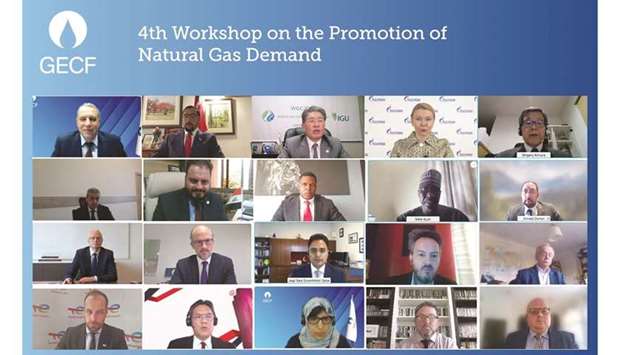
The role of natural gas in a low-carbon future was on focus at the '4th GECF Annual Workshop on Promotion of Natural Gas Demand' held virtually on Wednesday.
In his welcome remarks GECF secretary-general Yury Sentyurin, struck a message of unity in order to cement the role of natural gas in a low-carbon future.
“There is no doubt that over the past year, natural gas proved its resilience and flexibility to deal with market fluctuations. However, the future of the industry is being guided by emotions and unfavourable energy policies towards fossil fuels, resulting in a lack of financing and investment across the value chain”.
“Amidst these challenges, co-operation and dialogue amongst gas industry players, particularly between producers and consumers, is crucial for promoting natural gas, facilitating investment, reducing costs, and optimising operations across the entire gas value chain,” Sentyurin said.
This assumes poignancy given that in 2021 thus far, the gas industry has witnessed significant recovery in spot prices, supported by several factors including an extremely cold winter, a hotter-than-usual summer, and global economic, increasing supply constraints.
On September 28, natural gas price crossed the $1,000 mark for the first time ever, reaching $1,031 per 1,000 cubic metres for October future at the TTF Hub, once again validating the 18-member forum’s long-held position on a balanced approach to the energy transition.
Furthermore, higher spot prices risk reducing the competitiveness of natural gas against coal and may threaten gas’s market share, particularly in the power sector.
In other remarks, the outlook for natural gas as a fuel of choice for economic resurgence and sustainability targets was highlighted by a distinguished line-up of international gas industry leaders and panellists including Stuart Young, Minister of Energy and Energy Industries of Trinidad and Tobago; Kamal Abbasov, Deputy Minister of Energy and Mineral Resources of Azerbaijan; Joe M Kang, president, International Gas Union, and NJ Ayuk, executive chairman, African Energy Chamber (AEC).
The keynote session was followed by three thematic panels, including on young voices, aimed at bringing together high-level experts from various segments of the energy industry.
The scene-setting was provided by Mahdjouba Belaifa, head of Gas Market Analyses Department at the GECF, who elaborated on fresh, actionable and forward-thinking perspectives on a wide variety of natural gas benefits in the energy transition and how it will meet the future energy needs of the planet.
The debates featured top management of Gazprom Export, the National Gas Company of Trinidad and Tobago Limited, Nigeria National Petroleum Corporation, Equinor, ExxonMobil Qatar, TotalEnergies Qatar, Cheniere Energy, Qamar Energy, and International Group of Liquefied Natural Gas Importers (GIIGNL), as well as Oxford Institute for Energy Studies (OIES), Economic Research Institute for Asean and East Asia (ERIA), and the Abdullah Bin Hamad Al-Attiyah International Foundation for Energy and Sustainable Development, who provided their perspectives on the role of natural gas in new and niche sectors and collaborative strategies to reduce carbon and methane emissions.
For the first time in four editions, the event also heard from youngsters as students from Qatar University, Texas A&M University at Qatar, and Hamad Bin Khalifa University made several presentations.