


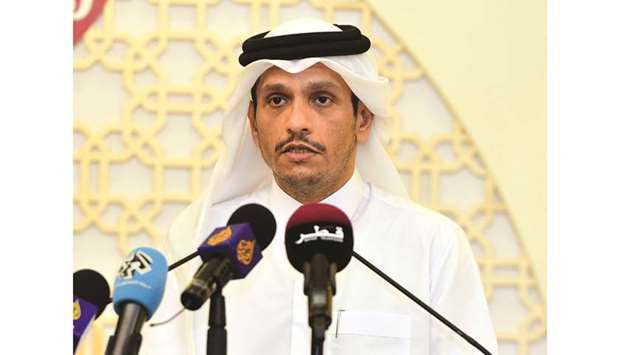
HE the Deputy Prime Minister and Minister of Foreign Affairs Sheikh Mohamed bin Abdulrahman al-Thani has stressed Qatar's full commitment to support partner and allied countries and entities, including the European Union (EU), regarding Afghanistan. This is in terms of evacuations from Afghanistan as well as in providing the necessary platform for them to facilitate dialogue between them and the interim government of Afghanistan.
He made the observations while addressing a joint press conference with Josep Borrell, High Representative of the EU for Foreign Affairs and Security Policy, on Thursday. He said the deliberations on Thursday came after the meeting that brought them together on the sidelines of the 76th session of the United Nations General Assembly in New York recently, where the two sides completed what was discussed during that meeting.
HE Sheikh Mohamed indicated that the meeting discussed the Afghan issue at length, and affirmed Qatar's support to Afghanistan while working with the international community and continuing to fight terrorism. He said Qatar is constantly following all developments taking place in Afghanistan and urging the parties to engage in a national reconciliation dialogue that brings together the Afghans, while ensuring freedom of travel and movement, whether for Afghan citizens or foreigners in Afghanistan.
He stressed the importance of adhering to what was agreed upon in Doha regarding the fight against terrorism. Also, he urged the interim government in Afghanistan to preserve the gains of the Afghan people over the past years, calling on friendly and allied countries not to isolate Afghanistan and that there should be permanent engagement through dialogue to facilitate humanitarian aid and not politicise it.
He added that Qatar will continue to take part in evacuations from Afghanistan.
Answering a question regarding the recent executions in Afghanistan, HE Sheikh Mohamed expressed dissatisfaction with the unfortunate happenings there, pointing to the need to continue to engage with them and urge them to avoid such behaviour. It is very important for Islamic countries to be a model for the Taliban to follow to avoid the mistreatment of women and misappropriation of the Shariah. For example, Qatar, which is a Muslim country as stipulated in its constitution and system, women constitute the majority and surpass men in terms of holding public office as well as in higher education, he explained.
HE Sheikh Mohamed noted that the meeting also discussed several regional issues, the most prominent of which is the nuclear agreement with Iran, where he affirmed the position of Qatar in support of the parties' return to negotiations with their commitment to the provisions of the nuclear agreement and that the region is free of nuclear weapons.
In response to a question about resuming the nuclear agreement with Iran or what is known as the Joint Comprehensive Plan of Action (JCPOA), he made it clear that Qatar is not a mediator, as its role cannot be described as a mediator concerning the talks on the nuclear agreement with Iran. HE the Deputy Prime Minister and Minister of Foreign Affairs pointed out that Qatar, due to its geographical location and its neighborliness with Iran, what is happening in Iran matters to Qatar, and added that Qatar will do its best to reduce the escalation between the parties (Iran, the EU countries and the US), and continue to push for positive progress on negotiations and their resumption, and ensuring that the region is free of nuclear weapons, stressing the importance to not have a nuclear arms race in the region, which is Qatar's goal.
In conclusion, HE Sheikh Mohamed praised the humanitarian efforts of the EU to support the regional issues, stressing the need for continued consultation between the EU and the countries of the region, which are important partners for all EU members. (With inputs from Shafeeq Alingal)