


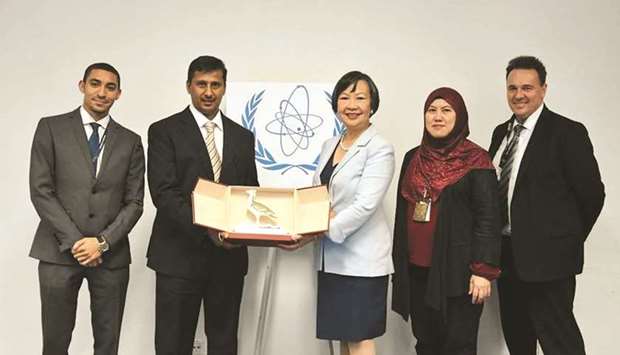
The Ministry of Municipality and Environment participated in the 65th session of the General Conference of the International Atomic Energy Agency (IAEA) held in the Austrian capital Vienna. The ministry's delegation was headed by Hassan Jumaa Bu Jamhour al-Mohannadi, the assistant undersecretary for environmental affairs and Qatar's contact person at the IAEA for technical co-operation programmes.
On the sidelines of the conference, the assistant undersecretary for environmental affairs held consultative meetings with a number of IAEA officials, including the head of the IAEA's Asia and Pacific Department to discuss bilateral co-operation between Qatar and the agency regarding current and future technical cooperation projects, which include four projects namely: Strengthening the regulatory infrastructure for effective radiological control over medical and industrial fields and continuous environmental monitoring, the establishment of a radiological calibration laboratory and a radiometrics laboratory, the establishment of a food irradiation facility in Qatar and a project related to external and internal dosimetry for children in medical studies.
The ministry's delegation also visited the emergency centre of the International Atomic Energy Agency, to learn about international communication techniques for preparedness and response to radiological and nuclear emergencies. Technical talks were held between the two parties regarding strengthening co-operation in the field of promoting radiological and nuclear emergencies between Qatar and the agency and the application of international conventions on reporting and international assistance.
Meanwhile, Eng Hamad Salah Ibrahim, Head of the Radiation Protection Department at the Ministry of Municipality and Environment, explained that the national nuclear framework is in its final stages of approval between Qatar and the International Atomic Energy Agency, adding that the Ministry of Municipality and Environment, represented by the Radiation and Chemicals Protection Department, has led the process of drafting this document (National Nuclear Framework ) through a consultative process in which the various relevant ministries and national institutions participated.
He noted that this document deals with key development issues and priorities identified by ministries and institutions related to human health, food and agriculture, environmental protection, water resources management, human resources development, and nuclear and radiological safety and security. He stressed that the implementation of this framework enhances the process of integrating nuclear science and technology into national development plans in key sectors of social and economic importance such as agriculture, environment, and human health.
It also contributes to increasing co-operation between the government and the International Atomic Energy Agency, Ibrahim said noting that this framework aims to strengthen the status of Qatar in the production of foodstuffs and vegetables by using nuclear techniques, strengthening national capacities to detect and diagnose animal diseases, improving water resources and using nuclear techniques to identify and reduce pollution, including pollution from plastic waste.
Qatar participated in the General Conference of the International Atomic Energy Agency with a delegation headed by ambassador of Qatar to Austria and the Permanent Representative of Qatar to the United Nations and international organisations in Vienna Sultan bin Salmeen al-Mansouri.