


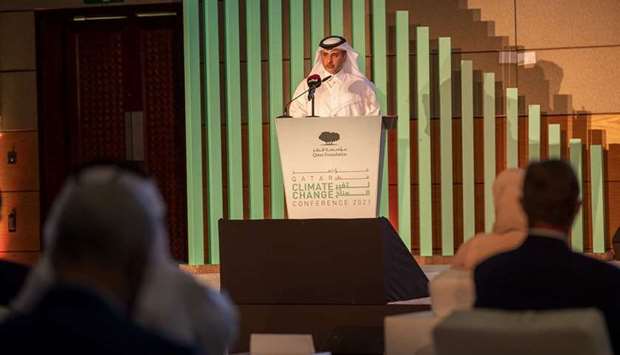
HE the Minister of Municipality and Environment and Acting Minister of State for Cabinet Affairs Dr Abdullah bin Abdulaziz bin Turki al-Subaie has affirmed that climate change represents a great challenge, with its repercussions already beginning to affect the world's economies and human welfare, and added the phenomenon is expected to lead to more danger and cause greater damage in the future, making it one of the most urgent global challenges.
In his speech during the Qatar Climate Change Conference 2021, which was held Monday at Educational City and is organised by Qatar Foundation for Education, Science and Community Development, and the International Foundation for Energy and Sustainable Development, HE the Minister said that these challenges can only be successfully addressed by adopting a common vision, building on values that support bold ideas, and under committed leadership.
HE the Minister explained that Qatar has started taking concrete action to mitigate the effects of climate change and to develop adaptation strategies to reduce risks in the future, and noted that the government has recently submitted its second report on its Nationally Determined Contributions to the United Nations Framework Convention on Climate Change.
The report was characterised by more ambition and urgency in the field of responding to climate change and taking the required mitigation and adaptation measures to reduce the negative effects of climate change, HE Dr al-Subaie said, adding that government agencies, the private sector and research institutions will participate closely in implementing the measures stipulated in the Nationally Determined Contributions of Qatar.
He noted that Qatar’s climate change policy is built on three main pillars –balancing economic growth and climate protection, setting regulations to accelerate rates of change, and engaging and empowering stakeholders to achieve a shared vision for the future.
HE the Minister added that the need to find a balance between economic growth and climate protection is one of the clearest and most obvious, with economic diversification a major step towards achieving this.
He said that environmental development is one of the four interconnected pillars upon which the Qatar National Vision 2030 is based.
HE Dr al-Subaie said that Qatar has already successfully invested in initiatives aimed at reducing carbon emissions, such as carbon capture, renewable energy projects, “green” buildings, “smart” grids and infrastructure, recycling, “smart” farming methods, and circular local economy and resource efficiency, which are sustainable technologies and practices that are essential elements in supporting the country's efforts towards meeting environmental and economic goals.
Qatar strongly supports increased spending on research and development as a key driver for generating new knowledge that includes new concepts and technologies to address climate change issues, he added.
The second pillar – the development of regulations to accelerate the rates of change – requires a combination of market and non-market approaches by adopting new rules and standards, and this would help in promoting market development and capacity building and capabilities in the public and private sectors.
HE the Minister said that the new rules and standards will form a cornerstone to support action on climate change by defining a framework for corporate and consumer behaviors.
Citizens and businesses must also be encouraged to adopt environmentally-friendly practices and accelerate environmental progress, HE Dr al-Subaie added.
He emphasised that "from this standpoint, co-operation with all parties will be a key element in achieving success, which highlights the importance of the third pillar, which is to involve stakeholders in achieving a common vision for the future”.
“Here, it is necessary to focus on the local and international dimensions,” HE the Minister said. “From a local perspective, it is necessary to lay the foundations for joint co-operation between the government, companies and individuals in order to promote work in the field of climate change.
“To achieve this, we need to raise the level of environmental awareness and responsibility."
He stressed that rules and regulations alone are insufficient to support taking effective measures related to climate change, but must be reinforced with full awareness, and the accompanying behavioural changes that urge us to start making radical changes to build a more sustainable future for all.
HE Dr al-Subaie added that education is of fundamental importance in understanding the challenges of climate change and the urgent need to address them, and Qatar will continue to invest to provide the people with the knowledge and skills necessary, to lay a solid foundation towards building a greener and more sustainable future.
HE the Minister said that the fast-growing sectors and industries that contribute to promoting sustainability will only succeed in achieving their goals and aspirations through the development of educational systems and training programmes capable of supporting this transformation.
As for the international dimension, it is not enough to focus on exchanging visions and sharing efforts within Qatar alone.
He noted that the global effects of climate change require an effective and appropriate international response.
HE the Minister pointed out that no country can tackle the climate crisis alone, so Qatar should co-ordinate its efforts within the international community.
He added that Qatar is a party to the United Nations Framework Convention on Climate Change (UNFCCC) and has ratified both the Kyoto Protocol and the Paris Agreement, which reflects the government’s adherence to commitments that support the global response to climate change.
Qatar also plays an active role in global debates by participating in international dialogues and hosting events that bring together stakeholders to identify responsibilities and share knowledge and solutions at the international level.
HE the Minister explained that Qatar has started taking concrete action to mitigate the effects of climate change and to develop adaptation strategies to reduce risks in the future, and noted that the government has recently submitted its second report on its Nationally Determined Contributions to the United Nations Framework Convention on Climate Change.
The report was characterised by more ambition and urgency in the field of responding to climate change and taking the required mitigation and adaptation measures to reduce the negative effects of climate change, HE Dr al-Subaie said, adding that government agencies, the private sector and research institutions will participate closely in implementing the measures stipulated in the Nationally Determined Contributions of Qatar.
He noted that Qatar’s climate change policy is built on three main pillars –balancing economic growth and climate protection, setting regulations to accelerate rates of change, and engaging and empowering stakeholders to achieve a shared vision for the future.
HE the Minister added that the need to find a balance between economic growth and climate protection is one of the clearest and most obvious, with economic diversification a major step towards achieving this.
He said that environmental development is one of the four interconnected pillars upon which the Qatar National Vision 2030 is based.
HE Dr al-Subaie said that Qatar has already successfully invested in initiatives aimed at reducing carbon emissions, such as carbon capture, renewable energy projects, “green” buildings, “smart” grids and infrastructure, recycling, “smart” farming methods, and circular local economy and resource efficiency, which are sustainable technologies and practices that are essential elements in supporting the country's efforts towards meeting environmental and economic goals.
Qatar strongly supports increased spending on research and development as a key driver for generating new knowledge that includes new concepts and technologies to address climate change issues, he added.
The second pillar – the development of regulations to accelerate the rates of change – requires a combination of market and non-market approaches by adopting new rules and standards, and this would help in promoting market development and capacity building and capabilities in the public and private sectors.
HE the Minister said that the new rules and standards will form a cornerstone to support action on climate change by defining a framework for corporate and consumer behaviors.
Citizens and businesses must also be encouraged to adopt environmentally-friendly practices and accelerate environmental progress, HE Dr al-Subaie added.
He emphasised that "from this standpoint, co-operation with all parties will be a key element in achieving success, which highlights the importance of the third pillar, which is to involve stakeholders in achieving a common vision for the future”.
“Here, it is necessary to focus on the local and international dimensions,” HE the Minister said. “From a local perspective, it is necessary to lay the foundations for joint co-operation between the government, companies and individuals in order to promote work in the field of climate change.
“To achieve this, we need to raise the level of environmental awareness and responsibility."
He stressed that rules and regulations alone are insufficient to support taking effective measures related to climate change, but must be reinforced with full awareness, and the accompanying behavioural changes that urge us to start making radical changes to build a more sustainable future for all.
HE Dr al-Subaie added that education is of fundamental importance in understanding the challenges of climate change and the urgent need to address them, and Qatar will continue to invest to provide the people with the knowledge and skills necessary, to lay a solid foundation towards building a greener and more sustainable future.
HE the Minister said that the fast-growing sectors and industries that contribute to promoting sustainability will only succeed in achieving their goals and aspirations through the development of educational systems and training programmes capable of supporting this transformation.
As for the international dimension, it is not enough to focus on exchanging visions and sharing efforts within Qatar alone.
He noted that the global effects of climate change require an effective and appropriate international response.
HE the Minister pointed out that no country can tackle the climate crisis alone, so Qatar should co-ordinate its efforts within the international community.
He added that Qatar is a party to the United Nations Framework Convention on Climate Change (UNFCCC) and has ratified both the Kyoto Protocol and the Paris Agreement, which reflects the government’s adherence to commitments that support the global response to climate change.
Qatar also plays an active role in global debates by participating in international dialogues and hosting events that bring together stakeholders to identify responsibilities and share knowledge and solutions at the international level.