


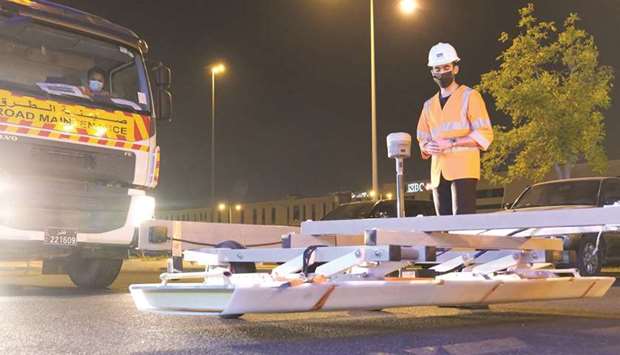
While implementing the preventive operation and maintenance plans for the roads network in Qatar, the Public Works Authority (Ashghal) has applied the latest technologies to scan asphalt using three-dimensional radar (3D-GPR).
The new system will enable the inspection of lower layers of roads, bridges and the sewage network, Ashghal explained in a statement on Wednesday.
The Roads Operation and Maintenance Department at Ashghal recently applied this advanced technology on Al Asiri Bridge (Midmac Bridge) along with highways, main roads and local roads. This comes in line with a comprehensive operation and maintenance plan to identify and explore voids and defects in the road layers at an early stage before they appear on the surface.
“The radar beams penetrate the surface layers of asphalt to reach the lower layers in order to identify any shortcomings or gaps in the foundations before they appear on the surface. The deep scanning process is carried out with a high accuracy of up to four meters below the surface of the earth,” the statement noted.
Engineer Mohamed al-Khashabi from the Roads Operation and Maintenance Department said that Ashghal uses this proactive approach to control the spread of these defects on the asphalt surface, thus reducing the impact on traffic, enhancing safety and traffic flow on roads, and reducing cost of roads operation and maintenance.
Some benefits of this system also include developing maps of infrastructure and utilities, bridge conditions, and voids under roads. “More tests are scheduled in the near future to cover a wider range of road networks and enhance safety of road users,” he said.
The three-dimensional radar (3D-GPR) works with high-resolution and 3D mapping under the road surface using variable frequency radar beams by transmitting radar waves and analyzing reflections from different layers under the earth's surface. The GPR radar device is installed on the vehicle and collects data at a speed of 20 km/hr. The data is also analysed using the “Examiner” programme, where holes and other defects can be detected.
The Laser Crack Measurement System (LCMS) is used to scan the properties of the road surface layer from cracks, depressions and other surface defects. This data is combined with (3D-GPR) data for the lower layers, and thus comprehensive information is available on the performance of roads, bridges and the sewage network. Based on these results, a special technical team analyses this information and develops appropriate and timely preventive plans to eliminate the origin of the problem and limit its aggravation.
The Roads Operation and Maintenance Department at Ashghal recently applied this advanced technology on Al Asiri Bridge (Midmac Bridge) along with highways, main roads and local roads. This comes in line with a comprehensive operation and maintenance plan to identify and explore voids and defects in the road layers at an early stage before they appear on the surface.
“The radar beams penetrate the surface layers of asphalt to reach the lower layers in order to identify any shortcomings or gaps in the foundations before they appear on the surface. The deep scanning process is carried out with a high accuracy of up to four meters below the surface of the earth,” the statement noted.
Engineer Mohamed al-Khashabi from the Roads Operation and Maintenance Department said that Ashghal uses this proactive approach to control the spread of these defects on the asphalt surface, thus reducing the impact on traffic, enhancing safety and traffic flow on roads, and reducing cost of roads operation and maintenance.
Some benefits of this system also include developing maps of infrastructure and utilities, bridge conditions, and voids under roads. “More tests are scheduled in the near future to cover a wider range of road networks and enhance safety of road users,” he said.
The three-dimensional radar (3D-GPR) works with high-resolution and 3D mapping under the road surface using variable frequency radar beams by transmitting radar waves and analyzing reflections from different layers under the earth's surface. The GPR radar device is installed on the vehicle and collects data at a speed of 20 km/hr. The data is also analysed using the “Examiner” programme, where holes and other defects can be detected.
The Laser Crack Measurement System (LCMS) is used to scan the properties of the road surface layer from cracks, depressions and other surface defects. This data is combined with (3D-GPR) data for the lower layers, and thus comprehensive information is available on the performance of roads, bridges and the sewage network. Based on these results, a special technical team analyses this information and develops appropriate and timely preventive plans to eliminate the origin of the problem and limit its aggravation.