


• Pope hopes many countries take Afghan refugees
• Afghanistan becoming ‘country without artists’, exiled directors warn Venice
UN Secretary-General Antonio Guterres has called for an end to violence in Afghanistan amid fears of a new civil war now that the Taliban has seized power.
“I call for an immediate end to violence, for the safety, security and rights of all Afghans to be respected, and for adherence to Afghanistan’s international obligations, including all international agreements to which it is a party,” the UN chief said in a report to the Security Council this weekend.
The document, obtained by AFP, has not yet been released publicly.
“I urge the Taliban and all other parties to exercise utmost restraint to protect lives and to ensure that humanitarian needs can be met,” Guterres said.
The report was compiled as the mandate of the UN political mission in Afghanistan is scheduled to expire on September 17.
The UN says Afghanistan is mired in a humanitarian crisis affecting 18mn people, or half the population.
United Nations aid efforts can finance help for only 38% of the population, so the world body urgently needs nearly $800mn, the report says.
“I call on all donors to renew their support so that life-saving response is urgently scaled-up, delivered on time and suffering is mitigated,” said Guterres, who has convened an international aid conference for Afghanistan in Geneva for September 13.
He also called on countries to take in Afghan refugees and refrain from deporting any they might already be hosting.
And in an allusion to the Taliban’s brutal first stretch of rule from 1996 to 2001, Guterres said: “Reports of severe restrictions on human rights throughout the country are highly concerning, particularly accounts of mounting human rights violations against the women and girls of Afghanistan who fear a return to the darkest days.”
Meanwhile, Pope Francis said that he is praying that many countries take Afghan refugees and, in an apparent reference to the Taliban’s past restrictions on schooling for women, said it is essential that young Afghans receive an education.
“In these moments of upheaval, in which Afghans are seeking refuge, I pray for the most vulnerable among them,” he told hundreds of people in St Peter’s Square for his weekly blessing. “I pray that many countries welcome them and protect those who are seeking a new life.”
The Pope is a strong supporter of the rights of refugees and migrants.
Thousands of Afghans evacuated by the United States are waiting in so-called transit hubs in countries such as Qatar, Germany, and Italy.
Thousands of others are trying to leave via land crossings with neighbouring countries such as Pakistan.
“I also pray for the internally-displaced so that they have help and necessary protection. May young Afghans receive an education, which is an essential good for human development,” Francis said.
At the ongoing Venice Film Festival, two female Afghan directors gave a moving testimony this weekend, warning against trusting the Taliban’s promises.
“In just two weeks, the most brilliant elements have left the country, at least those who were able,” 38-year-old director Sahraa Karimi told reporters at the festival on Saturday.
“Imagine a country without artists,” added Karimi, who has won several international prizes for her work.
She said the Afghan film industry had entirely stopped “in the space of a few hours” after last month’s sudden takeover by the Taliban in the wake of the US military’s withdrawal. “The archives are now under the control of the Taliban. The work of directors vanished in a few hours. Some were able to leave with their computers, others with nothing at all.”
Her fellow filmmaker Sahra Mani, known for a documentary about victims of incest A Thousand Girls Like Me, added: “This collapse meant we lost everything.”
Mani, with a timid but determined air, used the example of Kabul’s only mixed music school.
“The Taliban are now occupying the building. They have destroyed the students’ instruments and the students are in hiding,” she said on the verge of tears.
Mani, who became the first head of the Afghan Film Organisation in 2019, spoke of her personal escape on August 15.
“I started my day normally, and several hours later I had to take the hardest decision in my life: to stay or leave the country,” she said. “We are actors, directors, producers, we are not politicians. We just want to realise our dreams.”
Mani described her fellow exiles as “ambassadors of Afghan identity”, and warned against trusting the Taliban. “Not only are they more cruel, they are wiser due to their use of technology.”
“We can only be saved by the international community. Help us! We need hope. Please be our voices and speak about our situation,” she added.
The pair were joined at Venice by members of the International Coalition for Filmmakers at Risk (ICFR), which was formed at last year’s festival to help artists from countries in turmoil such as Myanmar.
Today in Afghanistan, “the status of artist puts you in danger, you’re at the top of the list”, said Orwa Nyrabia, the Syrian head of the International Festival of Documentary Film in Amsterdam, adding: “We all have an interest in saving them, it’s in our interest.”
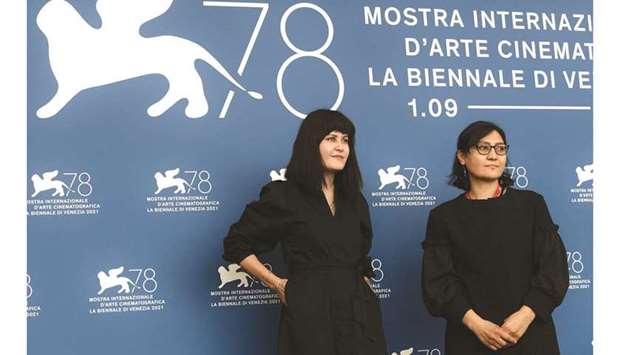
Afghan directors Sahraa Karimi and Sarah Mani (right) attend a photocall following an ‘International Panel on Afghanistan and the Situation of Afghan filmmakers and Artists’, on Saturday evening during the 78th Venice Film Festival at Venice Lido