


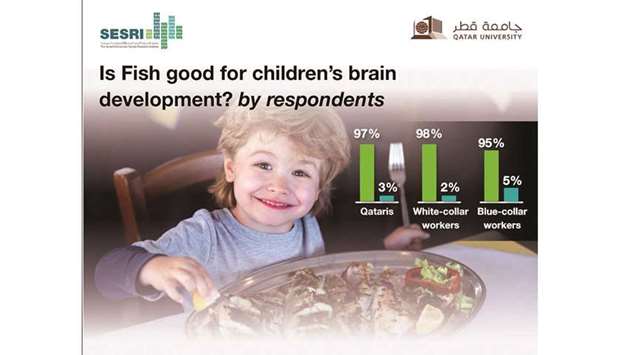
* Self-sufficiency in fish products in Qatar was estimated at 74% in 2020
* Average annual consumption was about 22.3kg per capita
* Fish consumption highest among blue-collar workers, shows study
* White-collar workers and Qataris prefer local fish, while blue-collar workers opt for imported varieties
Most participants of a research conducted in Qatar have said they prefer buying fish from supermarkets.
The study was conducted by Dr Sana Abusin, research associate at the Social and Economic Survey Research Institute (Sesri), Qatar University (QU), on fish consumption in the country.
"Studying fish consumption is vital to estimate local demand and hence identify the gap between production and imports. Managers will also be able to manage fish stock by using the insights acquired from these studies. In particular, they will be able to identify fish species that are in high demand and formulate the necessary policies pertaining to fishery sustainability," QU said in a statement.
Sesri conducted its 14th Qatar Semi-Annual Survey to provide valuable information to decision-makers, politicians, scholars and students about the general opinion of the three main groups of residents in Qatar (Qataris - citizens, white-collar - expatriates and blue-collar - labourers).
The survey consisted of 2,335 completed telephone interviews conducted across the three segments of the Qatar population (Qataris - 677, white-collar - 821 and blue-collar workers - 837).
* Socio-economic aspects of fish consumption
To understand the socio-economic aspects of fish consumption in Qatar, consumption rates were determined by asking respondents about the number of times they consumed fish per month. Based on their responses, three categories were created: low (1-3), moderate (4-8) and high (more than 8) times per month.
The results showed that, among all respondents, blue-collar workers reported the highest fish consumption as compared to Qataris and white-collar workers. Moreover, the frequency of consuming fish increased with education and there was preference for consuming local species for moderate consumers. White-collar workers and Qataris preferred local fish, while blue-collar workers opted for imported varieties. This may be because of lower prices and willingness to consume freshwater fish species found in their home countries, according to the study.
Consumers were asked about reasons for not consuming fish. The results showed that the religious factor behind not consuming fish registered higher numbers. This could be affected by the fact that the data were collected during Ramadan, when many people prefer not to eat fish.
Other factors negatively influencing fish consumption in Qatar are the existence of bones and strong smell of the fish, in addition to people being vegetarians or allergic to fish.
Fish consumption preferences were studied in more details based on respondents’ type. The findings revealed that among a total 10 commercial species, Qataris mainly preferred to consume four: hamour, safi, kanaad and shaari. Other respondents preferred these fish species too, but with different preference rates. In addition to the most preferred four species, white- and blue-collared workers also preferred tilapia and salmon.
The fisheries sector in Qatar is generally artisanal in nature, but has grown remarkably in the last decade, the QU statement notes.
In line with the food security strategy for 2018-2023, self-sufficiency in fish products in Qatar was estimated at 74% in 2020 while the average annual consumption was about 22.3 kg per capita, roughly the same as the world average.
Respondents were asked about factors that affected the purchase of fish or other fishery products. The results showed that fish products are affordable, fresh, healthy and tasty. Commercial fish species are available at various prices to ensure that all members of Qatar’s diverse community can access and consume fresh fish according to their budgets.
Moreover, most respondents (59%) reported buying fish from supermarkets, the study showed. As part of its food security strategy, Qatar has established new local markets for fish, such as the Umm Slal market, which replaced the old Abu Hamour market because of its relative proximity to fresh fish sources such as Al Khor and Al Shamal.
Policy recommendations
* Conducting a health awareness campaign to increase the consumption rate of fish species that are not under pressure, especially to safeguard fish biodiversity.
* Using species that are not highly demanded as 'byproducts', such as animal feed, and/or feeding aquaculture species
* Studying the Qatari community’s willingness to consume processed fish of species in low demand in the form of canned fish, snacks and dry fish protein.
* Opening foreign investment opportunities in some areas, including efficient aquaculture and land-based systems to produce fish species that support the fish stock under pressure
* Rationalising the management of fisheries in Qatar to meet the increasing demand and to change the fish industry from its artisanal nature into a more commercialised sector.
Tilapia consumption in Qatar
Tilapia is one of the freshwater fish species introduced to Qatar fisheries, to be produced as an aquaculture product so as to fill the fish consumption gap and ensure that a shift to 90% fish self-sufficiency is achieved.
Respondents were asked a hypothetical question, "Would they eat tilapia if it were produced locally?".
The results showed that 65% of people in Qatar would probably eat it, which gives a good indication that producing tilapia would be a step toward to fulfilling the food security strategy’s goal.
In order to know more details about tilapia consumption in Qatar, the data were analysed based on the respondent type. It seemed that both white-collar and blue-collar workers had enough knowledge about tilapia fish and willing to consume it, which likely reflects their diverse origins from countries with freshwater fish species.
In addition, half of Qataris are willing to consume tilapia, revealing unexpected but positive findings, the QU statement notes.
The study was conducted by Dr Sana Abusin, research associate at the Social and Economic Survey Research Institute (Sesri), Qatar University (QU), on fish consumption in the country.
"Studying fish consumption is vital to estimate local demand and hence identify the gap between production and imports. Managers will also be able to manage fish stock by using the insights acquired from these studies. In particular, they will be able to identify fish species that are in high demand and formulate the necessary policies pertaining to fishery sustainability," QU said in a statement.
Sesri conducted its 14th Qatar Semi-Annual Survey to provide valuable information to decision-makers, politicians, scholars and students about the general opinion of the three main groups of residents in Qatar (Qataris - citizens, white-collar - expatriates and blue-collar - labourers).
The survey consisted of 2,335 completed telephone interviews conducted across the three segments of the Qatar population (Qataris - 677, white-collar - 821 and blue-collar workers - 837).
* Socio-economic aspects of fish consumption
To understand the socio-economic aspects of fish consumption in Qatar, consumption rates were determined by asking respondents about the number of times they consumed fish per month. Based on their responses, three categories were created: low (1-3), moderate (4-8) and high (more than 8) times per month.
The results showed that, among all respondents, blue-collar workers reported the highest fish consumption as compared to Qataris and white-collar workers. Moreover, the frequency of consuming fish increased with education and there was preference for consuming local species for moderate consumers. White-collar workers and Qataris preferred local fish, while blue-collar workers opted for imported varieties. This may be because of lower prices and willingness to consume freshwater fish species found in their home countries, according to the study.
Consumers were asked about reasons for not consuming fish. The results showed that the religious factor behind not consuming fish registered higher numbers. This could be affected by the fact that the data were collected during Ramadan, when many people prefer not to eat fish.
Other factors negatively influencing fish consumption in Qatar are the existence of bones and strong smell of the fish, in addition to people being vegetarians or allergic to fish.
Fish consumption preferences were studied in more details based on respondents’ type. The findings revealed that among a total 10 commercial species, Qataris mainly preferred to consume four: hamour, safi, kanaad and shaari. Other respondents preferred these fish species too, but with different preference rates. In addition to the most preferred four species, white- and blue-collared workers also preferred tilapia and salmon.
The fisheries sector in Qatar is generally artisanal in nature, but has grown remarkably in the last decade, the QU statement notes.
In line with the food security strategy for 2018-2023, self-sufficiency in fish products in Qatar was estimated at 74% in 2020 while the average annual consumption was about 22.3 kg per capita, roughly the same as the world average.
Respondents were asked about factors that affected the purchase of fish or other fishery products. The results showed that fish products are affordable, fresh, healthy and tasty. Commercial fish species are available at various prices to ensure that all members of Qatar’s diverse community can access and consume fresh fish according to their budgets.
Moreover, most respondents (59%) reported buying fish from supermarkets, the study showed. As part of its food security strategy, Qatar has established new local markets for fish, such as the Umm Slal market, which replaced the old Abu Hamour market because of its relative proximity to fresh fish sources such as Al Khor and Al Shamal.
Policy recommendations
* Conducting a health awareness campaign to increase the consumption rate of fish species that are not under pressure, especially to safeguard fish biodiversity.
* Using species that are not highly demanded as 'byproducts', such as animal feed, and/or feeding aquaculture species
* Studying the Qatari community’s willingness to consume processed fish of species in low demand in the form of canned fish, snacks and dry fish protein.
* Opening foreign investment opportunities in some areas, including efficient aquaculture and land-based systems to produce fish species that support the fish stock under pressure
* Rationalising the management of fisheries in Qatar to meet the increasing demand and to change the fish industry from its artisanal nature into a more commercialised sector.
Tilapia consumption in Qatar
Tilapia is one of the freshwater fish species introduced to Qatar fisheries, to be produced as an aquaculture product so as to fill the fish consumption gap and ensure that a shift to 90% fish self-sufficiency is achieved.
Respondents were asked a hypothetical question, "Would they eat tilapia if it were produced locally?".
The results showed that 65% of people in Qatar would probably eat it, which gives a good indication that producing tilapia would be a step toward to fulfilling the food security strategy’s goal.
In order to know more details about tilapia consumption in Qatar, the data were analysed based on the respondent type. It seemed that both white-collar and blue-collar workers had enough knowledge about tilapia fish and willing to consume it, which likely reflects their diverse origins from countries with freshwater fish species.
In addition, half of Qataris are willing to consume tilapia, revealing unexpected but positive findings, the QU statement notes.