


Beijing’s municipal government has proposed an investment in Didi Global Inc that would give state-run firms control of the world’s largest ride-hailing company, according to people familiar with the matter.
Under the preliminary proposal, Shouqi Group - part of the influential Beijing Tourism Group - and other firms based in the capital would acquire a stake in Didi, the people said, asking not to be identified discussing private information. Scenarios under consideration include the consortium taking a so-called “golden share” with veto power and a board seat, they added.
Didi’s shares spiked 8% before paring gains to about 5% higher in pre-market trading in New York. It’s unclear how large a stake the city is eyeing and whether its proposal will be approved by senior government officials. Didi is currently controlled by the management team of co-founder Cheng Wei and president Jean Liu, which received aggregate voting power of 58% after the company’s US initial public offering. SoftBank Group Corp and Uber Technologies Inc are Didi’s biggest minority shareholders.
Representatives for Didi didn’t respond to a written request for comment. The Beijing municipal party committee press office didn’t respond to a faxed request for comment, while repeated calls to a phone number provided by Shouqi staff went unanswered. And the Beijing Tourism group didn’t reply to a request for comment faxed to a general office number provided by a receptionist.
Local governments have traditionally had a big say in the restructuring of companies on their turf, and the envisioned solution dovetails with Chinese President Xi Jinping’s priorities of redistributing wealth and curbing the influence of the Internet sector. The city’s proposal could entail taking a sizeable slice of Didi or a nominal stake accompanied by a golden share and board seat, the people said. The latter model would be akin to an earlier investment by the government in ByteDance Ltd’s Chinese unit, which gave the state entity veto-rights over important decisions.
The takeover proposal comes alongside a swath of penalties Xi’s administration is considering for the country’s ride-hailing leader, which debuted in New York in June over the objections of the Cyberspace Administration of China. The Internet industry overseer saw that decision as a challenge to the central government’s authority and officials from the CAC, the Ministry of Public Security, the Ministry of State Security and several other agencies initiated an on-site inspection at Didi’s offices in July.
It’s since been ensnared by probes into data security and the way it treats its millions of drivers. Many of the options Beijing is weighing involve re-asserting state control over a company that’s traditionally operated in a legal gray zone, Bloomberg News has reported. They are said to include getting Didi to hand over its troves of data to a third party and a delisting from US bourses.
The central thrust of the Beijing government’s proposal is to regain control over one of the city’s largest corporations, particularly data that it hoovers up from hundreds of millions of users daily - a fount considered vital to the economy and social stability. China’s government has proposed creating a joint venture with internet firms that would oversee that kind of information, a project led by the People’s Bank of China, Bloomberg News has reported.
Shouqi, which in 2015 set up a ride-hailing service known as Shouqi Yueche that now has more than 100 million users nationwide, will play a role in helping operate its larger rival. The company is one of the most important assets of the Beijing Tourism Group, which runs a chain of travel agencies, malls, restaurants and hotels across the capital.
In addition, Chinese regulators are considering severe penalties for Didi, ranging from a fine to the suspension of certain operations, Bloomberg News has reported. Also possible is a forced delisting or withdrawal of Didi’s US shares, although it’s unclear how such an option would play out. A delisting and privatisation of Didi remains on the table should the central government green-light the plan envisioned by Beijing’s municipal government, the people said.
Whatever the outcome, Beijing is likely to impose harsher sanctions on Didi than on Alibaba Group Holding Ltd, which swallowed a record $2.8bn fine after a months-long antitrust investigation and agreed to initiate measures to protect merchants and customers, Bloomberg News has reported.
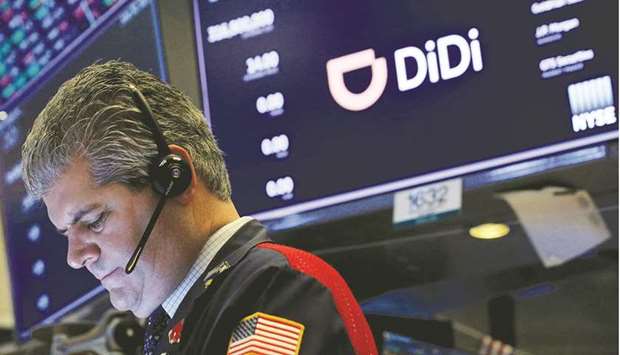
A trader works during the IPO for Chinese ride-hailing company Didi Global on the New York Stock Exchange (NYSE) floor (file). Beijing’s municipal government has proposed an investment in Didi Global that would give state-run firms control of the world’s largest ride-hailing company, according to people familiar with the matter.