


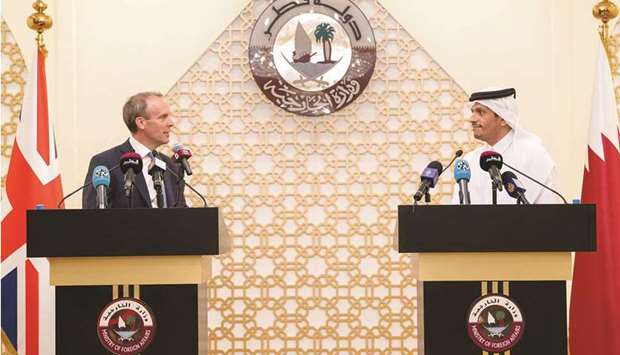
Qatar will continue its efforts as an impartial mediator to enhance international agreement over Afghanistan and co-ordinate with all friendly countries to ensure the interests of the Afghan people, HE the Deputy Prime Minister and Minister of Foreign Affairs Sheikh Mohammed bin Abdulrahman al-Thani said on Thursday.
Addressing a joint press conference in Doha with Dominic Raab, the UK Secretary of State for Foreign, Commonwealth and Development Affairs, he explained that their discussions focused primarily on Afghanistan.
HE Sheikh Mohamed praised the strong the strategic relations between Qatar and the UK in all fields, stressing that the meeting with Raab dealt with bilateral relations and the means to enhance them. The two sides evaluated the security and political developments in Afghan, discussed the challenges and how to address them, and share similar views in this regard.
The foreign minister noted that he reviewed with the UK Secretary of State the outcomes of the latest meeting with US Secretary of State Antony Blinken in the framework of the meeting of the foreign ministers of the group of 7, and how to build international agreement on Afghanistan.
He highlighted the importance of uniting efforts to reiterate the importance of protecting civilians, providing safe passages, ensuring freedom of movement, co-operation to counter terrorism and ensure that Afghanistan, in the future, is not a destabilising factor in the region.
On Qatar's role in restarting operations at Kabul Airport, HE Sheikh Mohamed said the evaluation process is continuing and it is early to take a decision. There is no clear indicator that the airport is ready.
"We are currently in the phase of evaluating whether Qatar's support will help make a difference in resuming operations at the airport sooner, there is currently no agreement on how that will take place and it is being discussed," he stated.
The foreign minister said Qatar is in contact with the Taliban regarding the issues and threats in restarting operations at the airport, and expressed optimism in doing so as soon as possible.
Qatar is sparing no effort in communicating with the Taliban. There is also constant communication with the Turkish side to discuss whether they could provide technical help in that regard, and hopes there will be progress in the coming days.
The UK Secretary of State Raab appreciated Qatar's role in Afghanistan, and its support of the UK's evacuation operations in Afghanistan.
He noted that Qatar has played an exceptional role in supporting the UK in facilitating safe transit for about 17,000 from Afghanistan, in the largest operation of its kind in the UK's history. The UK highly values the role Qatar played in these operations.
Raab said he visited the compound that hosts Afghan refugees in Doha and expressed his country's readiness to receive those who want to seek asylum in the UK.
Regarding his meetings in Doha, the UK Secretary of State said the discussions focused on bilateral relations with Qatar but highlighted that the Afghan issue was the most prominent.
The focus of the meetings was the need for Afghanistan not to become a haven for terrorism in the future, to avoid a humanitarian crisis there, maintain stability in the region, and test and hold the Taliban accountable according to their commitments in order to transition to an inclusive government.
Raab observed that there is a need to adapt to the new reality, and highlighted that the UK's immediate priorities are to ensure the safe passage of British nationals, Afghans who have worked with the UK, as well as other people who are most at risk.
The UK Secretary of State for Foreign, Commonwealth and Development Affairs pointed to the regional challenges resulting from the influx of Afghan migrants and refugees to the region and neighbouring countries, stressing that his country has doubled its support to confront these challenges.
He focused on the need to build an international coalition for this issue, noting that the Security Council resolution on Afghanistan, which was passed recently, constitutes a good framework that all countries agree on as a path for the future.
Raab reiterated the importance of expanding consensus by involving other countries in the region, pointing out that there are many countries that are directly affected by developments in Afghanistan.
On continuing evacuations, he said that the UK is following up on the reopening of Kabul Airport, and that he will visit the countries of the region in order to ensure safe passage to other countries.
The UK official also reiterated that his country would not recognise the Taliban in the foreseeable future, but stressed the need for direct communication with them at this stage. He expressed his belief that there is great scope for communication and dialogue to test the intentions of the Taliban to ensure they abide by the assurances they pledged.
The UK will judge the Taliban by their actions, and not words. The UK will work with all partners, most notably Qatar, to protect the gains made in Afghanistan during the last 20 years, and monitor the Taliban's commitment to human rights and women's rights.