


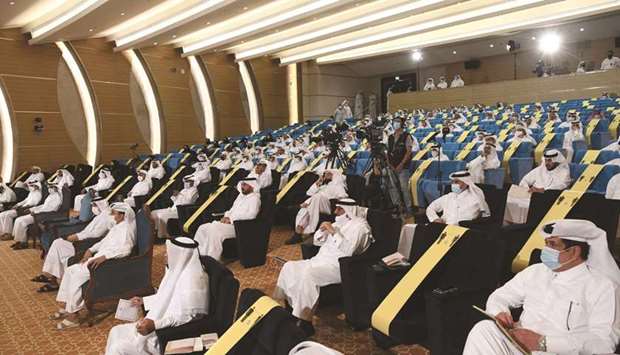
The Supervisory Committee for the Shura Council Elections held yesterday a forum for candidates of the Shura Council, aimed at promoting awareness of the electoral process in its legal and organisational aspects.
The forum, attended by candidates registered in the preliminary lists, shed light on the legal and organisational procedures related to electoral campaigning and its requirements as regulated by law; and provided an explanation of some procedures related to the polling day and the requirements of the committee monitoring spending on electoral campaigning.
Members of the committee listened to all the questions and inquiries raised by the candidates and provided adequate answers to all questions.
Vice-Chairman of the committee Brigadier-General Salem Saqr al-Muraikhi stressed the significance of this important national entitlement, indicating the Committee's keenness on providing all facilities to candidates and voters for the elections to be achieved in the fullest manner.
Brigadier-General al-Muraikhi noted the direction of HE the Prime Minister and Minister of Interior Sheikh Khalid bin Khalifa bin Abdulaziz al-Thani to the Committee to carry out its role in responding to candidates, listening to them and clarifying all procedures related to the electoral process.
On the election procedures, al-Muraikhi explained that according to the law, each electoral district has a committee called the "election committee" formed under the chairmanship of a judge chosen by the Supreme Judiciary Council, and two members, one from the Ministry of Interior and the other from the Ministry of Justice.
The committee is responsible for conducting the polling process, counting the votes and announcing the result at the electoral district headquarters.
He added that the law also stipulates that the election is a personal right, and it is not permissible to delegate it.
Every voter must exercise his electoral right himself at the electoral headquarters of his electoral district.
The law also stipulates that the election should be by direct secret general ballot.
Vice-Chairman of the Supervisory Committee Brigadier-General Salem Saqr al-Muraikhi outlined a set of procedures related to the election day, challenging the validity of the elections, and other procedures related to this matter.
On the other hand, Head of the Media Section of the Supervisory Committee Brigadier Abdullah Khalifa al-Muftah reviewed the controls of the election campaigns in accordance with the legal texts.
He explained that the law specified the period for practicing electoral campaign to start after the announcement of the final lists of candidates and to end 24 hours before the start of the election process.
He cautioned that it is not permissible to conduct election campaigns in a period other than the aforementioned period, and that the maximum expenditure for each candidate in the election campaign is QR2mn, adding that the municipalities will determine the places for placing advertisements, posters or electoral statements, and will allocate equal spaces in these places for candidates.
According to the law, the candidate is obliged when practicing electoral campaigning to respect the provisions of the constitution, respect the freedom of others to express their opinion, maintain national unity and the security of society, and not conduct any electoral campaign that involves deceiving voters or using the method of defamation or defamation others, Brig. al-Muftah stressed.
He also cautioned against using the official state emblem or its symbols in meetings, advertisements, electoral bulletins, and all kinds of writings and drawings used in electoral campaigns.
Other controls mentioned by Brig. al-Muftah include that means of electoral campaigning must not be similar to traffic signs and banners or other official signs in terms of the size, shape and colour; not violate the heights, measurements or dimensions determined by the competent municipalities; not obstruct the movement of traffic or pedestrians, or lead to blocking or disabling the functions of traffic lights or obstructing means for rescue.
In addition, a written approval must be obtained from the property owner or his representative if the advertising will be installed on real estate not owned by the candidate; and it must not pose danger to the users of the property or disturb their comfort.
Other controls set by the law stipulates that the installation of the electoral advertising should not cause any damage to public utilities, or endanger the lives of individuals or property, or conflict with the aesthetic character of the area or disturb public view, Brig. al-Muftah added.
On the prohibitions of electoral campaigning, Brig. Abdullah Khalifa al-Muftah indicated that the law stipulates a number of prohibitions when practicing electoral campaigning, such as including any tribal or sectarian tendencies or what contradicts public morals, prevailing traditions or religious and social values of the community.
The law also stipulates the prohibition of offending any other candidate, inciting tribal or sectarian strife among citizens in any way, exploiting state-owned means and tools in electoral campaigns, and infringing on others' electoral campaigns in any way, whether by cross-cutting, tearing, sabotaging or blocking.
He added that the candidate is prohibited from organising and holding electoral meetings, giving speeches or placing posters, advertisements or pictures in places of worship, religious centres, educational facilities, government facilities, and facilities and buildings of an archaeological or historical nature and the surrounding fences.
The candidate is also prohibited from organising and holding electoral meetings, giving speeches, or placing posters, advertisements or pictures inside the election hall or outside the electoral district at a distance of less than two hundred metres. The candidate is also prohibited from placing posters, advertisements or pictures on trees, plant containers, directional signs or traffic signals.
According to the law, loudspeakers are not allowed for electoral campaigning purposes without a license from the competent municipality, provided that the places and times specified in the license are observed.
Brig. al-Muftah added that Article (27) stipulates that it is not permissible for any of the employees in ministries and other government agencies and public bodies and institutions to carry out any election campaigning during the course of their work or their official working hours.
Meanwhile, Brig. al-Muftah noted that the candidate must remove electoral advertisements, posters, flyers, and any means of electoral propaganda within three days from the date of the end of the electoral process.
He added that the law obligated all public and private media outlets to observe equality, objectivity and impartiality in handling media coverage of the elections, in accordance with recognised professional principles.
In order to facilitate for the candidates, a group of halls in sports clubs and youth centres in various areas of the country has been identified to hold meetings and seminars for free. They were provided with all technical requirements, taking into account the current health conditions due to the coronavirus pandemic and to ensure the application of precautionary measures.
Brig. Abdullah Khalifa al-Muftah noted that Media Committee is fully prepared to provide assistance to the candidates, noting the free media services provided by the Qatar Media Corporation to all candidates to review their electoral programmes and communicate with voters through the various media outlets.
For his part, Mohamed Sarie al-Kaabi, representative of Qatar Central Bank and member of the Committee for Oversight of Expenditure on Electoral Advertising, spoke about controls and requirements that candidates must abide by, including that the maximum expenditure for each candidate on electoral campaigns is 2mn Qatari riyals.
He said that the candidate must determine the sources of funding for his electoral campaign and notify the committee that monitors spending on electoral campaigns with the names of the persons from whom he received a donation and the amount of the donation. The total donations should not exceed 35% of the maximum.
According to the law, only donations from Qatari individuals are allowed, and it is prohibited to receive any support from other foreign or local sources.
He noted that each candidate must deposit all private funds and cash donations in a bank account in the Qatar National Bank designated for electoral campaign 24 hours before the start of the electoral campaign, adding that all expenses should be spent on electoral campaigning from the aforementioned account and it is not permissible to spend from any source other than this account.
Al-Kaabi added that the candidate must verify the sources of cash and in-kind resources and deposit their amount or monetary value immediately upon receipt into the bank account. He must not exceed the legally permissible funding ceiling, use the bank account except for the purpose specified for it, or use it for any purpose or business related to the candidate personally. The forum witnessed interventions and questions raised by the candidates about the various stages of the electoral process.