


The six winners of 2021 WISE Awards have been revealed.
The winners, selected from all over the globe, were chosen for their innovative and impactful approaches to pressing education matters, and will join 78 additional projects that have been honoured since the creation of the programme in 2009.
The winners are the Delhi government’s Happiness Curriculum (India), Onebillion (UK), Trauma Informed Schools (Turkey), Aprendamos Todos a Leer – Let’s all learn to read (Colombia), Taleemabad by Orenda Project (Pakistan), and ProFuturo Digital Education Programme (Spain) by Telefónica Foundation and “la Caixa” Foundation.
Stavros N Yiannouka, chief executive of the World Innovation Summit for Education (WISE), an initiative of Qatar Foundation (QF), said: “These projects are tackling pressing education issues that have been exacerbated by the coronavirus (Covid-19) pandemic.”
“While the projects vary in terms of their area of focus, geography, and reach, each and every one of them demonstrates once again how innovative, sustainable, and scalable solutions can help global organisations and governments address pressing education challenges,” he said.
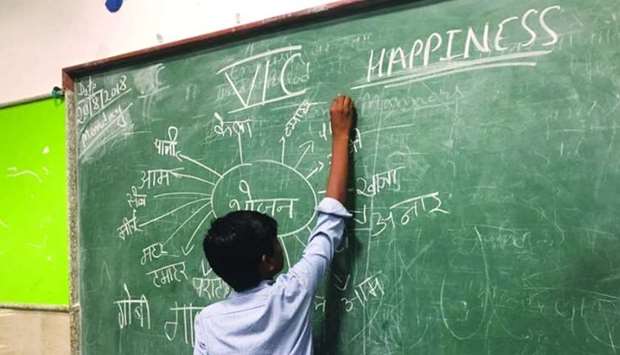
The Delhi government’s Happiness Curriculum (India) partnered with Dream a Dream and other NGOs to create a space in the school curricula dedicated to well-being, happiness, mindfulness, critical thinking, and other important social-emotional skills.
Their groundbreaking work positively-impacted 800,000 students in 1,024 schools, who became more involved and focused in class.
Teachers started prioritising values over academic success, and increased collaboration with their peers.
Onebillion (UK) developed a complete edtech solution – tablet and app – for children to achieve numeracy and literacy skills in their own languages, regardless of the context they live in.
The app provides children with adapted and personalised learning sessions.
A durable solution, the tablet can be solar-charged and is designed to be used in remote and marginalised environments.
Trauma Informed Schools (TIS, Turkey) transforms the classroom into a safe space for children suffering from traumatic experiences.
The intervention applies a multi-pronged approach targeting the children and the entire community surrounding them, through trainings and workshops with educational staff and caregivers.
Between October 2019 and September 2020, TIS directly reached 5,216 children, 406 teachers, and 190 caregivers.
Aprendamos Todos a Leer – Let’s all learn to read (Colombia) developed a comprehensive and innovative model for learning literacy for elementary school students.
It provides teachers with reading materials, training, and a grading system to allow all students – with or without learning difficulties – to reach average reading levels.
So far, the programme has benefited 703,277 children and teachers from public schools in Colombia and Panama, and has been adopted in these countries as a public policy.
Taleemabad (Urdu for “city of education”) by Orenda Project (Pakistan) was selected for infusing Pakistan's classrooms with digital technologies, providing highly-localised and contextualised content aligned with the national curriculum of Pakistan that teaches children English, Urdu, Math, and Science across the K-6 spectrum.
By partnering with low-cost private schools and providing a low-touch model, Taleemabad has not only improved educational outcomes for students, but also sustainability amid increasing school closures during the pandemic.
It has reached an audience of 8.5mn across the country.
The platform is also accessible through the Taleemabad app, which has been downloaded 1.5mn times.
ProFuturo Digital Education Programme (Spain) by Telefónica Foundation and “la Caixa” Foundation, created a digital education programme to be implemented in vulnerable environments, with or without connectivity.
Focusing on teachers training and support, ProFuturo helps strengthen their teaching practice and digital skills so they can offer the best education to their students.
It is present in 40 countries in Latin America, the Caribbean, Africa, and Asia, and has benefited more than 914,000 teachers and 19.7mn children.
The projects will be celebrated during the WISE Global Summit taking place from December 7-9, in Doha.
In addition to publicity and networking opportunities, each project will receive $20,000.
The winners are the Delhi government’s Happiness Curriculum (India), Onebillion (UK), Trauma Informed Schools (Turkey), Aprendamos Todos a Leer – Let’s all learn to read (Colombia), Taleemabad by Orenda Project (Pakistan), and ProFuturo Digital Education Programme (Spain) by Telefónica Foundation and “la Caixa” Foundation.
Stavros N Yiannouka, chief executive of the World Innovation Summit for Education (WISE), an initiative of Qatar Foundation (QF), said: “These projects are tackling pressing education issues that have been exacerbated by the coronavirus (Covid-19) pandemic.”
“While the projects vary in terms of their area of focus, geography, and reach, each and every one of them demonstrates once again how innovative, sustainable, and scalable solutions can help global organisations and governments address pressing education challenges,” he said.
The Delhi government’s Happiness Curriculum (India) partnered with Dream a Dream and other NGOs to create a space in the school curricula dedicated to well-being, happiness, mindfulness, critical thinking, and other important social-emotional skills.
Their groundbreaking work positively-impacted 800,000 students in 1,024 schools, who became more involved and focused in class.
Teachers started prioritising values over academic success, and increased collaboration with their peers.
Onebillion (UK) developed a complete edtech solution – tablet and app – for children to achieve numeracy and literacy skills in their own languages, regardless of the context they live in.
The app provides children with adapted and personalised learning sessions.
A durable solution, the tablet can be solar-charged and is designed to be used in remote and marginalised environments.
Trauma Informed Schools (TIS, Turkey) transforms the classroom into a safe space for children suffering from traumatic experiences.
The intervention applies a multi-pronged approach targeting the children and the entire community surrounding them, through trainings and workshops with educational staff and caregivers.
Between October 2019 and September 2020, TIS directly reached 5,216 children, 406 teachers, and 190 caregivers.
Aprendamos Todos a Leer – Let’s all learn to read (Colombia) developed a comprehensive and innovative model for learning literacy for elementary school students.
It provides teachers with reading materials, training, and a grading system to allow all students – with or without learning difficulties – to reach average reading levels.
So far, the programme has benefited 703,277 children and teachers from public schools in Colombia and Panama, and has been adopted in these countries as a public policy.
Taleemabad (Urdu for “city of education”) by Orenda Project (Pakistan) was selected for infusing Pakistan's classrooms with digital technologies, providing highly-localised and contextualised content aligned with the national curriculum of Pakistan that teaches children English, Urdu, Math, and Science across the K-6 spectrum.
By partnering with low-cost private schools and providing a low-touch model, Taleemabad has not only improved educational outcomes for students, but also sustainability amid increasing school closures during the pandemic.
It has reached an audience of 8.5mn across the country.
The platform is also accessible through the Taleemabad app, which has been downloaded 1.5mn times.
ProFuturo Digital Education Programme (Spain) by Telefónica Foundation and “la Caixa” Foundation, created a digital education programme to be implemented in vulnerable environments, with or without connectivity.
Focusing on teachers training and support, ProFuturo helps strengthen their teaching practice and digital skills so they can offer the best education to their students.
It is present in 40 countries in Latin America, the Caribbean, Africa, and Asia, and has benefited more than 914,000 teachers and 19.7mn children.
The projects will be celebrated during the WISE Global Summit taking place from December 7-9, in Doha.
In addition to publicity and networking opportunities, each project will receive $20,000.