


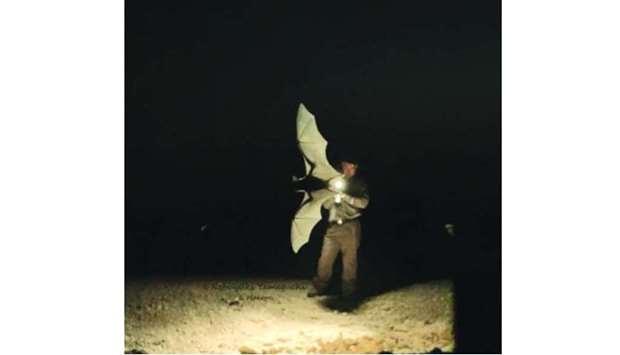
The first nationwide bat survey, conducted by Qatar University's College of Arts and Sciences (QU-CAS), has identified three species based on sonogram analysis, it was announced on Wednesday.
The species are Asellia tridens, Otonycteris hemprichii, and Pipistrellus kuhlii. The most commonly recorded species was Asellia tridens, the only species recorded in the northern half of the country.
The survey was conducted by QU-CAS Department of Biological and Environmental Sciences faculty Nobuyuki Yamaguchi, environmental sciences graduate Maktom Abdulrahman, and University of Western Australia's School of Molecular Sciences faculty Andrew Gardner.
The aim of the survey was to provide information on the bat species and their distribution in the country, together with the potential influences on bat distribution of land use changes.
Bats are considered a keystone species which makes them an essential component of many ecosystems and serve as bio-indicators for many environmental stressors. Therefore, it is vital to study and keep track of them.
The research looked for potential roosting and activity areas such as sinkholes/caves, old water wells, bridges, and farms, with a particular focus on finding the sinkholes/caves. Abdulrahman was able to find six sinkholes and caves. The study also attempted to cover as much of the country as uniformly possible under logistical constraints (56 sites in total).
The bat detector was moved in and around the site by 4x4 vehicle and/or on foot. If it detected any bat call during that period, the bats were classified either “present”, or “absent” at that site. The study classified a site as a roost when: 1) more than two bats were visibly detected emerging from the structure shortly after sunset, and 2) the site had a structure appropriate for bat roosting (e.g. abundant houses, cave, or sinkhole).
A total of 287 acoustic ultrasound recordings were collected across Qatar, of which 169 were bat call sequences. Asellia tridens was the most widely distributed bat species in Qatar with 107 calls recorded.
Due to the geographical proximity, bats may colonise southern Qatar from the main Arabian Peninsula more easily than the north of the country. Alternatively, in the north of Qatar, with a high concentration of irrigated farms, the bat populations may be affected by pesticide use. Bats may be more sensitive to pesticide use compared to other mammals.
Four of the five roost sites appeared to be occupied by a single bat species (either Asellia tridens or Otonycteris hemprichii, based on detection of calls. The single exception was the Mudhlem sinkhole site in the south where two call sequences of Pipistrellus kuhlii were recorded whilst call sequences of Asellia tridens dominated the site. However, it is not certain if the sinkhole is used as a roost site by Pipistrellus kuhlii. This may suggest the possibility of interspecific competition, where the more abundant Asellia tridens limits the range expansion of Otonycteris hemprichii and Pipistrellus kuhlii within Qatar.
The article is available via the following link: https://www.sciencedirect.com/science/article/pii/S0140196320302780