


The value of studying the Medical Humanities and the arts for healthcare professionals was explored in a newly-launched online certificate programme being offered by Weill Cornell Medicine-Qatar (WCM-Q)’s Division of Continuing Professional Development.
The six-week online programme emphasised that exposure to Medical Humanities helps healthcare professionals gain enhanced insight into the patient-clinician relationship and appreciation of the important role that narrative competence plays in the practice of medicine and self-care.
Named the Certificate in Medical Humanities, the programme is believed to be the only one of its kind available in the Gulf region.
It will now be run on an annual basis, taking place each summer.
The new programme is directed and delivered by professor of English Dr Krystyna Golkowska and Dr Aicha Hind Rifai, assistant professor of clinical psychiatry.
The first instalment of the Certificate in Medical Humanities course comprised of four modules: the challenges and opportunities offered by narrative medicine, the therapeutic value of the arts and humanities, the educational goals of the Medical Humanities in terms of the lived experiences of healthcare practitioners, and the role of the arts and humanities in patient-centred models of care.
The programme also discussed the challenges of incorporating the Medical Humanities into medical education and medical practice, and the capacity of the Medical Humanities to improve physicians’ well-being and self-care.
Dr Golkowska, who teaches the first-year writing seminar on the WCM-Q’s pre-medical curriculum, said: “There is a growing appreciation and understanding that exposure to the arts and humanities helps medical professionals to develop empathy, resilience and tolerance of ambiguity, all of which are crucial in their work, particularly in their interactions with patients.”
“This programme provided a strong foundation of knowledge for healthcare professionals to help them understand the value of the humanities and the arts in medical education and clinical practice,” she added.
The programme employs a blended learning model, in which synchronous sessions introduce the topics of the course’s four asynchronous modules that participants then complete via an online platform in their own time.
Dr Thurayya Arayssi, professor of clinical medicine and vice-dean for academic and curricular affairs, said: “Through study and enjoyment of the Medical Humanities and the arts, healthcare professionals develop a body of knowledge and experience that helps them build stronger relationships with patients, which in turn leads to better healthcare outcomes.”
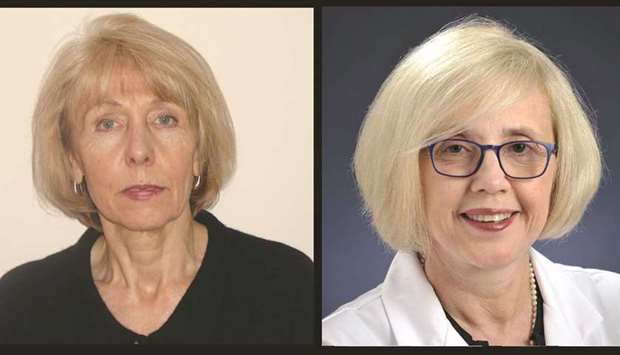
Dr Krystyna Golkowska (left) and Dr Aicha Hind Refai.