


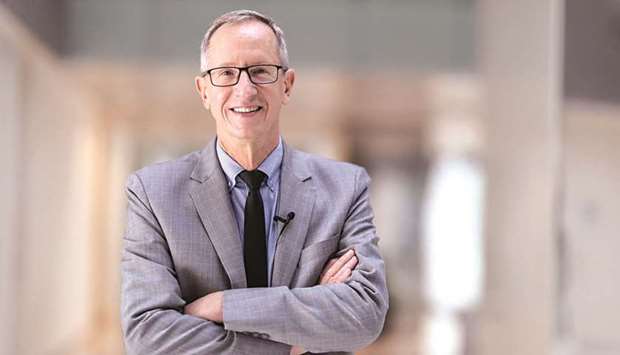
Founding dean of College of Health and Life Sciences (CHLS) at HBKU, Dr Edward Stuenkel highlights that there is great enthusiasm among the faculty and students for a return to face-to-face didactic instruction within the HBKU infrastructure as the university resumes in-person classes with the new academic year.
“Social and in-person interactions that occur in a classroom learning environment often stimulate critical thinking, appreciation of a diversity of perspectives and inspire innovative and collaborative efforts. Education is not only about the information conveyed but also benefits from an interactive and shared learning environment,” he said.
Dr Stunkel recalled that the Covid-19 pandemic experience with virtual online learning has added an appreciation to the spectrum of effective instructional methods. “The college is excited to retain aspects of online education within its learning environment. HBKU was amazing in its ability to transition efficiently and successfully to online instruction during the Covid-19 pandemic,” he continued.
According to him the biggest challenge from Covid-19 that CHLS faced was that research within the biomedical sciences is performed within research laboratories.
“Laboratory research requires a collective of faculty, postdoctoral fellows, and students to be active within that environment. CHLS adapted to this through the help of HBKU’s crisis management team by developing “bubble teams,” adaptive scheduling, phasing on return of personnel, and frequent checks on adherence to Covid-19 and laboratory safety standards. While research activity was reduced, CHLS continued to operate under the principle of delivering research training during the pandemic that was in line with the best practices to sustain the health of the students and faculty,” explained Dr Stunkel.
CHLS offers five degree programmes including an MS and PhD in Biological and Biomedical Sciences, an MS and PhD in Genomics and Precision Medicine (GPM), and an MS in Exercise Science, the latter a joint program with the University of South Carolina, US. CHLS is the only institution in Qatar to offer degree programmes in GPM.
“Healthcare is rapidly advancing toward precision medicine as this approach offers a deeper understanding of pathophysiology and treatment of individual patients. Foundational to achieving precision medicine is the development of a cadre of well-trained research scientists with expertise in precision medicine. CHLS’ advanced joint degree programme is novel to the region and its focus is on studying and developing strategies by which an individual may attain physical fitness to address preventative health,” he noted.
Qatar faces many global health challenges such as diabetes, cancers, and cardiovascular diseases. The best defence against these diseases is developing a good offence, which is defined by developing biomedical research scientists to begin to identify the “omics,” lifestyle and environment that may underlie the onset or progression of these diseases. Research scientists trained in precision medicine are the leaders in the fight against current and future health pandemics and CHLS, through its graduate-level academic programmes, is a regional leader in the training of these research scientists,” he added.
Dr Stunkel recalled that the Covid-19 pandemic experience with virtual online learning has added an appreciation to the spectrum of effective instructional methods. “The college is excited to retain aspects of online education within its learning environment. HBKU was amazing in its ability to transition efficiently and successfully to online instruction during the Covid-19 pandemic,” he continued.
According to him the biggest challenge from Covid-19 that CHLS faced was that research within the biomedical sciences is performed within research laboratories.
“Laboratory research requires a collective of faculty, postdoctoral fellows, and students to be active within that environment. CHLS adapted to this through the help of HBKU’s crisis management team by developing “bubble teams,” adaptive scheduling, phasing on return of personnel, and frequent checks on adherence to Covid-19 and laboratory safety standards. While research activity was reduced, CHLS continued to operate under the principle of delivering research training during the pandemic that was in line with the best practices to sustain the health of the students and faculty,” explained Dr Stunkel.
CHLS offers five degree programmes including an MS and PhD in Biological and Biomedical Sciences, an MS and PhD in Genomics and Precision Medicine (GPM), and an MS in Exercise Science, the latter a joint program with the University of South Carolina, US. CHLS is the only institution in Qatar to offer degree programmes in GPM.
“Healthcare is rapidly advancing toward precision medicine as this approach offers a deeper understanding of pathophysiology and treatment of individual patients. Foundational to achieving precision medicine is the development of a cadre of well-trained research scientists with expertise in precision medicine. CHLS’ advanced joint degree programme is novel to the region and its focus is on studying and developing strategies by which an individual may attain physical fitness to address preventative health,” he noted.
Qatar faces many global health challenges such as diabetes, cancers, and cardiovascular diseases. The best defence against these diseases is developing a good offence, which is defined by developing biomedical research scientists to begin to identify the “omics,” lifestyle and environment that may underlie the onset or progression of these diseases. Research scientists trained in precision medicine are the leaders in the fight against current and future health pandemics and CHLS, through its graduate-level academic programmes, is a regional leader in the training of these research scientists,” he added.