


US consumer prices increased by the most in 13 years in June amid supply constraints and a continued rebound in the costs of travel-related services from pandemic-depressed levels as the economic recovery gathered momentum.
With used cars and trucks accounting for more than one-third of the surge in prices reported by the Labor Department on Tuesday, economists continued to believe that higher inflation was transitory.
Federal Reserve Chair Jerome Powell has repeatedly stated similar views, noting that he expected supply chains to normalise and adapt.
“June’s CPI numbers looked scary, but once again, we see that it was mainly temporary price increases that pumped up the figures,” said Robert Frick, corporate economist with Navy Federal Credit Union in Vienna, Virginia. “Overall, this report is consistent with inflation cooling off later this year.”
The consumer price index increased 0.9% last month, the largest gain since June 2008, after advancing 0.6% in May.
Used cars and trucks prices accelerated 10.5%. That was the biggest increase since January 1953 when the government started tracking the series. A global semiconductor shortage has undercut motor vehicle production. Used cars and trucks have been the major driver of inflation in recent months.
But prices are rising across the economy.
Covid-19 vaccinations, low interest rates and nearly $6tn in government relief since the pandemic started in the United States in March 2020 are fuelling demand, straining the supply chain and raising prices across the economy.
Consumers also paid more for food, gasoline, rents and apparel last month. In the 12 months through June, the CPI jumped 5.4%. That was the largest gain since August 2008 and followed a 5.0% increase in May.
Excluding the volatile food and energy components, the CPI accelerated 0.9% after increasing 0.7% in May.
The so-called core CPI surged 4.5% on a year-on-year basis, the largest increase since November 1991, after rising 3.8% in May.
Economists polled by Reuters had forecast the overall CPI would climb 0.5% and the core CPI would rise 0.4%. US stocks opened lower. The dollar rose against a basket of currencies. US Treasury prices fell.
“Inflation is rising, but things are well behaved and have not changed materially,” said Jamie Cox, managing partner at Harris Financial Group in Richmond, Virginia.
Annual inflation rates have been boosted by the dropping of last spring’s weak readings from the CPI calculation.
June was likely the peak in these so-called base effects. With nearly 160mn Americans immunised, demand for airline travel and hotel and motel accommodation is picking up, also fanning price pressures.
Prices for travel-related services rose solidly last month.
Some parts of the United States with low vaccination rates are, however, experiencing a surge in infections from the Delta coronavirus variant, which could slow economic activity.
Those fears pushed down US Treasury yields last week.
Though inflation has likely peaked, it is expected to remain elevated through part of 2022, as prices for many travel-related services are still below pre-pandemic levels.
“The pace of economic recovery may slow a little in the months ahead and inflation may ease from recently very elevated levels,” said David Kelly, chief global strategist at JPMorgan Funds in New York.
“However, the economy still looks set to achieve very complete recovery in the months ahead, with plenty of excess demand to sustain stronger inflation.”
Minutes of the US central bank’s June 15-16 policy meeting published last week showed “a substantial majority” of officials saw inflation risks “tilted to the upside,” and the Fed as a whole felt it needed to be prepared to act if those risks materialised.
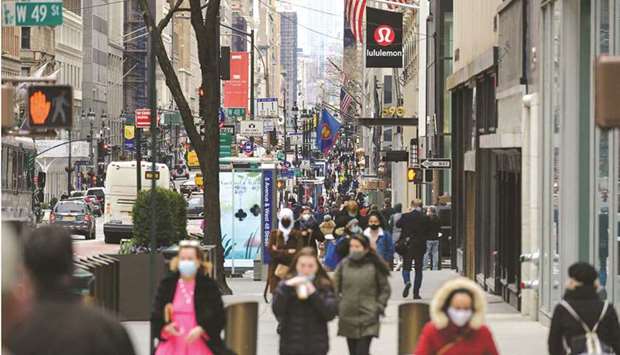
People walk on a busy 5th Avenue in New York City. US consumer prices increased by the most in 13 years in June amid supply constraints and a continued rebound in the costs of travel-related services from pandemic-depressed levels as the economic recovery gathered momentum.