


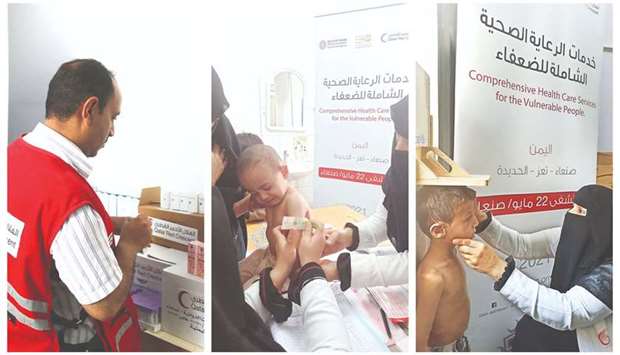
The Qatar Red Crescent Society (QRCS), in partnership with the Qatar Fund for Development (QFFD) and the United Nations Population Fund (UNFPA), has launched a project to provide comprehensive healthcare services for the vulnerable in Yemen.
The project involves supporting 10 health facilities in the governorates of Sanaa, Taiz, and Al-Hudaydah, as well as Khalifa Hospital in Al-Turbah, a town of Taiz.
For years now, the people of Yemen have been living in difficult conditions due to the war and blockade, which has rendered most of the health facilities out of order.
As planned, the new project will cover a total of 561,600 medical consultations for Yemenis over 30 months.
The QRCS is working on Phase 1 of the project through a set of mechanisms that include providing staff remunerations and securing operational supplies.
The needed medical equipment, furnishing, medications and lab solutions have already been procured, which has helped achieve a remarkable development in the public health system, the QRCS has said in a statement.
Records of the targeted health facilities show an increase in the number of visitors who have benefited from medical consultations, hitting 26,838 since the launch of the project in December 2020.
In a statement, QFFD deputy general manager for projects Misfer Hamad al-Shahwani said: “As a result of the successive conflicts and widespread epidemics, Yemen is in dire need of a rescue plan for the health systems.”
“Pursuant to the QFFD’s priorities and the UN Sustainable Development Goals (SDGs) to ensure safe access to health services, the QFFD and its strategic partners, the QRCS and the UNFPA, back the health sector of Yemen by providing services at 11 health facilities in Sanaa, Taiz, and Al-Hudaydah."
Dr Nasser Mabkhot, manager of the 22 May Hospital in Amant Al-Asimah, said: “Prior to the intervention, the hospital was in a very bad situation.”
“The services offered to visitors were of too low quality, compared even to a health centre,” he said. “Since the beginning of March 2021, the QRCS started to cover the payroll.”
“This translated into a better workflow and quality of service,” Dr Mabkhot continued. “The pharmacy was supplied with a good collection of drug classes, which helped attract noticeably more visitors.”
“Thanks to QRCS’s support for the laboratory department, we are able to conduct more lab tests,” he added. “Now, it can be called a hospital."
“We look forward to more support in terms of obstetric emergencies, such as neonatal incubators and intensive care furnishing,” Dr Mabkhot said. “We have the rooms to install all medical equipment and perform C-section procedures. This way, all the medical, treatment and surgical services will be readily available.”
He thanked the QFFD, the QRCS, and the UNFPA for their assistance to boost the quality of medical services for all patients who visit the hospital from different areas, particularly the poor and vulnerable communities.
Dr Abdul-Rahman Ahmed Saleh, general manager of Khalifa Hospital in Al-Turbah, said: “Since its establishment in 1989, the hospital has been facing considerable challenges.”
“It was originally designed to serve a population of 243,000,” he said. “Today, it has to serve some 1.2mn people, due to the overpopulation and mass displacement.”
“There are hard-to-meet gaps, including understaffing and lack of renovations due to the war since 2011,” Dr Ahmed Saleh said. “The hospital suffered a lot, both financially and operationally, (including having) obsolete medical equipment and furniture.”
“I hope that our brothers who are here for us will give more support for the health system, in order to meet the expectations of patients and upgrade diagnostic and therapeutic activities,” he added.
Through this project, the QFFD, the QRCS, and the UNFPA are working together to improve the health services at 11 health facilities in Sanaa, Taiz, and Al-Hudaydah.
It is divided into four phases, the first of which had a cost of $1.7mn.
In December, the project’s agreement was signed by the three parties, for the benefit of the most affected groups in Yemen.
For years now, the people of Yemen have been living in difficult conditions due to the war and blockade, which has rendered most of the health facilities out of order.
As planned, the new project will cover a total of 561,600 medical consultations for Yemenis over 30 months.
The QRCS is working on Phase 1 of the project through a set of mechanisms that include providing staff remunerations and securing operational supplies.
The needed medical equipment, furnishing, medications and lab solutions have already been procured, which has helped achieve a remarkable development in the public health system, the QRCS has said in a statement.
Records of the targeted health facilities show an increase in the number of visitors who have benefited from medical consultations, hitting 26,838 since the launch of the project in December 2020.
In a statement, QFFD deputy general manager for projects Misfer Hamad al-Shahwani said: “As a result of the successive conflicts and widespread epidemics, Yemen is in dire need of a rescue plan for the health systems.”
“Pursuant to the QFFD’s priorities and the UN Sustainable Development Goals (SDGs) to ensure safe access to health services, the QFFD and its strategic partners, the QRCS and the UNFPA, back the health sector of Yemen by providing services at 11 health facilities in Sanaa, Taiz, and Al-Hudaydah."
Dr Nasser Mabkhot, manager of the 22 May Hospital in Amant Al-Asimah, said: “Prior to the intervention, the hospital was in a very bad situation.”
“The services offered to visitors were of too low quality, compared even to a health centre,” he said. “Since the beginning of March 2021, the QRCS started to cover the payroll.”
“This translated into a better workflow and quality of service,” Dr Mabkhot continued. “The pharmacy was supplied with a good collection of drug classes, which helped attract noticeably more visitors.”
“Thanks to QRCS’s support for the laboratory department, we are able to conduct more lab tests,” he added. “Now, it can be called a hospital."
“We look forward to more support in terms of obstetric emergencies, such as neonatal incubators and intensive care furnishing,” Dr Mabkhot said. “We have the rooms to install all medical equipment and perform C-section procedures. This way, all the medical, treatment and surgical services will be readily available.”
He thanked the QFFD, the QRCS, and the UNFPA for their assistance to boost the quality of medical services for all patients who visit the hospital from different areas, particularly the poor and vulnerable communities.
Dr Abdul-Rahman Ahmed Saleh, general manager of Khalifa Hospital in Al-Turbah, said: “Since its establishment in 1989, the hospital has been facing considerable challenges.”
“It was originally designed to serve a population of 243,000,” he said. “Today, it has to serve some 1.2mn people, due to the overpopulation and mass displacement.”
“There are hard-to-meet gaps, including understaffing and lack of renovations due to the war since 2011,” Dr Ahmed Saleh said. “The hospital suffered a lot, both financially and operationally, (including having) obsolete medical equipment and furniture.”
“I hope that our brothers who are here for us will give more support for the health system, in order to meet the expectations of patients and upgrade diagnostic and therapeutic activities,” he added.
Through this project, the QFFD, the QRCS, and the UNFPA are working together to improve the health services at 11 health facilities in Sanaa, Taiz, and Al-Hudaydah.
It is divided into four phases, the first of which had a cost of $1.7mn.
In December, the project’s agreement was signed by the three parties, for the benefit of the most affected groups in Yemen.