


Australia’s central bank took the first steps towards dialling back its emergency stimulus for an economy that’s exceeded expectations, even as Governor Philip Lowe warned persistently weak inflation would likely see him trail international counterparts in raising interest rates.
The Reserve Bank opted against extending its yield-target horizon beyond April 2024 and scaled back purchases of longer-dated bonds at yesterday’s meeting, when it kept borrowing costs unchanged at 0.1%.
The RBA said once the current A$5bn ($3.8bn) a week quantitative easing programme ended in September, it would shift to A$4bn a week with a review in mid-November.
“This is a more hawkish statement than we had expected,” said Bill Evans, chief economist at Westpac Banking Corp.
The Australian dollar extended its intraday gain, rising to 75.84 US cents in response to the statement and subsequent comments from Lowe. The April 2024 bond yield crept slightly above the RBA’s target, to 0.13%, while the yield on the November 2024 note surged 8 basis points to 0.45%. Ten-year yields rose 4 basis points to 1.47%.
Lowe is determined to stay near the tail of global peers unwinding stimulus – particularly the Federal Reserve – even as Australia has recovered earlier and faster than many economies. That stance is likely aimed at avoiding the currency damage of previous early exits while also reflecting Australia’s vulnerability to further virus outbreaks due to a low vaccination rate.
The governor, in a post-meeting press conference, said that while Australia’s economy had surprised on the upside, this hadn’t passed through to wages and inflation. He said this explained why the RBA wasn’t laying the ground for rate increases like Canada.
“In Canada, the underlying inflation rate is quite close to the Bank of Canada’s target,” Lowe said. “Here in Australia, we’ve been below the target for too many years, and the prospect of reaching the target in the short-term is not particularly high.”
“The RBA’s conditions for rate hikes – sustainable inflation within the target band – are unlikely to be met until late 2024. We expect its QE programme to be extended again in November, with a further reduction in the pace of purchases likely,” says James McIntyre, economist at Bloomberg. Lowe said during his press conference that the central bank’s review of the bond programme in mid-November was based on two considerations:
The benefit of “being able to respond in a timely way to the flow of economic news in a world characterised by a high degree of uncertainty”; and that the RBA’s guidance about future bond purchases “helps with market pricing”. The RBA will keep buying bonds until “there is further material progress” toward its goals for full employment and inflation, he said.
Lowe added that the bank’s decision not to roll over the three-year yield target bond to November 2024 reflected a wider range of cash rate scenarios because of the economy’s improvement.
The governor, in response to a question from an economist at the press conference, denied that the central bank was hinting at a 2023 rate increase.
He spoke as Sydney continued to struggle with a coronavirus outbreak, which leaked to other states and at one point forced the lockdown of almost half the country. While that adds a layer of uncertainty to the near-term outlook, the RBA sees limited long-term impact.
“The experience to date has been that once outbreaks are contained and restrictions are eased, the economy bounces back quickly,” Lowe said in his rate decision statement.
The central bank’s drive to revive inflation is being aided by the government, providing a monetary-fiscal injection that’s helping his cause of pushing the economy toward maximum employment.
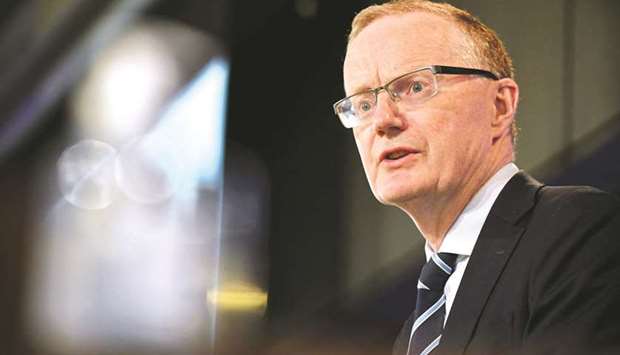
Lowe: Economy is recovering faster than many other countries.