


Didi Global Inc plunged on Tuesday after regulators in China ordered the removal of the company’s platform from app stores, days after it raised $4.4bn in the second-largest US initial public offering for a Chinese firm.
American depositary shares of the Beijing-based ride-hailing giant fell as much as 25% to $11.58, wiping out about $22bn of market value and taking the stock below its $14 IPO price. They traded at $11.99 in New York.
The Cyberspace Administration of China barred new users from Didi’s app, citing security risks and tightening its grip on sensitive online data. Didi, whose American Depository Receipts began trading in New York on June 30, said the move may have an “adverse impact” on its revenue in China.
In a statement, China’s State Council said it will improve regulations and laws regarding data security, cross-border data flow and management of confidential information. In addition, the council said it is increasing supervision and revising rules for overseas listings of Chinese companies.
“This is consistent with China’s broad strategy to encourage Chinese companies to list domestically on Hong Kong, Shanghai and Shenzhen exchanges,” said Benjamin Zhan, Vice President and Portfolio Manager at Dynamic Funds. A crackdown on the nation’s big tech names has knocked about $42bn off the market value of firms listed on the Nasdaq’s Golden Dragon China Index, which tracks Chinese ADRs, since the government derailed the planned IPO of giant Ant Group Co in November. Further moves included a record $2.8bn fine on Alibaba Group Holding Ltd after an antitrust probe found it had abused its market dominance, sparking concern about the future of the sector.
“The Chinese government’s tactics appear to have the twin purposes of keeping its corporate leaders in check while also making sure the investor pain lands primarily in the US more so than China,” said Michael O’Rourke, chief market strategist at JonesTrading.
While Didi’s half-billion existing users will still be able to order rides for now, China’s cybersecurity crackdown adds to the uncertainty surrounding all the nation’s Internet companies. Tencent Holdings Ltd, which has a stake in Didi, is down 2.7% so far this week, after sliding 3.6% on Monday and partially trimming losses on Tuesday in Hong Kong. The onslaught of government announcements began on Friday after markets in Asia had closed.
Chinese regulators asked Didi as early as three months ago to delay its landmark US IPO because of national security concerns involving its huge trove of data, according to people familiar with the matter. Prior to that, China’s antitrust watchdog ordered Didi to halt practices including arbitrary price hikes and unfair treatment of drivers. It was also among 34 Internet giants ordered by regulators in April to correct excesses.
Full Truck Alliance Co and Kanzhun, both of which recently went public in the US, plummeted 19% and 8.5%, respectively, after China expanded its probe on the technology industry to include the firms. Beijing ordered both to halt new user registrations, in addition to Didi. Meanwhile, Uber Technologies, the second-biggest Didi holder, fell 1.7%.
The number of companies based in China filing for New York IPOs has climbed for a third straight quarter despite weakness in other US-listed stocks that conduct most of their business in China and amid the broad antitrust probe into the nation’s Internet firms. The Golden Dragon China Index is down about 8% for the year, lagging behind the 14% gain in the Nasdaq Composite Index.
“With Beijing now clearly seeking to make a political statement in the capital markets, it is unclear who, if anyone, will be there to invest in China’s next mega public offering in the US,” said Charles-Henry Monchau, the chief financial and chief investment officer at FlowBank SA in Geneva.
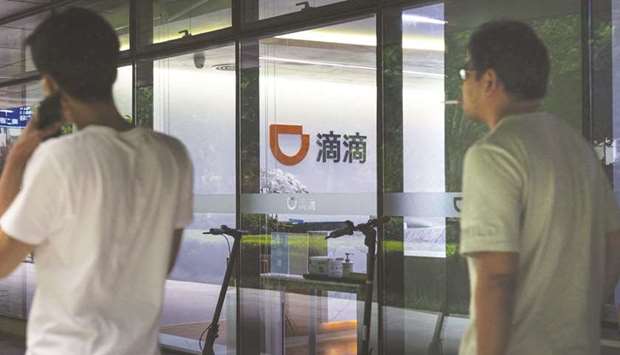
A logo is seen inside the Didi Global headquarters in Beijing. American depositary shares of the ride-hailing giant fell as much as 25% to $11.58 yesterday, wiping out about $22bn of market value and taking the stock below its $14 IPO price.