


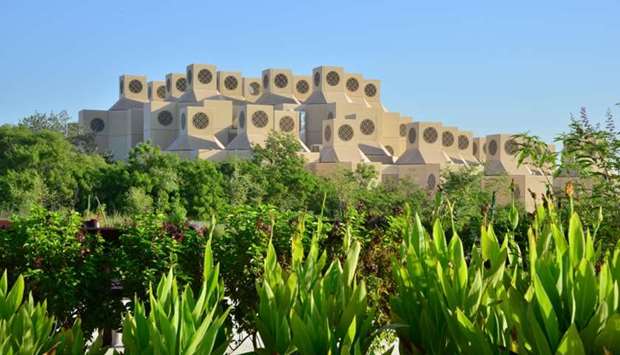
Qatar University’s Young Scientists Centre (QU-YSC) organised activities and workshops as part of the Summer Training Programme 2021 for Qatari students from QU.
The Summer Internship Programme 2021 is "one of its kind as a virtual exchange programme" and held in view of the difficulty faced by university students participating in international training programmes during the summer period due to travel restrictions imposed due to the Covid-19 pandemic, QU has said in a statement.
"These unprecedented conditions have prevented university students from engaging in a shared learning experience that brings together students from multiple cultures," the statement noted. "Thus, QU-YSC designed the reciprocal virtual summer training programme, which included
undergraduate students and mentors from different universities in a three-week-long training session."
The programme provided a range of opportunities for undergraduate students and mentors to experience innovative learning, exchange knowledge, refine research competencies and career readiness skills, and promote knowledge exchange and strengthen co-operation between the participating international universities.
The summer programme, held from June 6-24, provided a "unique learning experience, flexible and interactive, using virtual platforms, thus training participants in flexibility and the ability to adapt to new learning conditions".
During the programme, the students were involved in structured sessions of activities to improve their knowledge and techniques. The activities developed their key research competencies such as formulation of a research problem statement, research methodology design, data analysis, inference abilities, presentation and writing skills.
The internship also provided opportunities for undergraduate students to participate in the scientific research review process. Two topics were presented during the training period: 2D nanomaterials fabrication/production strategies, and the development of highly efficient perovskite/silicon tandem solar cells.
In a statement, Dr Noura Jaber al-Thani, director of QU-YSC, said: “Young people are the most dynamic and creative group, and providing such programmes to them enhances their research skills and qualifies them to become influential leaders in various scientific fields, to promote outputs that will contribute to achieving Qatar National Vision 2030.
"In addition, these programmes enhance the position of Qatar University among international universities.”
Dr Noura expressed happiness at the launch of the virtual exchange summer programme, which was fully developed by QU-YSC and presented to students in an innovative and unique way. Finally, she thanked the sponsors - Unesco Doha Office and Qatar National Committee for Education, Culture and Science - for their efforts.
"These unprecedented conditions have prevented university students from engaging in a shared learning experience that brings together students from multiple cultures," the statement noted. "Thus, QU-YSC designed the reciprocal virtual summer training programme, which included
undergraduate students and mentors from different universities in a three-week-long training session."
The programme provided a range of opportunities for undergraduate students and mentors to experience innovative learning, exchange knowledge, refine research competencies and career readiness skills, and promote knowledge exchange and strengthen co-operation between the participating international universities.
The summer programme, held from June 6-24, provided a "unique learning experience, flexible and interactive, using virtual platforms, thus training participants in flexibility and the ability to adapt to new learning conditions".
During the programme, the students were involved in structured sessions of activities to improve their knowledge and techniques. The activities developed their key research competencies such as formulation of a research problem statement, research methodology design, data analysis, inference abilities, presentation and writing skills.
The internship also provided opportunities for undergraduate students to participate in the scientific research review process. Two topics were presented during the training period: 2D nanomaterials fabrication/production strategies, and the development of highly efficient perovskite/silicon tandem solar cells.
In a statement, Dr Noura Jaber al-Thani, director of QU-YSC, said: “Young people are the most dynamic and creative group, and providing such programmes to them enhances their research skills and qualifies them to become influential leaders in various scientific fields, to promote outputs that will contribute to achieving Qatar National Vision 2030.
"In addition, these programmes enhance the position of Qatar University among international universities.”
Dr Noura expressed happiness at the launch of the virtual exchange summer programme, which was fully developed by QU-YSC and presented to students in an innovative and unique way. Finally, she thanked the sponsors - Unesco Doha Office and Qatar National Committee for Education, Culture and Science - for their efforts.